Oscar Trial – Day 30, May 13 VORSTER

OP crying

Dr. Merryll Vorster is back on the stand and Nel is still conducting cross-examination. The application that was mentioned yesterday has not been brought forth yet. They are discussing the diagnosis of generalized anxiety disorder (GAD).

Vorster explains that the word disorder implies impairment, which then means that Oscar suffered from some level of social and occupational impairment throughout his life.

Vorster says in general, anxiety is very common amongst people. People can have anxiety with or without the disorder.

Nel wants to know what differentiates every day anxiety from a diagnosed disorder. Vorster says in order to diagnosis somebody with a disorder, that person needs to have the anxiety more often than not for an extended period of time. The issues of what the person is anxious about are out of proportion with reality. The reaction to the anxiety is associated with various symptoms such as sleep disorder, appetite disorder, vomiting, nausea, sweating, diarrhea, irritability, inability to concentrate and distractibility. People with this disorder are not able to set their worries aside. They think about them constantly.

Vorster then talks about the fact that all disorders can either be mild or severe. A severe disorder would greatly affect your ability to have a normal life. She states that there is no evidence to suggest that Oscar had a severe form of the disorder. He was able to function at a high level as an athlete and he still socialized. He had distress because of anxiety, but could carry on with normal life.

Nel reminds her that yesterday she stated that Oscar’s GAD may have been relevant (on his version) to his actions on the night of the incident. Vorster says, that is correct and it would be for the court to decide if it’s relevant.

Nel says that there was evidence given from friends and a former girlfriend in this case and none of those individuals stated that he had any type of anxiety issue. Vorster says people can control and conceal their anxiety. Vorster points out that Oscar said that his family was not even aware of his anxiety issues. Again, Oscar can say whatever he wants to the doctor. It’s all his own word which has been proven in court to not be of much value.

Nel says, but it hasn’t been mentioned by anybody that they observed Oscar being anxious. Vorster says that it did come up in the collateral information that she obtained (from Oscar’s family, coach and manager).
Pistorius fam1

OP family

Nel brings up the three statements from Vorster’s report that she mentioned were included yesterday – affidavits from Justin Devaris, Samantha Greyvenstein, and Graham Binge. Nel asks her if she received them from the Defense team. She says, yes. He also asks her if these are the only statements that she had the opportunity to peruse. She says yes.

We’ve all seen this in court before, the Defense only gives their expert the information that is of benefit to their side rather than all of the relevant materials in the case. These three individuals testified in favor of Oscar at his bail hearing back in Feburary, 2013. Since that time, it has been reported that Justin and Samantha no longer have a friendship with Oscar (although, I cannot substantiate that). The Defense made a decisive move not to call Justin Devaris to the stand. You can read between the lines.

Nel asks Vorster if she took in to account that Oscar was severely anxious about crime in SA when diagnosing him. She answers, yes. Oscar told her that he took excessive security measures. He moved to a housing estate (Silverwoods) where he would be more secure because of the guards at the perimeters. After he found out that there had been some burglaries there too, he became more concerned that he still wasn’t sufficiently secure. He then added dogs, beams around his house, an alarm inside the house and he locked himself in his bedroom at night. He informed Vorster that he intended to move from that estate because he no longer felt safe. He was in the process of moving to Johannesburg. Vorster felt that the measures he took were more than the average South African would take.

Nel asks her why she considers his measures to be more than average. She says it’s her own perception. Nel asks her if she agrees that most people have burglar alarms, often with beams. She says, yes. Also, don’t most people have dogs? She agrees with this too. Nel doesn’t understand then why she thinks his measures are excessive. She says that most people don’t lock themselves in their rooms at night. Nel says, that’s interesting considering evidence was given in court from neighbors who did the same thing. Nel suggests to her that she is showing some level of impartiality to the accused because in Nel’s view, the security measures mentioned are quite common in South Africa. She disagrees that it shows bias towards Oscar. She was trying to evaluate if he was paranoid, which she found he was not. She states she is not a security expert, and these are just her opinions from being a South African herself.

I’d like to point out a few other things that jumped out at me:

First, the Defense specifically brought forth evidence that Oscar’s dogs were not guard dogs. Mr. Stander testified about how friendly and docile they were. There weren’t even reports of them barking during the incident. They were also playful with the police when they were there to investigate. You cannot all of a sudden say that they were guard dogs for his safety. If Oscar really intended to have dogs as guard dogs, he would have made sure to secure the appropriate dogs for that purpose. He did not.

OP with dogs

Second, evidence was presented by the Defense that Oscar was moving to Johannesburg to be closer to Reeva, so they could live together. The Defense has been bending over backwards to prove this supposed intense love that Oscar felt for Reeva… now he tells his psychiatrist (in the last few weeks) that he was moving to a new house in Johannesburg because of safety concerns? Just one more inconsistent story.

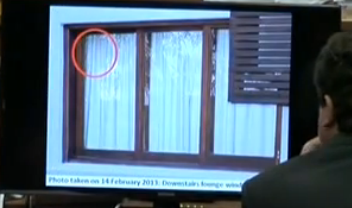
Nel says that if a person has GAD, wouldn’t you expect that the person would have taken even more measures to security the rest of his house (not just lock himself in his bedroom). She says yes, she would expect that. Nel tells her that there was a broken window downstairs on a window with no burglar proofing/bars (which he acknowledges they are not allowed to do at their estate) and Oscar wasn’t overly anxious to have it fixed. It was broken for days. She doesn’t think this is weird; he may have been reliant on his sensors and beams. Nel says, that would be the perspective of a normal person but we are dealing with somebody who has GAD. She agrees that one would not likely leave a broken window for an extended period of time.
74

73

Also, let’s not forget Oscar’s dodgy testimony about the painting of his house and the possibility that the sensors were not put back on properly. Oscar went to great pains to make it seem like his alarm system may not have been 100% reliable and he admitted that he did not have it tested after the last house painting to make sure. He also admitted to not checking to see if the ladders were outside. It was proven in court that he was not meticulous about his security measures. His testimony does not match what Vorster is now trying to say. I don’t necessarily blame her, because she’s just relaying what Oscar told her but there are very clear disparities.

Roux objects and says that it’s not accurate that Oscar wasn’t concerned about whether or not his security alarm worked. It was only one sensor outside, not the whole alarm system inside. Nel says the record will show that the evidence ended with the beams, but it started earlier with the alarm system inside. The Judge agrees with Nel but asks him to be more specific with his question to avoid any confusion.

So Nel asks Vorster, a person with GAD would insure that their alarm system is functioning properly? She says, yes.

Next, Nel wants to know if the doctor agrees that for a person with GAD who is concerned about crime, they would not be able to sleep with their balcony door open and not secured/locked. Vorster says she can’t directly answer yes because it depends on who the person is living with. If they live alone, it would be up to the person to ensure that the house is locked and secured. But if they were living with another person than they may need to consider that other person’s needs and comforts as well. So she will give him a conditional, yes. Nel says, but then wouldn’t it be an issue for that person to sleep. Even though their partner may be comfortable, the person with GAD would likely be laying there anxious about the door being open. Vorster concedes that it could be an issue.

Nel asks Vorster if she is aware of the incident with the police while Oscar was returning from the Vaal River. She says she would need specific questions to be able to answer. Nel tells her about the incident. He relays that Oscar’s friend had some type of disagreement with a police officer. Nel wants to know if for a person with GAD, wouldn’t they be anxious about this situation. She says, yes, the person would likely be afraid that they’d get in to trouble. But they don’t really get in to what he would or wouldn’t do, just that he would be more anxious than the average person in that situation. But to Nel’s point, Oscar hopped out of that car and had no qualms about arguing with police, especially when they unloaded his gun. To me, those do not sound like the actions of an anxious person. It sounds more like something a hot head would do.

She again points out how common it is for people to have GAD. It’s like the Defense is walking a tightrope of trying to say that Oscar didn’t act normally that night because of his anxiety, but they don’t want to fully commit to him being a disordered person. Nel is calling their bluff with this application. Either his disorder is severe enough to cause him to act differently, which then requires by law that he be referred (examined) under Section 78… or it’s not severe enough, in which case it has no relevance whatsoever in the case and Vorster’s evidence should not be given any weight.

Nel asks her if Oscar coped with his life growing up, and she says yes, he did cope well.

Nel establishes with Vorster that she stated yesterday that her report could either be used for the merits of the case or for sentencing. It would be up to the court to decide how to use it. Nel says, as far as it potentially being used for sentencing, is that why you included his depression and remorsefulness in the report? She says, no. The depression after the incident is simply as part of his current mental state. She doesn’t know if this would be a factor if he were to be sentenced or not. Nel asks, so then what portions of your report would be relevant to the sentencing process? Would it be the remorse and the guilt? She says no, it would be the GAD diagnosis and the vulnerability. Nel points out that these points could go to merits as well, and she agrees.

Nel has reviewed the portion of her report from Dr. Richard Holmes and comments that he is registered as an educational and industrial psychologist, not a clinical psychologist. Nel wants to know what the purpose of his report was. She doesn’t know. Nel asks, how did it assist you? She says it contained history and he also had a clinical psychologist who did testing on Oscar. The history and the test results matched her own impressions of Oscar after she met with him.

Nel wants to know if this clinical psychologist’s findings played a role in her own findings, and she says, no. It was just another source of information. Nel asks if Dr. Holmes’ report was for forensic or therapeutic purposes. She thinks it was forensic.

Nel says that in her report, she based her conclusions on Oscar’s version of events. She agrees. She did not take in to account the State’s version. She also states that she did not have it. No surprise. Nel asks if she thinks that is impartial. She answers, no. She stated in her report that it is based on what the accused told her and it’s up to the court to decide whether his version is a reasonably possible version. Her asking for Oscar’s version was not to come to the truth of the matter but rather to look at his mental state at the time of the offense.

Nel asks, if this is the purpose of your report, to determine his mental state at the time of the event, wouldn’t it have been better to have all versions available to you? She says it would have been an advantage to have them but at the same time, she wouldn’t have been to determine which version the court would accept. Nel asks, but shouldn’t an expert want to have all of the information before making a finding? She says she would be happy to look at alternative versions and comment on them to the court today, but all she had available to her at the time was Oscar’s version. She then says that she was given a transcript of Oscar’s evidence in court, but she didn’t go through it because it’s not necessarily the version that the court will accept.

Oscar wonders if different versions would have affected her opinion that GAD played a role. She says, no. The diagnosis stays constant, it played a role at the time of the offense, and that would be regardless of which version the court accepts. She says it’s up to the courts to decide what the accepted version is and how this diagnosis may factor in.

Nel asks, if the court finds that Oscar knew that Reeva was in the toilet room and he fired to kill her, would GAD still play a role? She says, yes. Nel asks, how does it play a role? Vorster answers because a person with GAD would be anxious about losing a relationship. Nel asks Vorster, so then you presuppose that there would have been an argument about the relationship? She answers, if there had been an argument about the relationship, a person with GAD would have had increased levels of anxiety. It could play a role in the build up (prior to the shots) but does NOT play a role during the shots.

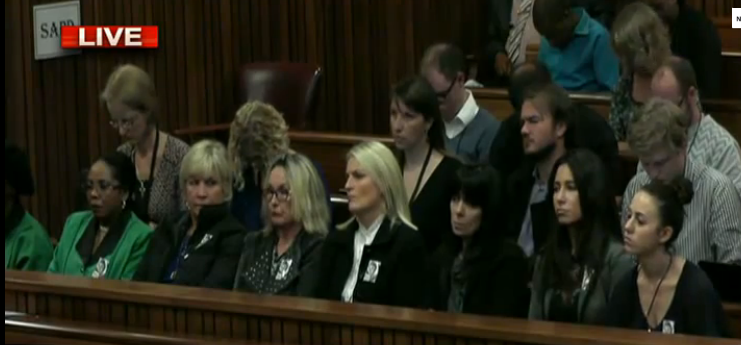
Everyone was listening very intently during this exchange.

court listens intently

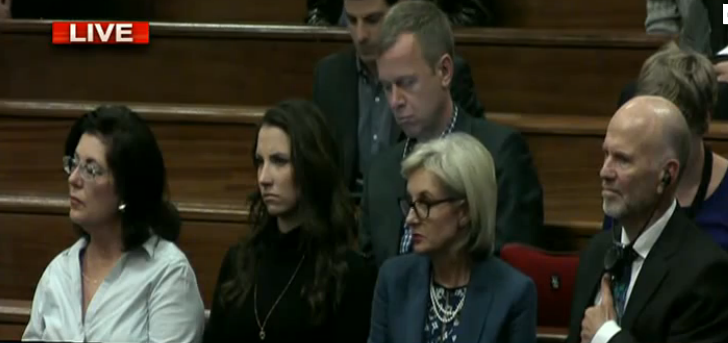
Steenkamp family and friends

Nel says, but all people get anxious during arguments. She agrees, all people get anxious and upset during arguments. That is the nature of an argument, it’s an emotional event.

Nel wants to know why the fact that a person with GAD who shot and killed a person and was considered a danger with a gun was not included in her report. She says, people suffering with GAD are not dangerous as such. “People with GAD probably shouldn’t have firearms.” That is the element of the dangerousness. The person alone is not to be considered violent, but if you add in a firearm, then you add in risk that they may be involved in violent activities.

Nel asks Vorster if she is aware that Oscar purchased more guns in 2012, and she states that she is aware. She comments that he is a gun enthusiast. Nel asks, so it wasn’t just for his own safety? She says, no, it wasn’t.

Nel asks her if she ever consulted the father. She says, no. Nel asks, wouldn’t it have been valuable, considering he is the only remaining parent, to get information from him. She agrees, it would have been advantageous to see the father. Sounds like the Defense and the Pistorius clan kept Henke out of this whole process. It seems those pesky .38 Specials in the safe continue to be a problem. Daddy needs to stay hidden.

Nel points out to her that she diagnosed Oscar with having GAD from the age of 11 months old, and also reported that he suppressed it as a child. But by all accounts, Oscar was a well-adjusted child at 17 months who was thriving. Nel says, a child that young does not have the ability to suppress anxiety. His family would have picked up on it. Vorster answers that these are the factors that contributed to his GAD developing. I guess she is now saying then that he didn’t fully have GAD then, it was just the beginning stages of it developing. Nel wants to know then, how did she know it was developing if he’s coping just fine? She says that all children who have amputations at that age have difficulty adjusting. So essentially, she is making a general assumption and not basing it on any real fact that Oscar was developing GAD. Nel points out to her that making an assumption is very different thing than making a finding in a report.

Nel moves on to when Oscar is a little older, around 14 years old. He was doing well in school, playing sports and socializing. He was coping well. Nel wants to know why the doctor is making a finding that Oscar was suppressing his anxiety. Where is the proof? She states, because he was always encouraged to be as normal as possible, he had to suppress his anxiety. This would once again be taking Oscar’s word for it. She then goes on to say that when she diagnosed Oscar with GAD, she said it was “likely” that this had been going on for years. Also, Oscar did not know before now that he had this diagnosis. He supposedly didn’t know that he had a treatable condition.

Nel reads her report to her where she basically expresses that Oscar’s anxiety began at 11 months, and wants to know if he is misunderstanding her report. She says that perhaps she expressed it wrong. The anxiety disorder is something that has developed over time and the factors that should be taken in to account when making the diagnosis, commenced when he had the bilateral amputation. Nel says, now we understand each other.

Nel asks, if at the age of 14 he was able to cope with his disorder and conceal it, how would it be getting worse? She answers that as his stresses increased, his anxiety would have increased. Again, assumption, not fact.

Nel addresses the death of Oscar’s mother and states that any child losing a mother would be traumatized and their levels of anxiety would increase. Vorster agrees with this. Nel says, so this is not really a factor that is uncommon.

Then they talk about when Oscar started traveling more, and he reported not seeing his family as much. Nel says, isn’t that what happens in life. People grow up and this is common. He is methodically going through all of the points in her report to illustrate that there really is nothing that is way out of the norm. These were pretty much my same thoughts yesterday when I first heard her report. It sounded like all the usual and expected ups and downs that people experience throughout life.

Nel also wants to make the point that the death of Oscar’s mother would have been the most stressful thing in his life and wouldn’t it have been very difficult for him to control his GAD after this? She answers, no, and again explains how people with GAD can conceal it.

Nel wants to know what information specifically was used to elevate Oscar’s anxiety to a disorder. She says that clinically he presents with an anxiety disorder. He appears to have an anxiety disorder. And then if one takes in to account the history that HE provides, then you can see the symptoms. The collateral information obtained by family members, his manager and his coach confirmed his history of anxiety. So to sum it up it was history + clinical presentation + collateral information.

Nel wants to discuss the timing of her report. He says a person who is accused in a high court matter, that has given evidence, must be anxious… and this is the first time you’ve seen him? She says, yes. Nel asks, would that have been a factor for you? She says, no. He asks, why would you say no? She says that most people seeing a psychiatrist for evaluation will be a little bit anxious but the history, collateral information and clinical presentation were all indicative of GAD. But she does concede that a person who is involved in a murder matter who has just given evidence and been cross-examined, would be more anxious than a person who is just coming in for evaluation.

Nel wants to know if he had global dysfunction because of the GAD, meaning having dysfunction in all aspects of life. She says socially he was coping, and he had friends that he had maintained over the years which is normal, but his new friends that he was spending time with were people that he kept around so he wouldn’t be lonely. They were not people that he could confide in. Also, his sexual relationships all appear to be quite short in duration. She doesn’t necessarily think that his socializing was healthy, but he did overall function socially. This sounds to me like a personal judgement, not a clinical assessment.

I’m surprised to hear her say that his sexual relationships were all quite short. He reportedly dated Samantha for one and a half years, and dated a handful of other girls each for a few years at a time. It all sounds pretty normal to me for a young guy.

Nel says that the fact that a young man might not make close friends or that he has short term relationships is quite common. She agrees that it’s common. And GAD is common. She is insinuating that perhaps they are linked.

Nel then says… but it’s not common to shoot and kill somebody in your house. And she agrees, that is not at all common. Nel says, and you are bringing in that GAD played a role. She says that she is introducing it as a factor that GAD may have played a role and that is for the court to decide on the facts of the case.

Nel says, yesterday you told the court that this was definitely relevant to Oscar’s defense. Vorster says, “it would be relevant if the court finds that he shot at what he presumed was an intruder. If the court finds that he deliberately shot Ms. Steenkamp, then it doesn’t play a role other than perhaps subsequently in sentencing.”

Vorster then says, what Oscar told her was: “he thought there was an intruder, he certainly armed himself and walked towards that danger and he certainly fired shots at the noise as he was scared.” Nel confirms with Vorster that Oscar said HE fired AT the noise. Nel says, he fired four times at the noise. She says, he did not specifically say how many times he shot but we know that he fired four times.

Oscar has had his head down this entire morning of testimony. I think he has looked up once or twice all day.

Nel asks, do you know that Oscar denies that he fired at the noise? She says, she doesn’t know what he said in court.

Nel says to Vorster, he told you that he fired at the noise, but then in court he denies firing at the noise… there must be red lights flickering for you as far as his version is concerned. She says, “it would appear that there are inconsistencies.”

She then says it may have been difficult for him to remember firing the shot if he was so frightened. Nel says, that’s interesting because I’ve never said that he didn’t remember firing shots. Her statement implies that she is indeed aware of what he said in court. For her to claim that she was given a report of his testimony, but didn’t read it, does not ring true to me at all. She was hired to evaluate him. Of course she would read his testimony.

Nel is pointing out to her that he told the court one thing and he told her another. It has nothing to do with him not remembering, he told you directly that he fired at the noise. The doctor is trying to explain it away that under extreme fear, he may not remember all the aspects of the incident but her argument doesn’t make sense seeing that he has clearly given two versions of it. Nel says, there could be another explanation… he could be lying. And she says, yes… he could be lying.

After a short break, Nel comes back and once again addresses with Dr. Vorster that she testified that the GAD may have played a role in Oscar’s actions on February 14, and GAD is a psychiatric disorder. She agrees that the psychiatric disorder may have played a role. But, Nel establishes that it only played a role in line with his version of events. Nel also establishes that there have been no psychiatric evaluations in line with other versions brought before the court. Vorster says his psychiatric diagnosis would remain a constant, but it hasn’t been applied to other versions.

Nel confirms with Vorster that the GAD does not come in to play as far as Oscar knowing right from wrong; it’s more in his ability to act in accordance with that understanding. Nel says, this is then in accordance with Section 78, part 1B (not 1A). See link below to read the act.

http://www.acts.co.za/criminal-procedure-act-1977/index.html?78_mental_illness_or_mental_defect_and_criminal_responsibility.php

Nel also confirms that GAD is contained in the DSM-5 (Diagnostic and Statistical Manual of Mental Disorder, version 5). This means that GAD would qualify as a mental disorder, as do all other disorders listed in there.

Nel concludes by stating that making a diagnosis is in the realm of the psychiatric experts, whereas the factual findings on the offense are in the realm of the court, and Vorster is in agreement.

Nel rests. Roux requests a ten minute adjournment.

Roux begins with the DSM-5 and wants to put it in the proper context. Vorster says that the DSM-5 is a comprehensive classification system of all mental disorders. Roux says it also has a cautionary statement in the beginning against its forensic use. Roux asks Vorster to read it and the following is just an excerpt from that statement:

“The use of DSM-5 should be informed by an awareness of the risks and limitations in its use in forensic setting. When DSM-5 categories, criteria and textual descriptions are employed for forensic purposes, there’s a risk that diagnostic information will be misused or misunderstood. These dangers arise because of the imperfect fit between the questions of ultimate concern to the law and the information contained in a clinical diagnosis. “

Roux then says he wants to put her evidence in the proper context and wants to read her evidence from the court transcript:

“Generalized anxiety disorder is a psychiatric diagnosis. I would not consider it to be a mental illness as perceived in a criminal procedure act and so in my opinion it would not be something that can be taken in to account in terms of looking at his responsibility as though it were mental illness. I think that what I’m trying to bring to the court’s attention is his generalized anxiety disorder that would affect his reaction when placed in situations. So it is not as though he has a mental illness, that perhaps he had a delusion about people entering his house, I’m not saying that at all. So it’s rather that, being a mental illness, although it is a psychiatric diagnosis, what I’m saying is that it’s not a mental illness as considered in terms of the criminal procedure act.”

Vorster acknowledges her words from yesterday and goes on to say that if one looks further at the mental health act, where one could be an involuntary patient, this would not be a diagnosis that would render one as in need of involuntary care or treatment.

Roux asks about her experience with people who are typically referred for observation. She states that she has seen many hundreds, if not thousands, referred for observation and in her opinion, a diagnosis of GAD would not be one of the reasons you are referred. GAD does not render one unfit to stand trial or make one unable to appreciate the wrongfulness of their acts.

Roux addresses delusions and paranoia and points out an example from Vorster. If Oscar’s version was that he heard a window sliding open and the common cause facts are that the window was closed the whole time, would that be a factor she would take in to account potentially rendering him delusional? Vorster says that people who have GAD can wake up at night and hear noises and think it’s something other than what it really is. That’s not really a delusion. But if there was a delusion that people were trying to break in to one’s house, in terms of a paranoid belief, then one would say that this person has lost touch with reality and should be referred for observation.

Roux says the evidence is that Oscar heard the window sliding open and the common cause facts in this case are that the window was open. They have photos of the scene to prove it. The second part of his evidence is that he heard the toilet door slamming and it was indeed closed. Vorster says an anxious person who thinks there’s an intruder in the house, who then hears the toilet door close, will become very fearful.

Roux goes on to say, it’s not like we are talking about a delusion here. The toilet door was closed and the window was open. Vorster says yes, this is not in the realm of delusion. Roux asks her if she looked for delusion and paranoia in this case and she says, yes. She looked for it but didn’t find it.

Roux says, as you stand here, you don’t make an allegation that he must be referred. Vorster answers, no.

Roux now wants to address her saying that Oscar is a dangerous person due to the disorder plus the firearm. Roux tells Vorster that there was evidence of an assault where Oscar was hit from behind and he needed medical attention, and he had his firearm with him but did not use it. What does she say about that? Vorster says that Oscar was obviously able to maintain a sense of responsibility and not use his firearm irresponsibly.

It’s very convenient of Roux to not mention the Tasha’s incident, the Vaal River incident or the time he pointed his gun at the people who were following him in his car, but instead pick the incident in which Oscar was noticeably vague when providing details on the stand (claiming he never knew who hit him). Give me a break. Should we give Oscar an award every time he doesn’t pull his gun out or shoot somebody?

Roux now addresses the issue about Oscar locking his bedroom door at night. He points out that not only did he lock his door but he also wedged his cricket bat in between the door and the display case to prevent anybody from getting in. He wants to know if this information supports Vorster’s thoughts about his anxiety and she believes it does.

The Judge calls out Roux on this and says “there was a reason for that, wasn’t there?” Meaning there was another reason why Oscar supposedly had the bat in that position. Roux has his confused face on. The Judge reminds him that there was an issue with the key mechanism. She is absolutely right! She is paying attention. On direct, Oscar stated that the lock mechanism on his door is not very strong. So he uses this bat for extra security up against the door since the lock itself is not reliable.

Roux doesn’t recall the testimony and says he’ll make a submission about that, and moves on.

The next topic is the broken window downstairs. Roux says that the new glass was already on the premises and Oscar was just waiting on the contractor to fix it. But he doesn’t mention how long it sat unfixed for.

As for the ladders, Roux points out that Oscar had given instruction to the contractors to lock them away.
Again, he leaves out that the contractors had not done that and it was apparently of no concern to Oscar because they were sitting below his bedroom window (not the bathroom window). Good of him to leave that out too.

ladders seen from bedroom balcony

Roux says to Vorster… “You were asked about other possible versions of the event. Relevant to the shooting incident, there was only one witness and that is Mr. Pistorius, so it’s how you interpret his version. It’s not that there’s somebody else coming to court and saying that’s not what happened, in fact I saw the following.” She says, yes, there’s only one witness.

That’s not entirely true. He may be the only eyewitness but there are plenty of ear witnesses. Their evidence counts too, plus the enormity of the physical scene. It’s completely misleading to even make that statement that he’s the only witness therefore what he says should be the only version to interpret. Why even bother to have trials if that is the case?

Roux addresses the mother’s death and ponders that if you add in an absent father, wouldn’t that play a role? Vorster goes on about how her death would be stressful but he then had to rely on his siblings and aunt for emotional support.

In regards to Oscar meeting with Dr. Vorster after he gave evidence in court and being excessively anxious, Roux points out to the doctor that she’s also seen many people prior to them giving evidence and they are anxious as well. She agrees. She doesn’t think it makes a difference. It’s anxiety provoking for everybody.

Vorster tells the Judge that many people are referred for examination, including those with PTSD, and that does not necessarily mean that they will be found to have that disorder affecting their ability to stand trial or their responsibility.

They move on now to Oscar firing at the noise. Roux wants to make sure that Vorster understands what Oscar said in court. He states that when Oscar was standing facing the toilet door, he heard a noise from the inside which he perceived to be the person(s) coming out and he… Roux catches himself there and removes “he” from the sentence, and instead says… “that’s when the firing took place.” They always have to be very careful to label it as random, no blame attached, firing. The Defense and Oscar constantly have to tap dance around their words. There would be no need to do that if Oscar would just give a genuine account of the story. But we are way too far gone for that.

Roux says the noise precipitated the firing. So does Vorster see this as contradiction, as Nel suggested? She says, from a psychiatric perspective, it doesn’t make a difference. I like that she added in “from a psychiatric perspective”. She’s absolutely right. From a legal perspective, his choice of words makes all the difference.

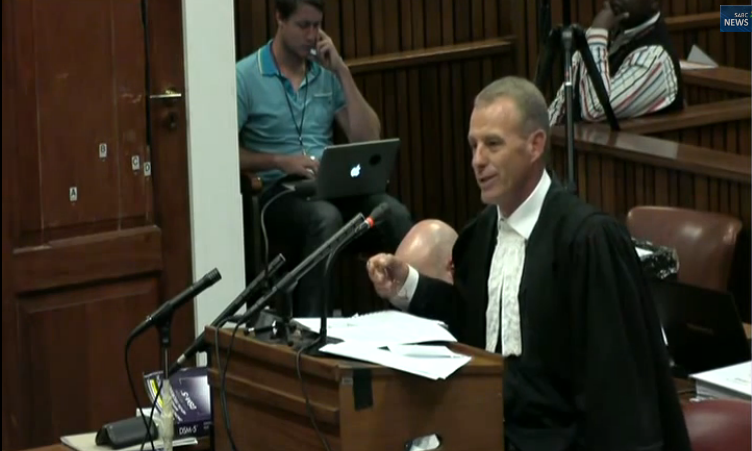
Nel tells the Judge that he is ready to hand up his application to the court, as mentioned yesterday.
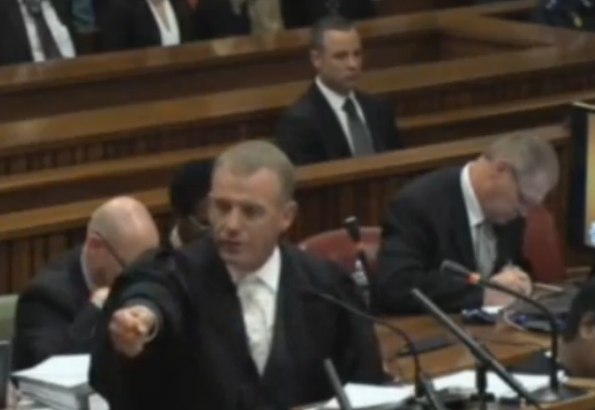
Nel

courtroom

Here are some of the main points:

1.This pertains to Section 78, 1B and 2, and Section 79 of the Criminal Procedure Act.

2.The Defense called Dr. Vorster. She’s a well-known, respected psychiatrist.

3.The purpose of her evidence was to present to the court psychiatric factors that may be of reference to conviction and sentence.

4.She specified that Oscar suffered from GAD.

5.She testified that the diagnosis is directly relevant to Oscar’s version and in her opinion, the GAD may have affected Oscar’s ability to act in accordance with an appreciation for the wrongfulness of his act.

6.GAD is a psychiatric disorder. At the least, it’s a psychiatric factor that impacted on Oscar’s ability to act in accordance with his understanding of wrongfulness.

7.GAD is listed in the DSM-5.

Nel then reads point 2 from Section 78. See the link above in this post for the full content of point 2.

Nel says in bringing this application, they are mindful of the practical implications and if granted, an expensive delay in the matter. They have taken in to account the provisions of Section 78, 1A and 1B, and although the current Defense team may indicate that it was never their intention that the GAD is part of the accused’s defense, the matter doesn’t stop here. Accused persons in the past have replaced their counsel particularly when things go wrong. Even though the court will take in to account the views of the Defense team, the facts before the court is of more importance and the case law would bear that out.

Nel says its fact that the Defense elected to call Dr. Vorster at this late stage. There had been no indication prior to Dr. Vorster giving evidence of any psychiatric condition that may have affected the accused. Nel says that the plea statement may indicate vulnerability and that he was anxious about the crime, but so is everybody in this case. The fact that it is a psychiatric diagnosis may play a role and must play a role, and that is what they have based their application on.

Nel lists the people who know Oscar who have come to give evidence and there has been no indication of an abnormal level of anxiety. Nel also says, in fact, Mr. Roux reminded him of the incident where people assaulted a taxi driver and Oscar witnessed it. For somebody with GAD, it must have been an unbelievable stressor. But Oscar was able to control himself. And yet, the Defense calls Dr. Vorster as a witness who indicates that the GAD may have been a factor on the day in question.

Nel reads some case law for the court. Then he tells the Judge that the timing of this evidence should be taken in to account. The consultation and presentation of evidence happened subsequent to the accused testifying, and subsequent to the accused’s experts giving evidence. Nel says, “My Lady, there must be a reason why that consultation would take place at that time.” Nel says the Defense can use this on appeal if we don’t refer. The court could very well question why the accused was not referred if psychiatric issues were brought up. But if this was part of the Defense’s intention, then why did it happen when it did. One could view it as a fall-back position. Nel tells the Judge that this should be significant.

Nel now addresses another paragraph in his argument. He states that we’ve had in this matter a defense of putative self defense. Which then in chief turned in to “I acted automatically.” Now they have a witness being called by the Defense saying the accused definitely did not act automatically in a state of automatism, but a psychiatric disorder may have played a role. Nel says, if one is confronted at this stage of trial by three different defenses, then the court should err on the side of caution expecting that there could be yet another defense. He says there should be red lights going off to the court and they should err on the side of caution.

Next, Nel says they made a point and they put it to Dr. Vorster that the accused was not the most impressive witness. That caught Oscar’s attention. His head popped up when he heard that. Nel says that they will argue that his testimony should be rejected. Nel says, “isn’t that the only reason why a psychiatrist is consulted after his evidence?” If this had sincerely been the Defense’s case from day one, why did they only consult with her when they did? Nel says, this is why he is arguing strongly that the timing of the consultations and the witness being called is important.

He refers to some more case law. Nel believes it is best that the doctors examining him have a global view of the case, not just one version (his version) that was given to Dr. Vorster. The court is entitled to know what the accused’s defense is.

Nel adds that the process in terms of Section 79 that would be followed, apart from all the different psychiatrists that would be appointed, is for the panel to make a finding if a psychiatric condition existed at the time of the offense. They would also need to make findings in regard to whether or not the psychiatric condition or mental illness played a role in the commission of the act, and to what extent. He believes it’s important for the court to know this.

He says the risk that the Defense took in calling Dr. Vorster at this stage of the trial has already indicated that there’s a reasonably possibility that it may play a role. Nel also says, if the court were to ask him directly if he thought it played a role, he would answer no, it didn’t, and he would argue that. He says that Section 78 has a low threshold and the court should act in terms of that.

Nel rests and Roux gets up to object the application.

He begins by saying that Mr. Nel’s reading of the law reports is rather unfortunate. Roux reads from the law books. Roux says the State wants a second opinion and wants the court to assist with this. Roux disputes that Vorster stated that Oscar may not have acted in accordance with his understanding of right and wrong. She did not claim him to be delusional or paranoid. He says it’s for the court to find what is relevant. Roux says that Nel is trying to suggest to Dr. Vorster that it’s a 78 situation. Roux read Section 78, part 1. See above for link.

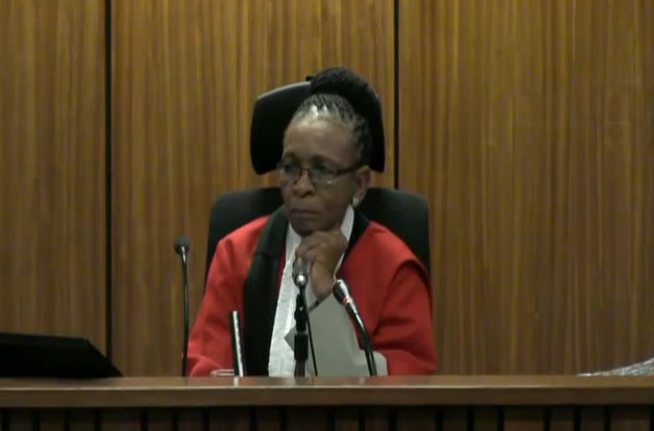
Roux does not believe that the state has said anything that warrants a 30 day evaluation. Roux then references the court record from yesterday and looks for an exchange that he had with the Judge. He tells her “with great respect, you’re absolutely in debate with some of the position and I want to show you where it is.” She doesn’t look too pleased.
Masipa

The record reads that the Judge stated to Roux: “In other words you say it’s not an allegation? There must be an allegation first.” Roux says, “absolutely, My Lady, that’s why I object.” Roux says an allegation cannot be a mere allegation; it must be supported by facts.

Roux says for the State to bring up that there are three different defenses is irrelevant. And the reason that counsel would do this is because your case is not good enough on what you argue. He also says for the State to allege automatism is also incorrect. Dr. Vorster clearly stated that was not the case.

Roux is fighting this pretty hard and getting worked up.

Roux also says they have a further witness who will talk about the fight and flight response, and the vulnerability of disability. Not related to Section 78, but in any event, even if there’s a question mark in the court’s mind, which there should not be, there’s another witness coming and it’s premature because what if that witness says something that requires the accused to be sent off again. What if he is sent away for 30 days on the GAD, and then sent away again for another 30 days on the next part. Roux says, apart from the absence of merits, it’s a premature application and the state is welcome to bring another application after that witness.

Roux now addresses the onus. He says it’s not entirely correct that they have the onus. There is a new insertion in to the act:

1A) Every person is presumed not to suffer from a mental illness or mental defect so as not to be criminally responsible in terms of Section 78, until the contrary is proved on a balance of probabilities.

1B) Whenever the criminal responsibility of the accused, with reference to the commission of an act or omission which constitutes an offense is an issue, the burden of proof with reference to criminal responsibility of the accused shall be on the party who raises the issue.

Roux proclaims that they do not raise the issue. The onus should not be on them. Roux rests.

Nel stands back up and says the one thing he agrees on with Roux is that they should not be emotional. He says that its one thing for counsel in 2 minutes to read a case that the State has referred to and tell the court that the State doesn’t know what they’re doing in the matter… but the 1991 case that he cited previously was one in which HE was the counsel. He knows the case by heart. In that case, he was arguing for the matter not to be referred, just as Roux is doing now, and he lost! Nel says he referenced these cases for a reason and they are there for the court to read, and he stands by them.

It was quite an interesting, in your face, moment there by Nel.

As for Roux’s argument about calling another witness… Nel says, “let ME now use the word unfortunate.” The fact that the Defense says they have another witness, should be considered holding the court for ransom. But in addition, the fact that they then said after that next witness the State can bring their application again, is a clear indication to Nel that they are on the right track with this application. Nel says, he too would be emotional if he called a witness and that witness left open the door for referral of his client.

If Roux is telling the court that he’s going to do this again, bring evidence that puts Section 78 in to question, then that should be a clear indication to do the referral now.

Nel says, “we’ve never in our case presented a case that there is some mental illness, not at all, and we will not. But there’s now, by a defense witness, evidence before the court and the court must act. And I stand by the cases that I’ve referred to.”

The Judge will be back tomorrow morning with her decision. They adjourn.
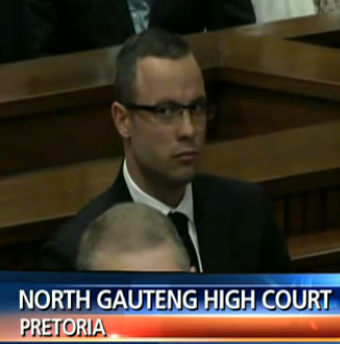
OP2

OP

Oscar Trial – Day 29, May 12 WOLMARANS, VORSTER

OP2

“Wollie” Wolmarans returns one last time for more cross-examination with Nel, who says this won’t take long. He just needs to cover a few things.

Nel confirms that Wollie has made available (as requested) his photos from the November 8, 2013, investigation at the crime scene.

Wollie would like to clear up that there may have been some miscommunication about what “file” meant on Friday. He does actually have a file for the case with some notes in it, even though he testified last week that he didn’t. But he is again careful not to commit to having done any full reports; he only compiled notes as his investigation continued. It’s really the same thing that he was discussing on Friday.

Nel asks, when he was at the scene on November 8th, did anybody give him a version from Oscar? Wollie answers, “not that I can remember.” After a pause, he then admits that he was given the bail application and he read through that.

Nel wants to know how Wollie knew where Oscar was standing during the shots. Wollie says that he used Mangena’s report to reconstruct the scene. He also believes that it was mentioned in the bail application, but Nel corrects him that Oscar did not go in to detail where he was standing in that document.

So Nel asks Wollie, at the time (on Nov. 8) was he in agreement with where the laser was placed to replicate Oscar’s position? He says he was happy that the laser was in the vicinity of where Oscar was standing. He then corrects himself to say, “let’s rather not say STANDING, but where the gun was when the shots were fired.”

Nel also wants to know if he agrees with Mangena that Oscar was on his stumps and in the normal firing position which would indicate the angle and trajectory of the bullets.

Screenshot 2014-05-24 15.55.11

This is important because it goes to Oscar aiming at his target. With his arm stretched out in normal position, he likely has line of sight to his target.

Wollie will only agree that shot B had sight alignment, but he’s not sure about shots A, C and D.
Nel asks, but it’s possible? Wollie agrees that it’s possible but he’s not sure.

Nel is able to establish with Wollie that if the laser stays in its original position after testing hole B, and you then try to get it through holes A, C and D, you cannot do it. Wollie agrees.

The importance of this is to prove that Oscar moved positions while shooting. One could make the inference that he moved because he was changing aim as Reeva is moving inside the toilet room.

30

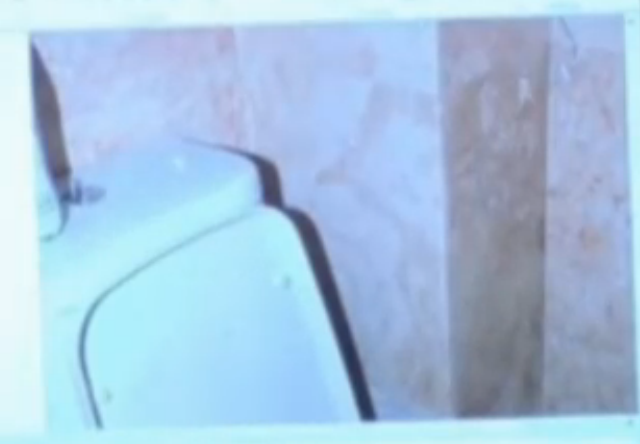
Nel says, as far as the splinters are concerned, he would like him to look at a photograph.

top of toilet

Nel points out that there is a splinter of wood on top of the toilet’s water tank area. It’s not visible to my eyes on the TV monitor but Wollie sees it and agrees there is a splinter there. Nel says that this is where the splinter landed after a bullet went through the door. Wollie says it could also be from a blow from the cricket bat on the door, but he concedes that in all likelihood it is probably from a shot. This indicates that a splinter could travel that far from the door. Wollie can’t disagree with him.

Nel then revisits the re-testing of the gun at the firing range. He wants to know why they went back to re-test. Wollie states that he believes he has answered this before, but the first firearm used was in his opinion not friendly with that type of ammunition and he couldn’t fire it in rapid succession. He was only able to shoot one bullet at a time and then had to reload manually. So the gun itself worked, it just couldn’t fire in rapid succession using the type of bullets they were trying to fire.

Nel asks, is that the only reason you went back to re-test, or could it also have been because of background noise?
Wollie claims it was only because of the issue with the gun. It had nothing to do with background noise.

Nel wants to know why they waited so long to go back and re-test. The first test was on March 21, 2014, and the second test was on April 9, 2014. That is 18 days. Why not go the next night? Wollie first states that he can’t say for sure why, but then goes on to say that this is not the only case he is involved with. He is busy.

Nel wants to know why they didn’t re-test the bat sounds on April 9th, since cricket/frog sounds were heard clearly in the background. Wollie says he doesn’t hear them due to his hearing condition, but other people had told him that the background noises were indeed there. So Nel says, since everybody was aware of these noises, to ensure that both tests had the same background noise, why not just repeat both tests on April 9th? Wollie says that the door was already broken to pieces and they didn’t have another one to use. Also, he’s not a sound expert. He didn’t think it would make any difference. He doesn’t see the necessity of it.

Nel then shows him the following photo which Wollie has seen before.

residue test

Nel tells Wollie that Roger Dixon thought this paper was used for splinter tests. Wollie laughs and says, “My Lady, that shows you that Mr. Dixon is not a ballistics expert.” Nel says, “I agree with you, you are right.”

Nel moves on to the back wound and the striations. The one aspect that they agree on is that the magazine rack would not have caused striations due to it being a smooth surface. In addition, the pattern of the striations on the abrasion are very “regular”. Wood grain is not a regular pattern.

To me, this is far more indicative of the striations being from the shirt. If the bullet had enough energy to create that injury, I would think that the energy or heat from that could have pressed that pattern on to the skin while the shirt was between the bullet and the skin.

close up of back wound

Nel points out to Wollie that he is contradicting evidence from Professor Botha, the defense pathologist. Botha testified that he concluded that the striations were caused by the magazine rack. Wollie does not agree with Botha, but expresses very high respect for both Professor Botha and Professor Saayman. Wollie also says that he does not believe Professor Botha is a toolmark examiner (and Wollie is).

Nel now addresses the fact that Wollie and Dixon met with each other a few times after Dixon’s testimony. Nel wants to refresh Wollie’s memory on those meetings. He asks Wollie if he remembers having dinner with him at Jocks Restaurant. He does remember this meeting but states it was informal. He remembers that he wanted a pork chop but they didn’t have any so they both had t-bone steaks. Nel tells him, “that’s impressive that you remember that since the meeting took place on March 26, 2014.” Wollie doesn’t dispute it nor does he dispute that they discussed the case. Conveniently, he can’t remember the content of what they discussed when asked by Nel. Selective memory in court is always fascinating to me.

The next series of questions by Nel is extremely important because he is establishing, and getting Wollie to concede on most points, that Mangena’s findings of the sequence are accurate. And with Mangena’s sequence, the following occurs… there was a delay after the first shot, Reeva moved positions, Oscar repositioned his aim, Reeva was covering her head for the last two shots likely in defense, and Oscar kept shooting until it was silent. The neighbors support this by hearing a woman’s blood-curdling screams before and during the shooting. They also experienced the silence after the last shot. This is devastating for Oscar’s case. It is crucial for Nel to solidify Mangena’s findings because it tells a VERY different story than rapid succession, panicked, non-aimed shots. Here is how the questioning unfolds:

•Nel wants to know, after his investigation on November 8th, was Wollie content that bullet A hit Reeva in the hip. Wollie says he’s still content with that finding. Nel says the question is different. He wants to know if he was happy on that specific day with the finding that bullet A hit Reeva in the hip. Wollie answers, yes.

•Nel also establishes that Wollie is in agreement that Reeva was standing upright in front of the door at the time. Wollie adds that she may have been bent slightly but yes, she was standing upright in front of the door.

•Wollie says at this stage of his investigation, on November 8th, he did not have a finding on which injuries were caused by the other bullet holes. The only one that he can clearly remember they established was bullet A hitting the hip.

•Nel establishes that Reeva’s head must have been down lower than normal standing position in order to be hit by the bullets and Wollie agrees with that. The bullet holes in the door are too low for the injury to take place while she is standing. (Concluding that some time would have to pass in order for her to go from upright to down)

•Nel also points out that based on his testimony from Friday, Wollie agrees that Mangena was able to get the laser to mark E on the wall by going through hole B, with no deflection. And if there was no deflection, then bullet B missed Reeva. Wollie again agrees that this is possible.

•Nel says, in order for B to miss her, she must have fallen somewhere before that shot was fired because otherwise that shot would have hit her. Wollie agrees, she must have fallen with her right hip completely destroyed but he’s clearly trying to be careful about directly conceding here. I believe he can see where Nel is going with this. But again, some period of time must have to pass in order for Reeva to change position (fall) and shot B to totally miss her. I don’t see how A and B could be rapid succession considering her body movement. And let’s not forget, there are ear witnesses to support the pause after the first shot. That only strengthens Mangena’s findings here.

•Nel says we can exclude that she fell flat to the floor because then she would be too low for the arm and the head wound if she’s flat on the floor. Wollie agrees, he does not believe she collapsed straight down.

•They move on to holes C and D. They establish that the height of hole C is 99.4cm. And the height of hole D is 97.3cm. Nel says that based on those heights, it would not be possible for Reeva to be sitting flat on the floor when those shots hit her. She would be too low. Wollie says that she may have been hit when falling down, but he has to concede with Nel that if she was sitting flat on the floor, or in a stationary position when the C and D shots were fired, then she would not have been hit.

•To further support his point above, Nel says that with Reeva’s hip injury, she would not have been able to be on her haunches. Wollie agrees. In other words, she would not be able to support her own weight; she would have needed to be sitting on something. They all agree that she was not sitting on the toilet. So the only other “something” in that toilet room was the magazine rack. Wollie agrees with all of this. Nel ultimately asks, doesn’t it make sense that she was sitting on the magazine rack for the remainder of the shots? Wollie says he does not think that she would be able to sit because of the hip injury. Nel says, she’s not supporting her own weight, she’s basically propped up on the rack and her head/upper body is leaning over. Nel asks, doesn’t this make sense? Wollie doesn’t understand. Nel tries to explain it to him again but he won’t concede, he just says he’s not sure.

I found this illustration online that gives a clear depiction of the position that Nel is referring to.

drawing of positioning

Nel then embarks on an exchange with Wollie about the magazine rack and where it was positioned for Wollie’s reconstruction done on November 8th. By this date, Wollie would have seen the police photos and known where the rack was when originally found. But again, Wollie is confusing the point and trying to act as if he didn’t know exactly where it was supposed to be at that time.

Nel says to him this is very concerning because the magazine rack position was an integral part of Mangena’s findings and Mangena’s report had been available to him by that time. Wollie answers back that he also had Saayman’s report and Saayman indicated that one potential cause of the back injuries was contact with a hard surface, so he was working along those lines at first.

To me, his point seemed more like an excuse than a genuine explanation. I get the impression that because the rack is very problematic for the defense (it supports everything that I outlined above), they did not want it to be where it actually was at the time of the shooting and played around with the position during their investigation. And that would be exactly why Oscar lied about the magazine rack on the stand! On the surface, it seemed really silly for Oscar to be lying about that, but when you fully understand the significance of the rack’s position, it then makes sense.

Nel says to Wollie, in fairness to him, he sees in his report that he was testing what Saayman said about the hard surface, but why would he not also test the magazine rack conclusion that Mangena had given because that forms the basis of his conclusion? Wollie just says he only concentrated on that one point from Saayman, plus he isn’t really sure that the magazine rack really mattered. Also, he had very limited time at the scene to conduct his investigation.

Don’t let Wollie fool you… he’s trying to brush this off, but the Defense does understand the significance of this rack and they do not want to concede to Mangena’s findings. Hopefully the court is paying attention on the points that Nel made today.

Nel moves on and wants to know if Wollie had done any experiments or tests prior to March 8, 2013. Wollie says no, he had just visited the crime scene and took a few photos. Wollie says the photos were really of no value because the exhibits had been removed from the scene. Nel wants to know the dates that he was at the scene. Wollie says he can’t remember, except for November 8th, but then says he was requested (by Oscar’s family and legal team) a few other times to go to the scene and remove some personal articles for Oscar. He kept notes of what was removed. Nel tells him it’s not a memory test and lists all of the dates that they know he was there:

•February 17, 2013
•February 18, 2013 (when he found the fragment in toilet)
•March 8, 2013
•November 8, 2013

Nel then asks if he conducted any other sound tests at the scene. He says no, not myself. And Nel is about to continue on when Wollie says he may have just told a lie and grins a bit. There was one other test that he wants to mention for completeness sake… The day that they asked him to hang the door, he stood outside the toilet room and shouted to somebody standing outside in front of the house. He shouted his name (Christo) three times and asked him if he heard it. The window and the toilet door were open at the time. Then he stood inside the toilet room and closed the door and shouted Christo’s name again three times, and Christo said he couldn’t hear him. He reminds the court that he is not a sound expert.

Nel asks, when was this? Wollie says it was very shortly before March 3, 2014, right before the start of trial. He was present along with Christo and the artisans who helped to hang the door. And FRANK was there too. Our mysterious gardener buddy Frank Chizweni pops up again! He was there to open the door for them.

Christo is a friend of Wollie’s who is an artisan and he asked him if he could assist him with the door, due to the disability with his back. Nel asks if this was done during the day. He says yes.

Nel asks him why he did this; did anybody ask him to do it? Wollie says that nobody asked him to do it, he just did it.

Nel asks Wollie why he was at the scene that day. He says that the legal team asked him to go to the house and take a door from the foyer leading to the garage, which is exactly the same shape and size as the toilet door, and hang it upstairs in the bathroom. He doesn’t know why. He also says he’s not an artisan, so he got some help. He says he still doesn’t know why they had him do that.

Nel asks if there were any other instances that he went back to the scene that had to do with the bathroom/toilet. Wollie says there was one more time that he and Dixon went back to the scene but he can’t remember the date. Nel says he’s not asking about that instance. That was the visit at night when they went to test the lighting conditions in the bedroom. Wollie says he can’t remember any other time. He’s been there a few other times, but can’t remember dates.

Nel wants to know if Wollie went back to the scene at night any other time. He says yes, one other time, but can’t remember the date. It was about 3-4 weeks ago, while the trial was in process. It was because of Mr. Dixon testifying on visibility. The legal team asked him to go put on the balcony light to see what he could see. It was only he and Frank there that night. Again, Frank opened the door for him. It only took him 15-20 minutes.

So overall, even though Wollie was seemingly reluctant to give details, Nel established that Wollie was at the crime scene quite a bit over the past year and there was some additional testing that the State didn’t know about.

Nel looks at Wollie’s CV and states that he left SAPS in 1992, and asks if it’s correct that he’s been practicing as an independent consultant ever since. Wollie confirms this is correct. Nel wants to know if he has done any proficiency tests during this time. He says no, it’s not required for independent consultants.

Nel concludes by showing Wollie a photo that Dixon gave to the court when he testified. It was this photo:

test bullets entry

He wants to know what this is from but Wollie does not know. He is not familiar with the photo.

Nel rests and Roux is up for reexamination.

Roux addresses Mangena’s report and asks Wollie if anywhere in the report there is mention of Mangena testing holes A, C and D to see if they match up with mark E, taking deflection in to account. Wollie says, no.

Roux then asks about the bullet fragment hitting the back. Wollie states that in order for the fragment to end up in the toilet, it would have to make a U-turn after hitting the spot on the back. After hitting the spot, it would likely lose all of its energy. So he is still standing firm that the fragment could not hit the back and end up in the toilet. He thinks if it hit the back, it would be more likely to fall on the floor and the fragments under the magazine rack don’t match the injury.

Roux then addresses that the back injuries go in an upward pattern. He asks, how could the bullet fragment go from F to the bottom of the back and then upwards? Wollie says it would have to bounce off the back twice and then go up… it’s just not possible.

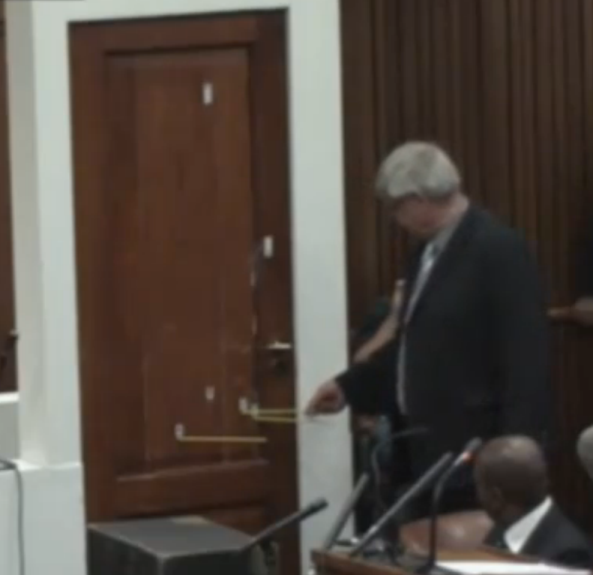
Roux wants to know about the accuracy of probes; can they move in various directions? Wollie walks over to the door and wiggles the probes and shows that there is movement upwards, downwards and sideways.

Wollie with rods

Roux asks, “when somebody fires four shots, would you expect them to be from the same exact position?” Wollie says, no. With recoil, your hand will never be in the same position.

Roux wants to know what Wollie meant about “sight alignment”. He answers that when he is at the shooting range, shooting at a target, there are certain principles to follow. The firearm has a back side and a front side. The back side has a V-shape and the front side has a pin. He demonstrates with his hands.

Wollie sight alignment

He then aligns his eye with the back side, front side and the target. They must all be lined up to hit the target correctly. Looking at the holes, he would not say that Oscar shot with sight alignment.

Wollie concludes his reexamination by saying that if the court wishes, he can have the shooting range and door set up again so that the court can go there to experience the sound tests in person. He thinks this will be the best way for them to experience it.

Roux rests, Wollie is excused.

The next witness is Dr. Merryll Vorster. She is a registered forensic psychiatrist.

She reads the introduction from the report that she has compiled for court. She states that Oscar was evaluated to determine his present mental condition and any psychiatric factors that may have been present at the time of the alleged offense.

Interviews were also conducted with family members, colleagues and friends to obtain collateral information.
The documents available are listed:

•A report from Richard Holmes dated February 18, 2014.

•Medical records from Milpark Hospital dated February 21, 2009.

•Affidavits from Justin Devaris, Samantha Greyvenstein and Graham Binge (cousin).

•And then the people that she interviewed for collateral information: Diana Binge (aunt), Aimee (sister), Peet Van Zyl (manager), Alex Pilakoutas (friend), Carl (brother), and Ampie Louw (coach).

The developmental history: Oscar is the middle of 3 children, born with a congenital abnormality resulting in the amputation of both legs below the knee at the age of 11 months. This surgery was performed pre-language level. Oscar would not have understood why he was in the hospital. Vorster explains that there would have been pain with this surgery, and since he was pre-language he would not have been able to be comforted by his mother. It would be perceived by the young child as a traumatic assault.

He was fitted with his limbs and able to walk by the age of 17 months. He was never restricted from participating in physical activity and was raised to be normal. Vorster says this is significant because he was never able to allow himself to be seen as disabled. To me this seems like a double-edged sword. One would think it would be a positive thing that the mother raised him to be a (for lack of better word) normal person but the doctor seems to imply that it had the opposite effect. Vorster says that over time, this could result in increasing levels of anxiety.

Oscar described his mom as being very loving. His father was often away. At 6 years old, his parents divorced and there were drastic changes in his social circumstances. His mom started working and his father had financial problems and didn’t always support them. The father was described as irresponsible and mostly absent according to all siblings.

From the collateral information obtained, his mother was an anxious person who abused alcohol intermittently. She slept with a gun under her pillow. There were frequent times that police had to be called to their home to investigate because of her fears. The siblings all grew up with issues of anxiety because their mother never adequately comforted their fears, she added to them.

I was really disappointed to hear the doctor testify about the mother. In everything I had previously read about her, she was described as being very loving and supportive, and that Oscar was very close to her. Now in court, while he’s trying to blame anxiety on his bad behavior, they are seemingly throwing her under the bus saying she had alcohol issues and gave them anxiety. Of course, I have no way of knowing what is true, but the poor lady is dead and this just feels wrong.

This type of testimony drives me nuts. In general, it’s just a sob story about every sad thing that ever happened in the accused person’s life. Everybody has tragedy and adversity, some worse than others. When people try to use it as an excuse for killing another person, it really makes me cringe. Prior to the shooting, I would imagine that the last thing that Oscar ever wanted was to be seen as emotionally or mentally challenged. Everything about his public persona was quite the opposite. Now that he’s on trial for killing a person, he is all of a sudden going to pull out psychological challenges as an excuse. Speaking bluntly, I find it insulting and malingering at its finest.

The report continues, Carl was often tasked with looking after his two siblings. The paternal grandmother supported the family financially. Oscar was a sociable child; he did well in school and in sports. He was occasionally teased and his brother would have to intervene. Vorster believes that in being sociable he was concealing his feelings about being disabled.

At age 14, Oscar moved to Pretoria to attend high school. He lived with his father and saw his mother on weekends. Within a few months of living at his father’s, there were problems at home so he became a weekly border at school. On weekends, he would go to his mother’s and his aunt’s/uncle’s homes. Carl attended the same school as a boarder as well. Aimee continued to live with the mother. Oscar played many sports.

At age 15, Oscar’s mother died suddenly. He was significantly traumatized by her death, increasing his anxiety levels. He describes this period of his life as very stressful which was confirmed by his siblings and his aunt.

After his mother’s death, he continued to be a weekly boarder at school and stayed with his aunt and friends on weekends. He had support from his extended family and friends, but had infrequent contact with his father. His relationship with his siblings was very close, but he had no primary attachment to a parental figure at this point in his life.

At age 16, Oscar sustained a knee injury playing rugby. As part of his rehab, he started running. He obtained a coach, started training and that lead to competitive running.

By grade 11, in addition to his coach, he had a manager, was competing internationally was becoming financially independent.

After he completed high school, he began competing as an international athlete. He had a coach, manager and various sports advisors and traveled extensively. He had few strong emotional ties. He saw extended family infrequently but saw his sister often. He described being quite lonely.

At age 21, he says he broke all ties with his father following an argument. He was financially independent by this time. He spent many months during the year in Italy training. On the occasions that he came back to South Africa, he reports being anxious about the high level of violence and crime as reported by the media and as discussed within his family setting. He bought a firearm for his own protection. His aunt, Mrs. Binge, mentioned that he had a burglary in his townhouse and that resulted in him adding extensive security measures to his property.

Oscar reported that as a professional athlete, he worked very hard to gain sponsorships to make a lot of money and be financially secure. Autonomy and independence was his attempt to manage his anxiety. He had a strict training regimen with focus on diet, lifestyle and training. He made sure he was always punctual and well-prepared for media events.

He had few long term relationships. He was very self-sufficient. He relied on social media to stay in contact with friends and siblings.

Vorster then says it is her opinion that Oscar has an anxiety disorder. People that have this disorder work hard to control their environment and be very prepared in order to alleviate their levels of anxiety. His strict training and diet helped him to alleviate his anxiety, but as he became exposed to being more famous and having media attention, he would have to prepare more and more to not embarrass himself in any way. Having order in your life helps to alleviate stress from anxiety.

Past medical history: Bilateral below knee amputations at 11 months old. On-going stump pathology treated intermittently. As a child, he contracted Encephalitis and since then has had chronic headaches. In Feb 2009, he was involved in a boating accident during which he sustained facial fractures. He had a brief period of loss of consciousness and had mild concussion. He was admitted to Milpark Hospital where he had extensive facial surgery.

Past psychiatric history: Oscar has many features of anxiety. There is a clear family history in his mother, sister and brother. Roux asks, what is the relevance of the family history of anxiety? Vorster says that anxiety disorders do have genetic pre-disposition. Oscar notes that he was always encouraged to appear as normal as possible, despite his disability. He became determined to participate in sport and was able to keep up with able-bodied friends in activity. He became increasingly unwilling to reveal his stumps publically and this gradually extended to family members and friends. He would keep on his prosthesis during the day, only removing them at night when he went to bed. He gradually started having feelings of inadequacy about his amputations.

I would imagine to some degree or another, that all of the feelings described above would be quite normal at certain stages of life for anybody dealing with amputations or disability. I don’t pretend to understand what it is like to experience this, my point only being that I’m not hearing anything that is shockingly abnormal for somebody who lives with a disability. And last I was aware; having these feelings should not be a pre-cursor to murderous activity.

Roux wants to know how having a poor self-image, yet being successful (confident) on the race track are compatible. Vorster explains that due to his success on the track, he strove to always conceal his stumps and his feelings of inadequacy. By concealing his disability, it rendered him less able to access the emotional support required to manage his vulnerability and self-esteem issues.

Matters were further compounded as he developed sexual relationships as he would shy away from revealing the extent of his disability. As he became more famous, his various sponsorships required him to attend media events and to do interviews. He describes that he would be anxious about these events and would spend many hours preparing so that he would not embarrass himself. He also describes feeling increasingly stressed by the demands placed on him as a professional athlete.
Vorster says with increasing stress, he would have to work even harder to keep his anxiety under control.

Not to sound insensitive to his issues, but average people with anxiety issues experience all of these things too. Everybody has jobs, responsibilities, families, and financial burdens that create extreme stress. In my opinion, just because you are famous, does not necessarily make your anxiety any more prolific or important. If anything, Oscar would have the financial resources and close personal advisors available to help him manage what he needed. Most every day people do not have access to that. If he really had an anxiety disorder and chose not to seek any help from anybody for his entire life, then he has to take responsibility for not treating his issue much earlier. To only reveal it now in court when it may be viewed as an advantage for you, is a bit disingenuous and that is why I tend not to fully believe it. He may very well have some anxiety, but I do not believe it caused what happened on February 14.

Everybody has an opinion about this trial, as they should. And I’ve noticed that those who seem to be on the side of not guilty are on that side only because they believe that the violence in SA coupled with Oscar’s anxiety are absolutely believable, end of story… despite all of the other evidence.

I do not dispute that violence exists frequently in SA nor do I dispute that Oscar may have some anxiety. I would think for anybody with his life story and circumstances, some anxiety would be fairly typical. BUT, I cannot ignore the totality of the evidence presented in this case. You can’t put the perceived intruder + anxiety story in one bucket, and the physical/circumstantial evidence + ear witnesses + common sense in another bucket. They cannot be separated. The totality of the evidence always tells the story. And the reason that we have this psychiatrist on the stand, days before the defense is due to rest, is because the defense team has hit the end of their road. Trust me, if psychological issues were at the heart of this case, it would have been dealt with LONG ago. Do not let your heart strings cloud your common sense in this matter.

Vorster goes on to say that while Oscar was training in Italy, he would feel lonely, but his fears about personal safety were fewer. He followed SA news closely and worried about his siblings’ safety, in particular his sister’s safety. Vorster states that as one becomes more anxious, their fear of personal safety increases, even when their safety may not really be threatened.

While in SA, Oscar describes having increased anxiety over safety, he was worried about being followed and worried about the safety of his home. He moved in to an estate believing that it would be safer for him there, but subsequently there were break-ins there as well.

Now keep in mind, these are all things that Oscar has relayed to the doctor. He can tell her anything he wants without having to completely substantiate it. But we all know that in court, the defense was not able to substantiate their claims of multiple break-ins and crimes against Oscar personally. Oscar and a friend (Stander) saying that crimes happened versus the police reading actual police reports is not much of a match. It is not a coincidence that the police do not have reports of what Oscar claims happened to him. Oscar couldn’t even remember who he called to pick him up on the night he was supposedly shot at on the highway.

She goes on to say that he tried to increase the security at his house, and his routine was to sleep with his bedroom door locked. He describes being hyper-vigilant and having sleep disturbances, waking often if there was a noise. He believed that being famous put him at increased risk.

He didn’t like to be home alone and always tried to invite friends to visit and sleep over. He describes feeling generally isolated and alone, although he made friends easily. He did not share his private feelings with his friends and is a guarded and mistrustful type of person.

Habits: Oscar does not generally drink alcohol during his training and competitive periods, but describes drinking excessively at times during the off season in which he may become intoxicated. He does not smoke or take drugs.

History of the incident: Oscar relates that he believed he heard an intruder. He became scared and had escalating levels of anxiety. During his description of the events, the following emotions were observed – distressed, crying and retching. He stated that he had no intention of shooting Ms. Steenkamp and he feels devastated that he killed his girlfriend.

Roux asks, in her profession, what is her opinion about the emotions that she observed? In her opinion she believes they were genuine, primarily because of what she witnessed with the retching. When feigning retching, one would develop a hoarse voice, redness in the face, perhaps some tears but what Oscar showed was a pallor (he became pale) and started sweating profusely. That cannot be feigned. That is a real manifestation of anxiety. This is why she believes that his distress was genuine.

I’m sure we all agree though that he was genuinely distressed. He just killed somebody and was charged with murder. Anybody would be distressed! That does not equal being remorseful or sad about Reeva dying.

Mental state evaluation: Oscar presented as a well-groomed, well-spoken and polite man. He was clearly anxious as could be seen by his tremor and from the way he perspired heavily during the interview. He had no speech difficulties or thought disorder. He was fully orientated. He gave a very detailed account of himself. His mood was markedly depressed and his affect flat (few expressions on his face). Vorster states that a flat affect is a typical feature of a depressed person. Oscar is on treatment for depression. His memory and concentration were good and he had no cognitive deficits (no intellectual incapacity).

Vorster goes on to say that depression can have a negative effect on memory and concentration. In this instance, she did not find any deficit on memory and concentration. Therefore, there shouldn’t be any reason why he can’t remember his call with Baba, his call to Netcare, his call with Justin Devaris, him carrying Reeva across the upstairs hallway to the stairs, etc. He has no problems talking about himself (as Vorster stated above) but conveniently forgets some incriminating parts of February 14. This goes to my point above about not just believing his intruder story and ignoring the facts of the case. You cannot ignore these very significant details. There is a reason why on the stand he suddenly could not remember those phone calls and it’s not anxiety. It’s because they do not support his story!

During their examination, Oscar was asked to remove his prosthesis. He was clearly embarrassed but complied. She observed him walking on his stumps. She says his balance was poor and he could easily be pushed over. His physical vulnerability was immediately apparent.

Vorster says that Oscar frequently expressed his guilt of having caused Ms. Steenkamp’s death.

Psychiatric diagnosis:

•Generalized anxiety disorder (GAD)
•Depressive disorder (caused by the shooting)

General anxiety disorder is pervasive, as opposed to having anxiety over specific things.

The depressive disorder is secondary to the shooting. She did not find any evidence that he was depressed prior to the shooting.

Discussion: Oscar has a long history of GAD which appears to have increased with time. It is likely to have commenced at the age of 11 months. His anxiety increased after his parents divorced. His mother’s anxiety heightened his and his siblings’ anxiety. After his mother’s death, Oscar lost his primary attachment figure. Although close with extended family members, he does not have a secure attachment to them.

One way to alleviate anxiety is to become very controlling about one’s environment. His anxiety increased commensurate with his increasing levels of public fame. A further factor increasing his anxiety was crime in SA. He had increased security measures at his home, more so than most people in SA.

The injuries he sustained from the boating accident in 2009 added to his levels of stress. He became aware that his life could change radically if he were to be injured, and that increased his personal sense of vulnerability. He could lose his ability to be an athlete, which in turn would mean he would lose his income and his independence.

A further factor that may be of relevance is the incident with Mr. Batchelor in December 2012. He was concerned that Mr. Batchelor and his friends posed an on-going physical threat to him.

These feelings of anxiety are confirmed by Peet Van Zyl, Aimee and Carl. These factors were all operating during the incident and would have been compounded by Oscar’s physical vulnerability and the additional pressure of perceiving his environment as hostile and unsafe. When exposed with a threat, Oscar is more likely to respond with a fight response rather than flight, as his physical capacity for flight is limited.

In Dr. Vorster’s opinion, Oscar’s reaction to the perceived threat on February 14, should be considered in the light of his physical vulnerability and his co-morbid diagnosis of GAD.

She would like the court to take in to consideration the following – operating at the time of the offense would have been Oscar’s physical vulnerability and secondly, his pervasive GAD which was present for many years, and would have been present on the day of the offense.

She states that he is remorseful about the events and feels guilty that he has caused Ms. Steenkamp’s death and has developed a depressive disorder as a consequence of this.

Roux rests and Nel is up for cross-examination.

Nel wants to know from Dr. Vorster, the fact that she diagnosed Oscar with GAD and that he had it at the time of the incident, did that affect his ability to distinguish right from wrong? She answers, no, not at all.

Nel asks, did it affect his ability to act in accordance with right and wrong? Vorster says, she is not saying that. Nel asks if Oscar had diminished responsibility at the time? Vorster answers that what she is trying to say is that the court should take in to account these factors and it’s really up to the court to determine if he had diminished capacity.

Nel says, well if you are going to say that, then we need to deal with Section 78. He pulls out a very large legal book and says to her… “so you are saying it is possible that he had diminished responsibility at the time?”

Nel section 78

She says that what she is really trying to express is that Oscar is different from other offenders and from the normal person because he has a physical vulnerability and GAD, so his reaction to situations would be different.

Wow. If it becomes acceptable for people to use disability and anxiety as an excuse for murderous behavior, then we are certainly going to have a lot more murders on our hands. This is a dangerous path she is taking!

She then says, “I’m not saying that this constitutes a mental illness.” Nel says, I don’t understand why we are hearing this evidence now. He says, “if we are not dealing with a mental illness and not dealing with a direct contribute, then why are we dealing with this evidence now?” She doesn’t know the answer to the question. Of course, Roux called her as a witness, all she can do is come and testify. But Nel can only deal with the issue through her, so he is putting it to the court… why are we hearing all of this right now? And of course we already know the answer… because the Defense is desperate.

Nel tells the doctor, if you say there is a possibility of diminished responsibility, then he has to be referred today for mental observation in terms of the provision with Section 78. Vorster says, “that could be something the court could consider.” But what she is rather saying is that his reaction to situations would be different based on his GAD and his vulnerability. Nel says, taking that all in to account, it could have diminished his responsibility at the time. A referral is what would determine that.

Nel says to the doctor that he is aware she has spent many years doing this type of evaluation at hospitals. She confirms that she has and also understands the provisions of Section 78.

Nel reads section 78, point 2, from the book:

If it is alleged at criminal proceedings that the accused is by reason of mental illness or mental defect or for any other reason not criminally responsible for the offense charged, or if it appears to the court at criminal proceedings that the accused might for such a reason not be so responsible, the court shall in the case of an allegation or appearance of mental illness or mental defect, and may, in any other case, direct that the matter be enquired into and be reported on in accordance with the provisions of section 79.

Nel says, you have diagnosed a mental illness, GAD, am I right? Vorster says that GAD is a psychiatric diagnosis, but she would not consider it to be a mental illness as perceived in the criminal procedure act. In her opinion, it should not be taken in to account in terms of his responsibility. She only wanted to present the GAD as a possible reason for the way he reacted. So I’m right back to where Nel was… why are we even talking about this? It either played a role in his actions that night or it didn’t.

Nel says, but if the GAD is severe, it will affect your mental capacity? She says that if it were severe enough where one started to become paranoid about individuals or threats, then one may consider it as a mental illness. But GAD is not an uncommon psychiatric diagnosis. There are many people who have GAD. It affects social and occupational function but it doesn’t imply that one has lost touch with reality or can’t see right from wrong.

She was called by the Defense and she linked this GAD to the incident and that is what Section 78 deals with, linking a disorder to an incident. The court is then left no option but to refer.

Roux objects. He says it must be linked to mental disorder.

Nel wants to know if she is categorically saying that GAD is not a mental disorder. She answers that it is a psychiatric diagnosis. Nel asks her, what is the difference? She says mental disorders affect one’s capacity to see right from wrong, and act in accordance. She doesn’t believe that an anxiety disorder limits capacity unless there are psychotic elements, which she doesn’t believe that Oscar suffers from.

Oscar went from looking sad with his head hanging low during direct examination, to looking pissed at this cross-examination.

OP head low

OP glare

Now that an evaluation is on the table, Vorster seems to be back-peddling a little bit to get out of this jam. Nel states that Oscar’s defense is that he thought there was an intruder in his house and that he was under attack that night. If the Defense is going to introduce evidence that Oscar has a diagnosed anxiety diagnosis, and his supposed heightened fears and hyper-vigilance played a role in his actions that night, then it certainly is relevant for the court to have him examined per Section 78.

Vorster says that the diagnosed GAD is relevant for the facts of the case, so it would be up to the court to decide if it constitutes a mental illness or if the accused should be referred or not.

Nel asks for an adjournment to review documents as he may bring an application. They break for an hour.

When they return, Nel asks the doctor if it is correct that the first interview she had with Oscar was on May 2, 2014 (that would be 10 days ago). She acknowledges that it was, and that it was after Oscar and other witnesses testified.

Nel wants to know if she followed the trial at all. She says, not daily, just parts of it in the media. Nel asks her, if I put it to you that it was reported that Oscar was not a good witness, and some of the expert witnesses were not good either, do you think that would increase his anxiety? She says, I don’t know. Nel says… if he believed his case wasn’t going well, and now he has to see a psychiatrist, wouldn’t that have made him anxious. Vorster says she does not know how he perceives his case.

Nel points out to the doctor that at one point during cross-examination, Oscar expressed that he was fighting for his life. Vorster acknowledges that she heard about that statement. Nel states, so in his interview with you, he is fighting for his life. Vorster says that he did not say that to her.

They only had two interviews total. One on May 2, and the other on May 7, 2014. The other people in the report were interviewed on the following days:

May 2: Mrs. Binge
May 5: Aimee, Carl, Peet, Ampie

Nel asks Vorster, what is the purpose of your report? She says to bring psychiatric factors to the court’s attention that may be of relevance for the purpose of conviction, and if required, of sentencing. Nel states, these are factors that may have affected his capacity to act appropriately at the time. She agrees. In terms of his defense, it is directly relevant.

Nel asks, his anxiety disorder is worsening? She says, yes.

Nel asks, for somebody suffering with a general anxiety disorder, for them to possess guns, does that make them a dangerous person in society? Vorster answers, yes!!

Nel asks if people with PTSD are typically referred for observation, and she says that’s correct. Vorster acknowledges that PTSD and GAD are related disorders. Vorster seems to agree with Nel that having him evaluated would not be a bad thing because then the court could have another opinion. Not so sure the Defense agrees with that.

Nel says, the court really doesn’t have an option in this matter. They have to follow the law.

Roux objects and says that the accused has to have both a mental defect and lacked the capacity to act in accordance with right and wrong, and that is not her evidence.

Nel and Roux embark on a pretty fascinating legal argument to determine if this application for evaluation is valid. Roux seems pretty hell bent on objecting to this.

Nel asks a few more questions to Vorster which seem to solidify his application and he states his intentions to formally bring the application forward. Per the terms of Section 78, he states that Oscar should be observed and evaluated at a mental institution for 30 days. Nel presents some relevant case law to the Judge. He also throws in a dig at the Defense saying this is the 3rd defense that they have now presented for Oscar (first was putative self-defense, second was accident, and now third is GAD). He asks for the witness to be provisionally excused after he asks her a few last questions. Judge agrees and allows him to proceed.

Nel asks the doctor if someone who killed their partner while in the midst of anger could have deep remorse immediately afterwards. She says, yes. Nel states that they both (meaning Nel and Vorster) have dealt with these matters in court before, and they have seen immediate remorse before. She agrees. He asks her to consider only normal people, not psychopaths, and doesn’t she usually expect normal people to have deep remorse after they’ve done something like this. She says, yes.

Nel states that it’s interesting how she phrased her last sentence in her report. “He’s certainly remorseful about the events. “ He asks, what does that mean? She says he feels remorse about having caused the death of Ms. Steenkamp. Nel asks, did he ever say to you I’m so sorry I killed her? She says, no, she does not have a recollection that he said that. But she doesn’t believe that how he phrased it has psychiatric relevance.

Nel asks, if somebody had a defense that they acted “automatically” (without thought), wouldn’t you then look for events leading up to the shooting and after the shooting, and if planning is observed along the way, then shouldn’t you discredit that they acted automatically?” She says, yes, there’s no question in her mind that this is not a defense of insane automatism, there was no evidence of amnesia and his reaction after the death is appropriate.

This was an important point to establish. We all know that Oscar wants to claim that he just pulled the trigger without any thought process, but the doctor is saying that there is no evidence to support that he would have acted in such a way that he wouldn’t be responsible for his actions. In other words, he knew what he was doing!

Nel goes through Oscar’s version: He thought there was an intruder, he armed himself and he approached the danger to sort the danger out. The doctor says, yes. Nel says to Vorster, having lots of experience in these types of matters, when Oscar armed himself, he at least saw the possibility that he might have to shoot because otherwise why would he arm himself and approach the danger, am I right? She says, “he must have (seen the possibility).” And we know that he did end up shooting.

Nel tells her then she must agree with Dolus Eventualis (where a perpetrator foresees consequences other than those directly desired as a possibility). By Oscar intentionally arming himself and going toward the danger, he may not have wanted to kill someone, but he could foresee the possibility and acted anyway. And he did kill that person.

The way that I understand the SA law is that you can get to the conviction of Murder a few different ways. Dolus Directus is direct intent. You want to kill somebody, so you do. The State has been setting up their case as Dolus Directus. Oscar knew he was shooting Reeva (hence the ear witnesses, the argument heard at 2am, etc.)

However, if the Judge rejects Dolus Directus (that Oscar knew it was Reeva), the State has also been setting up Dolus Eventualis, where Oscar acted in such a way that he foresaw he could kill a person. Even though he didn’t have direct intent to kill, he took actions that he knew could potentially kill. Essentially, recklessness.

I don’t see how the Judge could reject Dolus Eventualis. Nel has proven it through many witnesses in this case, and just did it again with Dr. Vorster. I cannot possibly fathom how they would let him walk on this.

Nel wants to address Vorster’s observation that Oscar is more likely to fight then flee. Nel says, so we have a person with GAD that has a fight response, and doesn’t this make him even more of a danger because he gets anxious quickly and he approaches danger and wants to fight? She says that is not her evidence. She says that his desire to fight is really only because he has limited ability to flee because of his disability.

Nel says, but Oscar armed himself and walked 5 meters on his stumps towards the danger. He entered the bathroom and walked another 2 meters on his stumps towards the danger. In actuality, it would have been much easier for him and Reeva to flee out the bedroom door instead of walking that distance. Nel asks, is this how an anxious person acts? She says, yes, some do approach danger. She states, he couldn’t run away, he’s not really mobile on his stumps. Nel says, but you did state that somebody with GAD plus a gun is a danger, and she still agrees with that statement.

Nel asks Dr. Vorster what documents or witnesses she had available to her to establish Oscar’s version of events. She says she did not have access to the court docket, the bail application, or witnesses. She only relied on her interviews with Oscar and she did have available to her a report by Dr. Richard Holmes. Nel asks if the state of Oscar’s case, his evidence, or the multiple versions he has presented, ever came up during their interviews. She says, no.

Nel asks, he wanted to shoot an intruder? Dr. Vorster says, yes, that’s what he told me. Nel also asks, his deep remorse is because it wasn’t an intruder that he shot, but because it was Reeva? Dr. Vorster says, yes.

Nel asks to adjourn, provisionally excuse Dr. Vorster, and he will bring the application forward. If the case is referred (meaning Oscar gets sent for evaluation), then that’s the end of the evidence with Vorster. But if it’s not referred, then he might continue with her. The Judge agrees.

But Roux objects, you can’t deprive me of the right to reexamine the witness. He doesn’t want to argue this point in front of her so the Judge asks the witness to wait outside. While Roux is adamantly arguing his point against this application, Brian Webber looks like he’s having a baby behind Roux. Somebody might need to refer him; I think he has GAD too.

Webber2

Webber1

Roux wants Nel to first finish his cross-examination, so he can then reexamine, and then Nel can bring forth the application (which they will object to). They go back and forth on this for a while and then take a ten minute break so Nel can consider what he wants to do. When they come back, he asks to adjourn for the day. Vorster will return tomorrow.

OP