
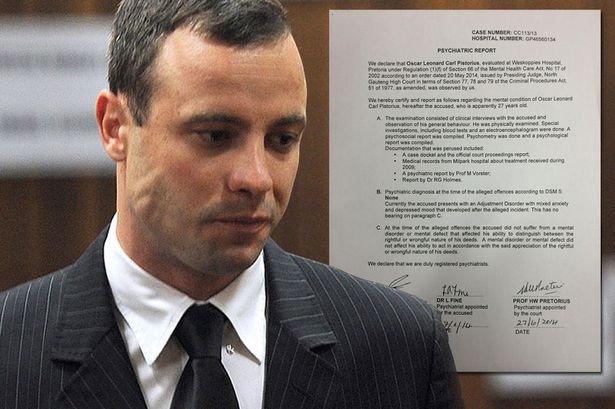
This first day back after a month break in trial begins with the results of the psychiatric evaluation. It has been determined that Oscar did not suffer from a mental defect at the time of the offense. He was able to act in accordance with an appreciation for right and wrong. It was also determined that he does not suffer from Generalized Anxiety Disorder (GAD), therefore the testimony of Dr. Vorster, in my opinion, will not be considered relevant in this trial. The evaluation did state that Oscar is believed to be suffering from Post Traumatic Stress Disorder (PTSD) and depression. The trial went on to proceed.
Dr. Versveld is the orthopedic surgeon who performed the original amputation operation on Oscar as a baby. He is still his doctor to this day.
On May 7, 2014, Oscar gave the following report detailing the current condition of his stumps to Dr. Versveld. The details are as follows:
• He can stand with his knees straight and put weight on his stump on the right side
• On the left side, he has to move the pad around to stand on it (the pad rolls with the end of the stump). If he’s not concentrating, it can click and it’s extremely painful.
• If he is able to put his left stump in the right position, he can stand on his left leg and put the right leg forward, but there is discomfort and insecurity. I have to bend the left knee to put weight on it.
• When he is standing, he can’t stand still, he has to move the stumps around.
• He can’t stand for long (1-2 minutes). Then the weight starts hurting.
• It is better on a soft surface, and worse on a hard surface.
• His balance is better in the light. In the dark, he really struggles.
• At night, if he gets out of bed, he holds on to things.
• If he is standing and is pushed, he will tend to fall over.
• If he puts sudden weight on the stump, the pad will move backwards. It clicks, and it is sore. It is sorer on the left side than the right.
• He struggles to carry something when he’s on his stumps because he struggles to balance. He needs his arms to balance.
• He falls often, mostly because of the left stump but sometimes because of the right too.
• If he clicks that stump (the left one), he falls to the floor. It’s like a shock of pain. It lasts for about 15 seconds.
• The pad goes back when the weight is off. When this happens, he grabs the stumps and squeezes it and it gets better.
• He falls about once a week or once every two weeks.
• If he gets out of bed, he can just fall down. If the bed is a different height, when I put the stump down, I can fall down.
• At night, I will go to the loo without prosthesis. But he doesn’t go in to the house without prosthesis.
• He can’t reach for things and he can’t move quickly.
• The dog can knock him over and has many times.
• He bathes rather than showers because he can’t stand long. He has a bench in the shower since he can’t stand and wish himself. He has slipped many times in the shower. If there is a small mosaic in the shower, he can’t stand on it.
• When he has no prosthesis on, he needs to bend the left knee and put the left stump down so that the outside of the stump is in contact with the floor.
• He has to bend his left leg and walk with his back bent.
• If he walks without prosthesis on a small stone or a crease in the carpet, it is painful.
• He can’t stand on pavement. Even a small inequality of stone, and he is in trouble.
• If he turns around, he shuffles.
• He has to be careful as the bone moves, as the stump could click out.
• He gets back pain when he stands on his artificial legs. If he stands for about an hour, his lower back gets sore and shortly after that, his stumps become sore.
• If he races, and has to do an interview on those prosthesis (the blades), and he’s on them for more than an hour, they feel constricted, tight, and throbbing.
• If he is standing with his prosthesis on, he has some balance if he is pushed from the side. If he is pushed from the back or the front, he doesn’t have much resistance.
And the following are Dr. Versveld’s findings:
• Stumps measured 28cm long from medial joint line in the knee to the tip of the soft tissue.
• With the patella pointing forward, the stump was rotated inward by 20 degrees on both sides. (When he walks with his prosthesis, his knees are turned out by 20 degrees on both sides.
• Above heel pad circumference on right side measured 16.5cm.
• Above heel pad circumference on left side measured 18.5cm.
• The heel pad circumference on right side measured 18.5cm and 19.5cm on left side.
• The heel pads exhibited considerable mobility on both sides.
• On the left side, it was possible to move the heel pad from the anteromedial (front inside) to the posterolateral (back outside) and this resulted in a snapping/clicking of the soft tissue which resulted in pain.
• Pressure over the distal end of the lateral side of the tibia resulted in pain on the left stump.
• There was a scar measuring 9.5cm over the back of his right calf above the heel pad posterially, and one measuring 6cm over the back of his calf on the left side posterially.
• There was anterior bowing at the right distal stump measuring 12 degrees, and on the left distal stump measuring 12 degrees.
• He walked with his left knee bent, his hip externally rotated and the stump tipped inwards (to get the weight on the outside of the stump).
• When he put weight on the left stump, the knee buckled.
• Because of the bent left knee, his left leg was shortly than the right.
• He walked with difficulty, without holding on.
• He could not walk on the industrial carpeting.
• When trying to stand without holding on, he had difficulty standing and was moving all the time.
• The biggest stride he could take, bearing weight on the left stump while holding on to something measured 23cm.
• While holding on to something, and bearing weight on his right stump, the maximum stride was 33cm.
• The left leg actually buckled when he put weight on it.
• When standing or walking, he was bending his back forwards.
• Standing on his stumps, he measured 1.56 meters tall.
• In walking standing, he measured 1.44 meters tall.
• When standing in his prosthesis and shoes, he measured 1.86 meters tall.
• He weighed 73kg when not wearing his prosthesis. (it was difficult to weight him because he could not stand still on the scale)
• He weighed 79kg wearing his prosthesis, fully clothed and in shoes.
• He had a bruise measuring 4.4cm x 3cm over the lateral aspect of his right mid-thigh.
• At this time he said that if he stands on the grout between tiles, this hurts his stumps.
Versveld shows Oscar’s x-rays to the Judge and then has him conduct a demonstration on his stumps. Both are done off camera.
Next, Roux tells Versveld that it’s common cause evidence that Oscar struck the door with the cricket bat but there are differing versions as to whether or not he was wearing his prosthetics at the time. Oscar’s version is that he had his prosthetics on. Vermeulen’s evidence was that Oscar was on his stumps at the time.
Versveld says that Oscar has a severe problem balancing on his stumps if he is holding something with both hands. He doesn’t believe that Oscar would have been able to strike anything using both hands, especially with force, otherwise he would fall down.
Versveld goes on to say that he did see some evidence of Oscar falling from time to time. There were bruises on his right mid-thigh which had been sustained a few days earlier.
Nel gets up to cross-examine. He starts by pointing out that Oscar met with Dr. Versveld in May of 2014, which was after Oscar had already testified. Versveld says he did not follow the court evidence but did see a few clips on the news. He denies having in-depth knowledge of Oscar’s version.
Nel further points out that when Oscar went to see Dr. Versveld, he was supposedly suffering from depression and PTSD (per the psychiatric findings). Oscar told Dr. Versveld about all of his physical limitations and challenges, and then Dr. Versveld made a determination based on what Oscar told him. Dr. Versveld says he did not solely rely on what he was told; he also did an examination to try to verify the details. Nel tells him that he is trying to link Oscar’s vulnerability to a dangerous situation, and Nel does not believe that he is qualified to do that as an orthopedic surgeon. Versveld says that he has produced medical, x-ray, and clinical findings and has made a deduction on Oscar’s vulnerability, which is the same deduction that the court can make. Nel agrees, the court will make its own deductions.
Nel asks Versveld very directly, “would it be possible for the accused to, instead of firing shots in the bathroom, run away?” Versfeld answers, “yes, it would be possible”. But he goes on to say, he would not run as we run. And for him to turn around is quite a process. Nel fires back that Oscar did in fact run from the bathroom back to the bedroom and yet he never fell. Versveld states that he never said he falls every time. Nel tells Versveld that Oscar never fell at all the night of the incident. In all of the back and forth running that he included in his version, Oscar never once fell. Versveld says that he is not aware of that. He did not ask Oscar what happened the night of the incident nor did Oscar tell him.
Versveld is yet another uninformed defense witness with no supposed clue about the incident, being hired by the defense in the fourth quarter of the game, after Oscar has testified and desperately needs saving.
Nel challenges him on whether or not Oscar would have been able to fire the gun with both arms stretched out, and after an objection by Roux and some interjection by the Judge, Nel is able to get Versveld to answer that with both hands stretched out he would have less of a chance to balance and would likely be affected by the recoil.
Nel then poses, what if the accused could foresee that the recoil would be a problem and deliberately stood with his back against the wall to be able to fire better? Versveld says that if Oscar is leaning against something than it would have a big beneficial value to his balance. This constitutes a conscious decision on Oscar’s behalf, an important point to make.
Nel points out to Versveld that on Oscar’s version, he was searching the room looking for Reeva with the firearm in one hand and he never fell. He was also walking around the tile on the bathroom floor, pulling on the toilet door trying to open it. And then he walked back to the bedroom and opened the curtains and the balcony doors, all still on his stumps. He was also able to move two fans that were on at the time from the door to the front of the bed while on his stumps. Versveld says that it’s possible that the tripod fan could have been used as a balancing agent as he is walking with it.
Nel goes back to the part about Oscar opening the curtains and going out on to the balcony. He reiterates that Oscar has just come from the tiled bathroom floor, and then he is walking on the carpet and next goes out on to the balcony. He wants to know if this is all possible while Oscar is on his stumps. Versveld says yes it is, which does seem quite contrary to what he was trying to imply with his report about Oscar’s disabilities earlier. Nel asks him, “so nothing in your report would say that that’s impossible to do?” Versveld answers, no.
Nel now wants to know if everything that he has recounted from Oscar’s evidence (how he moved from room to room, etc) is possible. Versveld feels it’s unacceptable to make a blanket statement like that.
Nel asks him, as the treating physician of Oscar, is he an objective witness? Versveld answers that “the evidence” that he has produced for court is objective. He did not answer that he is objective. Interesting answer.
Nel points out that everything that Oscar did, he did in the dark. Versveld says it depends on how dark it was. If it was very dark, he would have needed to hold on to things otherwise he would have been falling down. Nel informs Versveld that his answer assists the State because Oscar’s version was that it was pitch dark.
Versveld back peddles a little bit and says that it may be possible if that’s what happened, but Nel points out to him that it is only Oscar’s version, it’s not what the State believes happened so he needs to know from him if he thinks it’s possible for the accused to “walk from a pitch dark room, on your clinical findings, without falling”. Versveld says he would find it improbable and he would suggest that he would have to hold on to something along the way to do that.
Versveld goes on even further to say that it would be difficult to run in the pitch dark holding on to a weapon and he would be at high risk for falling. Nel asks him, if the lights were on and he could see, would the probability of him falling be less? Versveld says, yes.
Nel then asks Versveld why he made the statements in his report that Oscar has a severely impaired ability to ward off danger without a weapon. He answers, because this trial is about using a weapon. He tried to make his report relevant to the trial.
Nel also ponders whether items on the floor would cause an issue for the accused, especially in the dark, such as a duvet on the floor and electrical cords. Versveld agrees with him that those things would likely be a problem.
Nel wants to know if when Oscar first went to meet with the doctor in preparation for this trial report, did he arrive with a completed document? Versveld answers no, he asked him what he is like on his stumps, as well as other individual questions, to which Oscar responded. His intention was to try to establish the type of disability that he had for the benefit of the court.
Nel wraps up and Roux asks a few more questions. He is taking the doctor through Oscar’s motions that night and is trying to point out that with the assistance of his hands holding on to things, he would not necessarily have fallen on some of the items that were in the room.
One thing that I found interesting was Roux asking Versveld if Oscar stepped on the duvet and the duvet was right next to the bed (where he could hold on), would he have definitely fallen. When Oscar was on the stand, he of course testified pretty adamantly that the duvet was always on the bed and the police were the ones to put it on the floor. As the cross-examination with Nel progressed, he then moved to a position of “I can’t remember” where the duvet was. Now Roux is asking Versveld about whether or not Oscar would have fallen if the duvet was on the floor. It looks like they have come full circle with that piece of evidence. They must be banking on My Lady having a pretty poor memory. Versveld answers that he may have fallen but he can’t say that he would have fallen as a fact.
Versveld is excused.
Roux brings up a few unresolved matters to address.
He first discusses the missing electrical cord from the bedroom.
The first image of it was taken on February 14 at 5:58am, during the initial crime scene investigation and it can clearly be seen in the photo. And then another image was taken of that same area of the bedroom on February 15 at 6:34pm, but the extension cord is now absent from the photo. Roux is making the argument that if the house was sealed by police at that time, where is that cord? Mike Van Aardt’s response was that they do not have the cord. The Defense wants to show the court that the cord is 5 meters long and they need the cord in order to do that.
Nel explains to the Judge that the Defense cannot order that the State produce an item that was not seized as evidence. And he is correct about that. The Judge inquires whether or not there was an inventory list and Nel answers yes, but again states that the cord was not seized evidence therefore it would not be on the list.
Nel states that yes it is common cause that the cord was in the house on February 14. The Defense is indicating that per their photograph, the cord is no longer in the same position as it was on the 14th. That is the most that anybody can say. As to where it was that day, whether it was somewhere else in the house, nobody can say. And adding my own thoughts here, the Defense took possession of the house 3 days later and had access to it for the remainder of the year. That cord could have simply been placed in another location inside the house while they were investigating and has since been removed considering his house has been sold. This is a ridiculous argument by the Defense but unfortunately the Judge seemed concerned about it.
Nel tells the Judge that when the police were done with their investigation, the key was handed over to Mr. Stander and Mr. Stander handed it over to the Defense team. There was not an inventory made of every single item left in the house. How could there be? That would be ridiculous and just doesn’t happen in any investigation. Hopefully when the Judge thinks more about this she will realize that Nel is quite correct in his argument and Roux is yet again just grasping at straws.
Roux continues his housekeeping and hands in the security guard track report from the evening/morning of February 13/14.
The next witness up is Ivan Lin. He is an electrical engineer and has practiced as an acoustic engineer since 1992.
They read from his report and address a number of questions that were posed to him. The primary focus being whether or not one can reliably differentiate between a male and female scream, and discern emotion, from about 80-177 meters away.
Lin talks about how the act of listening is different from person to person, and factors such as culture, language, etc can have relevance on how you interpret the noises. In other words, two people can hear the same noise from a distance and have different views about it. Nothing earth-shattering here that we don’t already know.
Then they address if it’s correct to assume that all male and all female screams sound the same. He states that although typically one can tell if a sound is male or female, one cannot reliably say with certainty if it was a male or female.
They also investigate the scientific possibilities of sounds traveling through a closed window and a closed door in the toilet cubicle, sound traveling out of the open bathroom window and sound traveling out of the open balcony door, and he reads off all of the respective numerical findings.
Nel states that yet again the State has received the witness’ report that same day before he took the stand so they have not yet had time to read it. They break for the day and will cross-examine tomorrow.
 Juror13