Oscar Trial – Day 25, May 5 JOHAN AND CARICE STANDER

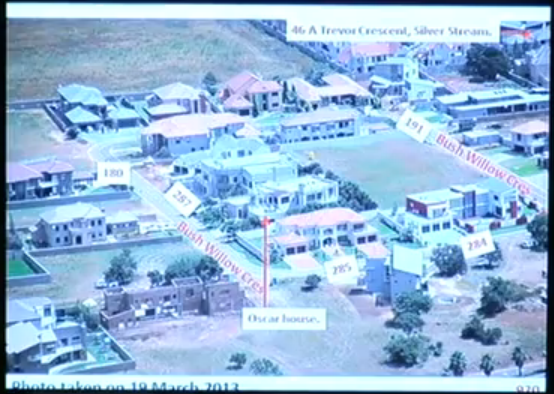
OP neighborhood

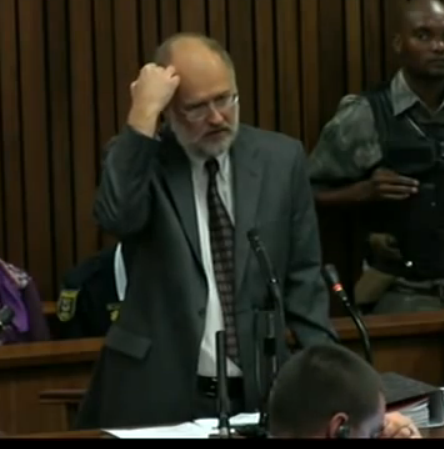
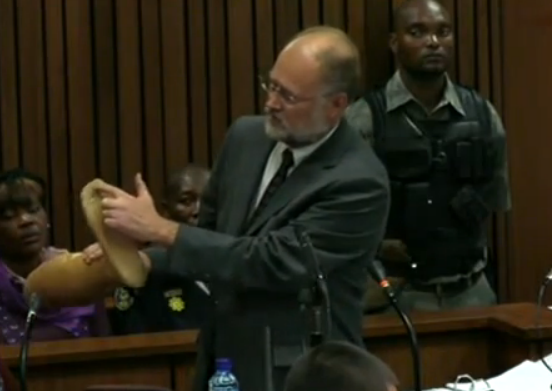
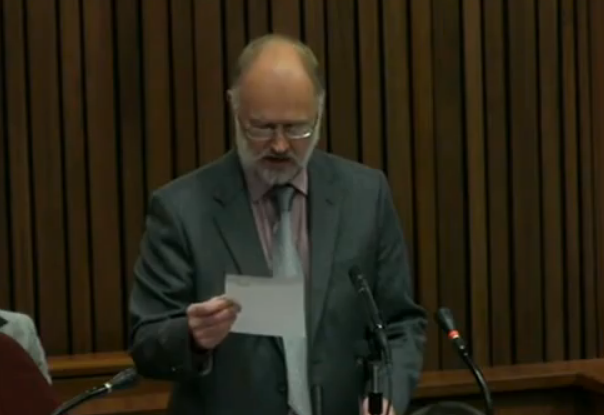
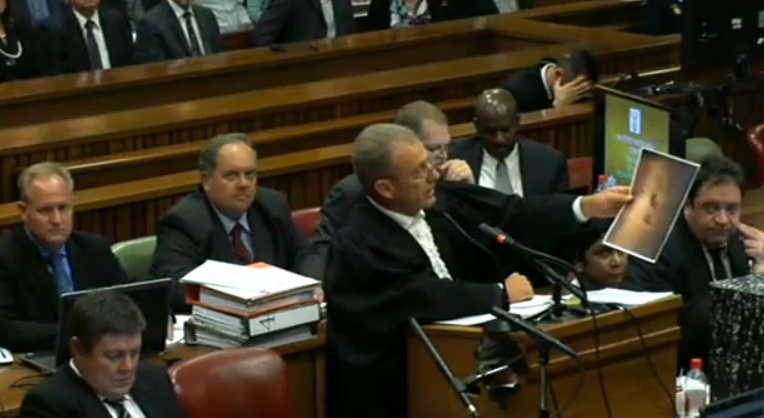
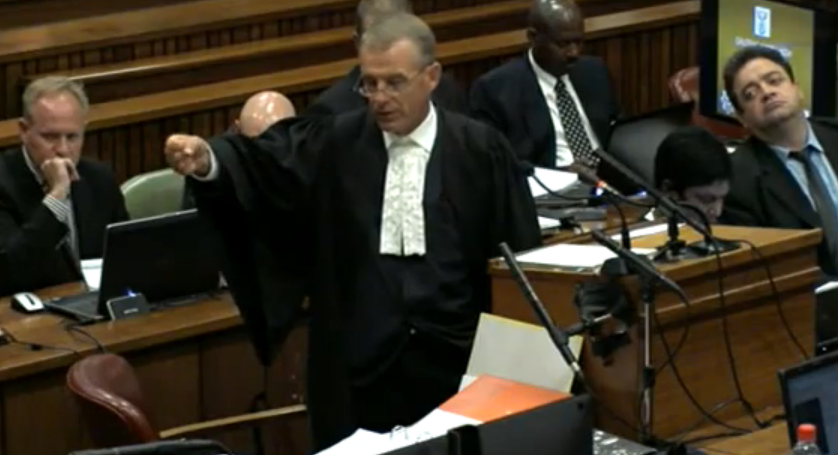
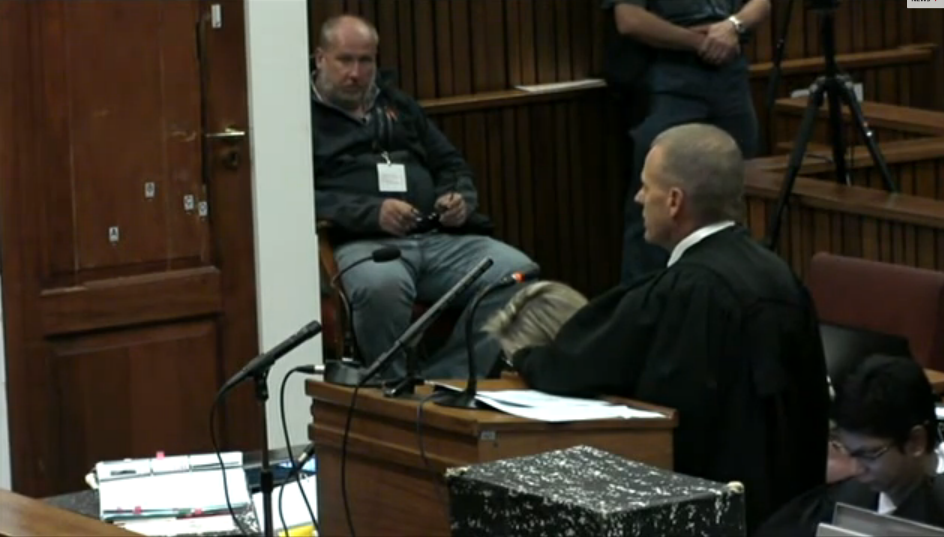
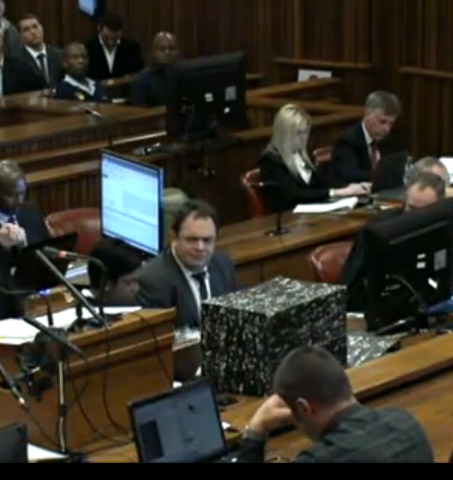
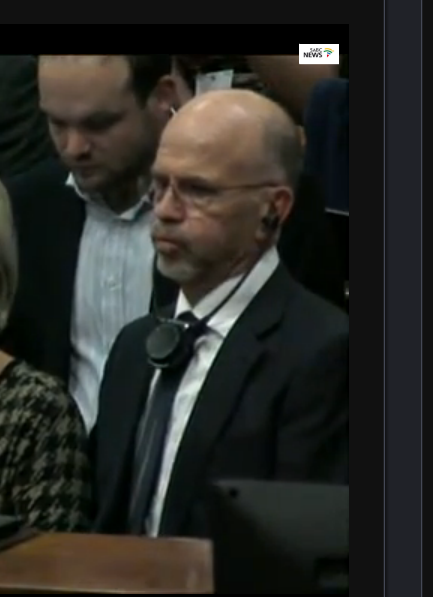
Court resumes after a two week break and Johan Stander is first up on the stand. He is examined by Oldwage for the Defense.

Mr. Stander’s address in the Silverwoods Estates is 212 Summerbrooke. He has lived there since May 2009, and has known Oscar since that time.

His stated that his home is about 350-400 meters away from Oscar’s, however in later testimony it was determined that it is actually 212 meters away. It’s only a one minute drive by car.

Mr. Stander testifies that after the incident, he was approached by SAPS to give a statement. Hilton Botha went to his house on Feb 15, and took his information. Stander wrote the statement on his own without counsel. He was requested to furnish an additional statement by Capt Van Aardt. For this second statement, he did have counsel with him which was arranged by his daughter, Carice, who is also a lawyer.

Oldwage asks if there were any additional meetings with the State after he gave his formal statements. Mr. Stander testifies that both he and his daughter did meet with the State at his house in December of 2013. He did regard himself as a State witness as he had been informed that he was going to be called by them. Oldwage asks him if he knows why the State did not call him. He answers that there was a second consultation arranged with both he and his daughter in January 2014, and at that time one of the advocates who arrived prior to the State indicated that Nel had decided not to call him. He believes her name was Ms. Johnson. He goes on to say that she told them that the State had decided to only call one person per family; therefore he took that to mean that they would be calling Carice.

Mr. Stander states that around 3am on February 14, he was home asleep in bed. Oldwage wants to know if Stander had ever been in Oscar’s home. He says yes, he had been there before to look after his dogs when Oscar traveled overseas.

At about 3:19am on February 14, Mr. Stander received a call from Oscar. He said to him, “Johan, please, please, please come to my house. I shot Reeva. I thought she was an intruder. Please, please come quickly.”

He got up, and his wife woke up as well. As he was walking out of his room, Carice was walking out of her room and she said that she just heard somebody scream. His wife then told Carice that her father had just received a call from Oscar saying that he shot Reeva.

Both Johan and Carice decided to go to Oscar’s house as quickly as possible. Carice was driving. She parked the car in the street and they rushed to the front door; Carice walking in front. The door was slightly open and there was a light on. Carice pushed the door open and they saw Oscar coming down the stairs with Reeva in his arms.

Mr. Stander could see that she had a head wound. When Oscar saw them, there was relief on his face. When he reached the bottom of the stairs, Carice asked him to put Reeva down. Oscar was really crying; he was in pain. He asked them to please assist him; put Reeva in a car and take her to the hospital. Mr. Stander starts crying during his testimony.

My opinion is that Oscar could not get Reeva out of his house fast enough. He shot her. He knew that he just put 4 bullets in to her. He saw her lifeless body in the bathroom. Not to be overly blunt, but she had brain matter in her hair. She was not going to live and the only thing he needed to do was distance himself from this situation as quickly as possible.
He rushed to get her out of the toilet room and down the stairs, claiming that Netcare told him to bring her to the hospital himself. Have you ever heard of any ambulance company suggesting that you transport a bullet-ridden person to the hospital on your own? Really think about that for a moment. He needed to get her away from that highly incriminating bathroom and on the way to the hospital as quickly as possible, even though it was futile.

I believe that Oscar wanting the Standers to get her in a car and over to the hospital was nothing more than him getting her out of the house so he could make the scene look better than it did! After watching Oscar on the stand for over a week, I have no doubt in my mind that Oscar has the ability to cry quite fiercely for himself when cornered and in a panic. Any desperation that he showed that night was for him to get out of the situation. I don’t blame the Standers for having deep sympathy for their friend. He was after all… their friend.

Once Mr. Stander collects himself, he goes on to say that they tried to calm Oscar down. He describes Oscar as being “broken… screaming… crying… praying.” He told Oscar that he would go outside and call an ambulance.

While he was out trying to call the ambulance, Dr. Stipp arrived and introduced himself as Johan and stated that he was a medical doctor. Mr. Stander says HE asked Dr. Stipp to go inside and see if he could assist. He also asked Stipp for the number to an ambulance because he couldn’t get a hold of them. Stipp gave him the number 082911. As Dr. Stipp was walking to go in the house, he turned around and said to Mr. Stander “I’m actually a Radiologist” and then carried on walking.

Stander then phoned 082911. He managed to get through. While he was still speaking on the phone, Stipp came back out. Stander states that he said to Stipp he was having a hard time explaining to the people on the phone where to come. How is that possible? He has lived in the estate since 2009. I find it odd that he had difficulty explaining how to get to the estate.

So Stipp then took the phone and spoke to them. My thought here… the ambulance people wanted to know the extent of the injuries, no directions, and that is why he gave the phone to Stipp.

When Stipp testified, he said that Stander handed him the phone and he explained in detail the extent of the injuries. As you will see in my notes a little further down, Stander claims to have no knowledge of the extent of Reeva’s injuries. That is also very odd to me. For somebody who is a friend of Oscar’s, who was the very first person he called, how can he be so oblivious to the extent of her injuries? He was standing outside with Stipp when he was on the call. I think he is trying to dodge having to discuss what exactly Oscar did to Reeva.

The ambulance arrived shortly after that and declared Reeva dead. Stipp was standing outside with Stander at this point. He asked Stipp what he had heard, because Stipp had previously mentioned his house was behind Oscar’s, and Stipp said he heard 4 shots, silence, screams, and 4 shots again. Then Stipp mentioned that he couldn’t do anything more, so he was going to leave. Stander asked Stipp for his telephone number to give to the police in case they asked for it.

Just before he left, Stipp said to Stander that he saw Oscar going up the stairs. Stander saw this as well; he walked inside and asked Carice where Oscar is going. Carice jumped up, went up the stairs and was calling Oscar’s name. Stander then says that he had gone upstairs because the ambulance people were asking for ID for the lady.

Shortly after that, people started coming. A man introduced himself as Col. Van Rensburg. He asked what happened and took over the scene. This was right around 4am. Just before this, Stander had called Oscar’s brother (Carl) and informed him of the “accident”. He did not call the police. He then all of sudden seems to remember that security guards were there too (It was not lost on me that he failed to mention Baba or the other guards already being outside Oscar’s home WHEN THEY FIRST ARRIVED.) Stander says he asked the security guard to radio the gate and urgently get the police.

There were a number of vehicles there now. Some in uniform, some in civilian clothes. He could see people moving up and down the stairs. Then the police took over. For the rest of the day, Stander was only outside.

Oldwage asks Stander if he knows approximately what time Dr. Stipp arrived at Oscar’s house. Stander says he made the call to Netcare around 3:27pm, so he must have arrived just before that.

He also asked about the call made to 082911, he wants to know which phone was used to make the call. Stander testifies that it was his phone. The call was about five minutes long.
During the period that he was at Oscar’s home, Oldwage wants to know if he was able to observe Oscar. Stander says yes. First when he initially came down the stairs with Reeva, he spent some time with him in the house. Also, just outside the door on the pavement area. At certain times, he (Stander) went back inside. At one point, he saw Oscar in the kitchen.

He goes on to say it’s not something that he’d like to experience again. He again describes Oscar’s expressions of pain and sorrow. He was crying, praying and asking God to help him. Broken, desperate, pleading.

All throughout Stander’s testimony, Oscar never once looked at him. He mostly kept his head down or looked straight forward.

OP3

OP2

Stander then describes how Oscar put his finger in Reeva’s mouth to try to help her breath. Stander says “he saw the truth that morning. I saw it, and I feel it.”

No offense to Mr. Stander, but I believe that Oscar was legitimately very distraught by the SITUATION, not by the loss of Reeva. I believe that Stander believes Oscar. I believe that he saw Oscar at a very desperate time and he witnessed some very raw emotion. I do not fault Mr. Stander for believing him. He is Oscar’s friend and is biased.

Oldwage wants to know if Stander can recall approximately how long Oscar was upstairs, when he and Stipp observed him going up there.

Stander testifies that it’s difficult for him to say in seconds or minutes. When he approached his daughter and asked her where Oscar was going, she said to him that he was going upstairs to get an ID. But then he said she jumped up and went up the stairs to call for him. Oscar immediately came down after that. So he estimates it couldn’t have been longer than 30 or 40 seconds.

Oldwage asks if he knows what time the police arrived that night. Stander says that he phoned Carl at 3:59am. The police had arrived around that same time but he doesn’t know the exact time. He just remembers a man introducing himself as Colonel Van Rensburg.

Oldwage wants to know what Stander and Stipp discussed outside. Stander says that Stipp only told him that he had heard four shots, silence, screams then four more shots. Then Stander asked him his telephone number. After that, Stander went back inside when he saw Oscar going up the stairs and Stipp left.

Stander says he is sure that Stipp told him he heard 4 shots first, and then another 4 shots after. He remembers this clearly because when he was later discussing this incident with Carice he made the comment to her that he was concerned because you cannot shoot 8 shots at a person, even if he’s an intruder. I wonder if he considers 4 shots to be more acceptable.

Oldwage asks him if he remembers how long it took him to arrive at the scene that night after he received the call from Oscar. He believes it was approximately 3 minutes.

Stander then testifies about Oscar’s two dogs. He has interacted with them in the past and they are pleasant, kind-mannered and playful. He is testifying about this to explain away why they would not be barking that night when the “phantom intruder” was breaking in through the window. Oscar would not necessarily be tipped off to an intruder by these dogs since they are mild-mannered.

Stander says he was previously a member of the management committee at Silverwoods Estates but resigned in January 2013.

Oldwage wants to know if he knows of any incidents of crime that took place within Silverwoods. He testifies that there were three incidents. One was an incident where the intruders came over the fence and tied a woman up. Also, another incident where somebody came through the fence and used a ladder to get up in to the house. The third incident was theft, but the owner did not want to report it to police. It was electronic equipment that was taken.

Nel objects to this hearsay evidence for the record. The evidence was not presented as fact, only as what the witness has heard.

Oldwage says that Stander gained knowledge of these incidents via his management position within the estate.

Nel states again, he understands that, but it is still technically hearsay because these are incidents that Stander is aware of (he did not directly witness them, and is therefore relying on somebody else’s accounting of them). They are not police reports, just hearsay reports.

Stander says that when Oscar would come back in to town, they would get together for coffee and discuss what had happened in the community while he was gone. So he had discussed these incidents with him.

Oldwage asks Stander if he knew Reeva and he answers yes. He also asks if Reeva, at any stage, resided at Oscar’s house without the company of Oscar. He says yes, he met Reeva for the first time in December 2012. Oscar and Reeva were at Stander’s house at the time and Oscar was just about to leave for a trip to Cape Town. He asked Stander to look after his pets while he was gone but Reeva instead offered to look after them and she ended up staying at the house that week. She was there until December 31 (he accidently said Jan 31, but it was really Dec 31.) She dropped off Oscar’s keys with Stander before leaving.
They then look at a few more maps of the neighborhood. Stander points out the view to Oscar’s house from his top balcony.

Oscar’s bathroom windows can be seen just to the right of the middle palm tree in this photo.

view from Carise bedroom balcony

They also look at the route that he drove that morning to get to Oscar’s house. See the red line below. Stander’s house is at the beginning of the red line on the upper left of the photo, and Oscar’s house is the end of the red line in the middle of the photo.

red route from Stander to OP

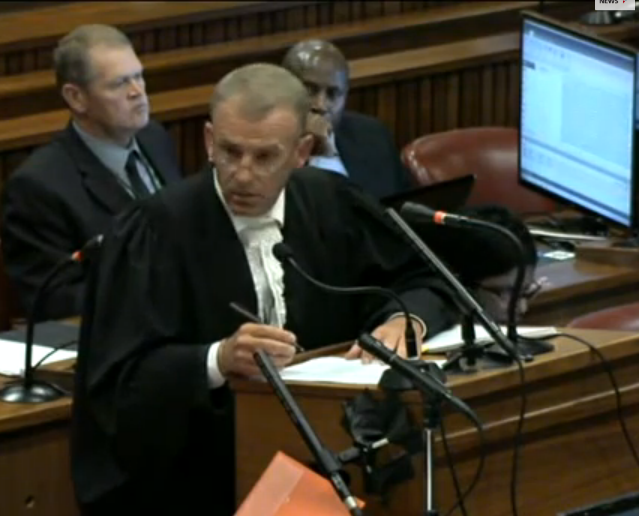
Oldwage rests and Nel is up for cross-examination.

Nel asks Stander if while he was on the management committee at Silverwoods, security measures were increased. Specifically, was the height of the walls increased? He says no, they were not. They add some additional strands and rings to the top of the gates. They also added in some additional beams. This was done in either 2011 or 2012.

Nel asks when the lady in the estate was tied up. Stander says he can’t recall the exact dates but around 2011 or 2012. Nel asks if there was a police report saying it was 2009, is that possible? He says yes, that’s possible.

As for the ladder incident, Nel wants to know where that happened. Stander says at the house of Mr. Christo Menelaou. Nel states, he and Oscar are good friends. Stander says he’s not aware of their friendship. Nel asks when this happened. Stander says he thinks 2010 or 2011. Nel wants to know if this was reported to the police. Stander says he can’t recall.

Nel then asks him, in January 2013; wouldn’t you agree that Silverwoods Estates was a safe place to live? Stander says it was safe but you cannot always be sure that you’re staying in a 100% safe place. Nel points out that Stander does not have burglar bars on his home. Stander says its estate policy that you can’t just install them. They would have to be built in to the frame of the house.

Nel then says, he’s not inviting hearsay in to this questioning but for this one instance he is. Nel goes on to say that Carice went to sleep that night with her balcony doors open. She only closed the doors in the early morning hours. Stander says, that’s correct.
Nel then confirms with Stander that he did not hear any shots or screams from anybody that morning.

Nel asks Stander if he is 100% certain of the contents of the phone conversation with Oscar on the morning of February 14. He says yes, he is. Nel asks him to repeat it. Stander says, “Johan, please, please, please come to my house. I shot Reeva, I thought she was an intruder. Please, please, please come quick.”

This is very important because it goes to intent, which is required for the Murder charge. There is really no mistaking from this statement that Oscar intended to shoot somebody. Oscar says very directly to Stander that he shot and that he thought the person was an intruder.

Nel asks, when you saw Oscar at the house that morning, did he talk to you? Stander says no, with the exception of when he was being taken away by police (around 8am), he walked over to Stander and hugged him and said “thank you very much.” But there was no conversation with him on the scene that night. His daughter did however talk to him.

Stander says he introduced Col Van Rensburg to Oscar upon Van Rensburg’s arrival but Oscar didn’t really say anything. He just shook his head and said yes. Not sure what he said yes to, maybe just acknowledging who he was.

Nel then says to Stander that he regarded Oscar as a friend. Stander seemed to try to downplay this and just says yea, we knew each other, he came to my house from time to time. Nel then goes on to say that Oscar even viewed him as a mentor. Again, Stander says Oscar would come over for coffee on occasion when he was in town. Oscar would ask for his advice regarding wanting to assist some of his team members and Stander would let him know what he thought. But never did he ask him over for dinner, nor did they go out to get a drink. It was not a relationship like that.

Nel asks if he ever saw him armed. Stander says no. Nel asks, when he came to your home did he ever have his gun with him? And Stander again says no. Nel asks if he ever saw Oscar with a gun at his own home. Stander says he was only in Oscar’s house once.

Nel asks Stander if he has had any discussion with Oscar since the incident. Stander says, “no, not about the incident.” He saw him at the private memorial for Reeva that was hosted by Oscar’s uncle Arnold. Both he and his daughter attended. But they did not discuss the incident.

So Nel wants to confirm the following – they spoke on the phone the morning of Feb 14th when Oscar called him for help, they spoke that morning briefly at the scene (and hugged) when the police took him away, and he saw him at the private memorial for Reeva at Oscar’s uncle’s house but they never discussed the incident (they only had friendly discussion about coffee while there.) He asks if this is correct. Stander gives a long pause and then answers yes.

So Stander is testifying that he NEVER discussed the incident with Oscar.

When the State rested their case, and it was apparent that the Standers were not going to be called by them, the Defense called them and set up a meeting. Oscar was there in chambers for that meeting, but again Stander states that he did not discuss anything directly with Oscar.

Nel then asks him about his comment to Carice about the 8 shots. Stander again summarizes what Dr. Stipp told him he heard that morning. He confirms that he made that comment to Carice that the 8 shots was problematic. So Nel asks him if he ever discussed 4 shots with Oscar. Stander says no, he did not.

Nel then asks him, did he ever tell you that this was an accident?
Stander says that when Oscar phoned him he said, “I made a mistake.”

Nel tells him no, you cannot say that. Nel reminds him that when they started he asked him if he remembered the conversation 100%, and Stander said yes, then he repeated the conversation. That conversation did not include the words “I made a mistake.” Nel wants to know why he wants to add things on now.

Stander says it was a mistake by him to say that. Nel wants to know why he would make this mistake. Stander is trying to say now that it was his inference that Oscar made a mistake. Nel really rakes him over the coals about this and points out that Stander did not present it as an inference, he was stating it as if Oscar said it.

Nel asks him why he would make a mistake like that, “do you want to assist Mr. Pistorius with his defense?” Stander says no, he is there to tell the truth.

Stander goes on to say that his inference of the phone call that morning was Oscar saying to Stander that he made a mistake. Nel asks him what Oscar’s mistake was. Was it that he wanted to shoot the intruder, but shot Reeva instead? Stander says he didn’t want to shoot the intruder. Nel keeps going around and around with him and finally Stander says the mistake was that he shot. Nel says no, and almost laughs here.

Nel tells him that nobody would make the inference that “the shots” were a mistake when they hear the statement “I shot Reeva, I thought she was an intruder.” Again, Oscar is trying to weasel his way out of his INTENTIONAL act. And clearly Stander subscribes to his cause, trying to say that the gunshots themselves were a mistake. That’s not what Oscar said to him that morning and he knows it.

Nel moves on to when Stander saw Oscar walking down the stairs with Reeva, and the comment that he made about Oscar looking relieved when he saw them. Nel points out there must have been enough light for him to see the expression on his face. Stander says that’s correct, there were lights on.

Nel asks Stander if he saw Oscar make a phone call that night. He says no. Nel also asks if he has knowledge of his daughter making a call from Oscar’s phone. He says, yes, she called Mr. Devaris. Nel asks him if he is aware where the phone came from. Stander says it was on the counter, closest to the outside wall of the kitchen. He believes that it was on a charger. He made notice of this phone when Oscar was in the kitchen, bending over “trying” to vomit. He was trying, but nothing was coming out.

Nel wants to put this in a timeframe. He establishes the following:

1. When the Standers arrived that night, they were the first two people in the house.
2. Johan Stipp arrived next.
3. Then after him, the paramedics arrived.
4. Then the police came last.

Nel asks, during the time that Dr. Stipp was there, where was Oscar? Stander can’t say for sure because he was outside.

Stander next saw Oscar when Stipp pointed out to him that he was going up the stairs. This is when Stander went back inside. Nel asks if this is when he saw the phone. Stander says no. Nel asks him, at what point did you see it?

Stander says he saw the phone the period just before the police arrived which was close to 4am. (This is after the paramedics announced that Reeva was dead and Oscar had gone upstairs to get her bag.) Stander says the phone was in the kitchen, fixed to a charger.

It seems pretty darn obvious to me that Oscar got his phone when he went upstairs, along with Reeva’s bag.

Stander believes that Carice made calls from that phone, but he’s not sure.

Nel establishes that Stander did not know Stipp prior to this incident. When they were outside talking after Stipp examined Reeva, Nel wants to know what they discussed. Did they discuss the injuries? Stander says no, Stipp just told him that she had a fatal head wound but he did not discuss any of the other injuries with him.

Nel asks him if Oscar or anybody else told him how many wounds she sustained. Stander says no. Nel then asks, “not even your daughter?” Stander pauses, then answers, “I can’t recall.”

That is highly odd to me that after seeing what he just saw, and knowing that his friend caused it, he didn’t ask any questions. Plus it’s not consistent with what Stipp testified. But even more odd than that is him saying he didn’t discuss it with his daughter. How in the world can they witness something like that and not discuss it?
Carice was inside with Oscar the whole time, helping him try to stem the bleeding on Reeva’s wounds. Surely she would have talked with her Dad about the incident in detail.

Nel asks him if he has followed the trial while it’s been on. Stander says yes, he reads the newspaper every day. He also watched some of it on TV in the evenings. But he has not followed everything that has been said.

Nel asks Stander if he ever went back to the scene to assist the Defense while they were doing their investigation. He says no. But initially he had the key to the house. There was an arrangement made after the incident that Col Van Rensburg would keep the key but when they finished at the house, they would turn it over to Stander, which they did. He then handed it over to the Pistorius family. Nel asks if he has ever been back in the house since February 14, and Stander says no.

Nel asks, when you spoke to Dr. Stipp, were you convinced that he had heard gunshots (both the first set and the second set of noises)? Stander says yes. Nel asks him if he ever asked Dr. Stipp about the screaming that he heard. Stander says no, they didn’t discuss it. All they ever discussed was what Dr. Stipp initially heard and that was all.

The only other thing that Stander asked Stipp that night was for his cell phone number. Stander says he did this in case the police needed it.

Nel then asks him about his call to Stipp later that night after he left the scene (the one that Stipp got around 4:30am). He wants to know why he made that call. Remember, per Stipp’s testimony, during this call he was informed that the Defense lawyer would be contacting him. Stander says he believed it was the right thing to do to inform Stipp that he had passed along his number.

Interestingly enough, he did not give Stipp’s number to the police; he gave it directly to advocate Oldwage. Within one hour of Reeva’s violent death, prior to Reeva’s mom even knowing she was dead, Mr. Stander was providing details and phone numbers to Oscar’s defense lawyer. Any question about whose side the Standers are on?

Nel asks Stander if he knows whether or not Oscar’s house was fitted with an alarm system. He says, yes it was. When he was taking care of Oscar’s dogs, he needed the remote control to activate and deactivate the alarm system. So Oscar would give the remote to him.

Nel then asks Stander how long Reeva stayed at Oscar’s house in December 2012. He says she was there for about a week and gave him the key when she left. Nel asks, you had no concerns about her staying there alone? Stander says no, they communicated by SMS messages when necessary.

Nel rests. Oldwage is back up for a few issues.

Oldwage asks Stander if he knows for sure who the cell phone belonged to that was seen in the kitchen. Stander says he does not know for sure.

Then Oldwage asks Stander about the testimony he just gave to Nel about being the first on the scene, along with his daughter, that morning. Oldwage wants him to really think back to the scene and see if he can remember anybody else being there (hmm, borderline leading here?)

Stander says he remembers a security guard being there. Finally he mentions Baba! Remember… Baba testified that he was there in the driveway when the Standers pulled up and they followed the Standers up to the front door. I was wondering when he was going to get around to mentioning him.

He then says there was another person there named Frank, a worker who was staying at Oscar’s house. This is the first we are hearing about Frank during trial too! Frank is Oscar’s helper around the house and he lives on the property. I have read online that originally Frank did have a statement for the police, but he later retracted and stated that he heard and saw “nothing.” This is unconfirmed, just something that I have read online, but still an interesting tidbit if true.

Oldwage then asks Stander if he made an interpretation about the call he had with Oscar that morning. And he says, he interpreted the conversation to mean that Oscar had made a mistake. He also confirms that he’s never discussed this interpretation with the investigators before prior to court. Oldwage is trying to point out that Stander simply made a “mistake” on the stand by sharing his interpretation as something that Oscar had said.

Oldwage rests.

The female assessor has a question for Stander. She wants to know if Reeva had the alarm remote when she stayed at Oscar’s house in December 2012. He answers yes, she had the alarm remote. She knows how to activate and deactivate the alarm and she turned it back in to Stander when she dropped off the house key. The assessor also wanted to know if the remote made a beeping sound when arming/disarming it. Stander says the beeping sound can be heard inside, you don’t hear it from the actual remote. I’m guessing he means that you hear the beep from the panel on the wall inside. He had his own disabled at home, which can be done from the menu. He can’t recall if he ever heard that beeping sound when he was at Oscar’s house.

No further questions and Mr. Stander is excused.

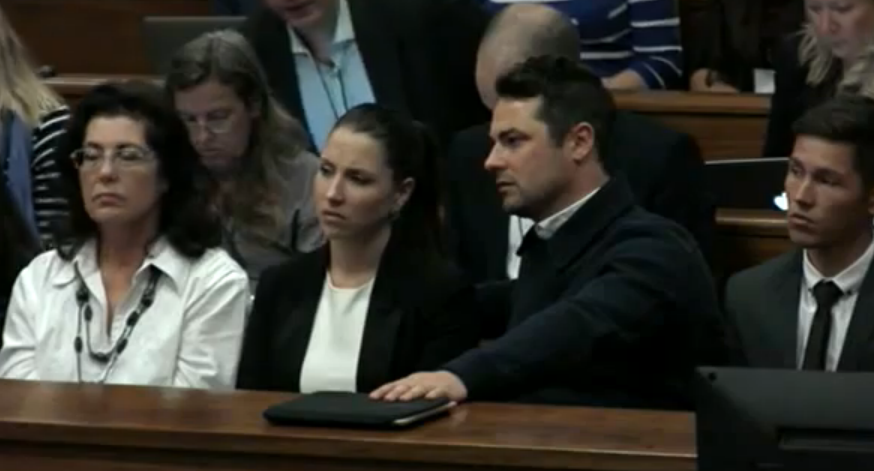
The next witness up is Carice Stander. Her new married name is Viljoen. I will just refer to her as Carice.

Carice

Carice no longer lives in Silverwoods, but during the time of the incident in 2013, she was living there with her parents (Johan Stander is her father.) She is a lawyer advisor for a vocational recreation service.

Carice considers Oscar to be a friend. She met him when they first moved in to the estates in 2009 and they would have coffee together at her house, and she would visit his house on occasion too.

On the morning of the incident, she did make a statement to the police. It was a blonde police officer at the scene; she does not know her name. She was later asked to give a supplementary affidavit by Capt Van Aardt. They did this statement in the presence of their advocate.

A picture of the balcony at the Stander’s house is shown again and Carice identifies it as the balcony outside of her bedroom. (The same balcony seen above.)

In order to gain access to the balcony, she can go through the sliding door in her bedroom.

On February 13, 2013, Carice says she went to bed around 8:30pm-9pm. She was sleeping and was awakened by her dogs barking. The dogs sleep in her bedroom. She also heard other dogs barking in the neighborhood. It was a hot night so she was sleeping with the balcony door open. She didn’t want her dog to run out on the balcony while barking, so she decided to get up to close the slider.

As she was getting out of bed, she heard a person shouting “help, help, help.” She froze in her bed for a moment and realized that something was wrong. Then she got up, went to the blinds and closed them. She stood by the door to see if she could figure out where the noises were coming from. She closed the door and latched it, closed the blinds and got in to bed. Her heart was pounding fast. Her dogs were still restless.

She was lying in bed trying to settle down and was thinking about the man’s voice yelling for help. She thought there must be terrible trouble. And she was wondering “where is the lady?”

I’m not sure why she would immediately assume a woman would be involved too? That comment felt very well placed to me.

From Carice’s room, she can see her parent’s room and she saw their lights and heard commotion.

She then got up and walked to her parent’s room. She told her Mom that she heard somebody shout for help and somebody is in trouble. Her Mom then told her that they just received a call from Oscar. He told her Dad that he shot Reeva, he thought she was an intruder.

Carice and her Dad immediately went to help. Carice pulled her car (a silver mini) out of the garage and waited for her Dad in the street. Her Dad came running out and they rushed to Oscar’s house. She confirmed that they took the red route shown on the map above, which her Dad testified to as well.

She parked her car in the road with her hazards on and she and her Dad jumped out of the car. When they arrived, there were some people in the road and she remembers asking them what was going on. There was confusion. One was a security guard and the other was Frank, a man that worked at Oscar’s house.

Roux asks Carice approximately how long it took from the time her Mom told her about the phone call to the time they arrived at the scene. She believes it was about 3 minutes or so.

He also wants to know how long the time frame was in between when she heard the “help, help, help” shouts and when she spoke to her Mom. She guesses about 5 minutes.

She proceeds with telling the story. She reiterates that she asked the men in the street (Baba and Frank) what was going on and they said they didn’t know.

Baba stated in his testimony that the Standers just ran past them and did not say anything to them which I tend to believe. Why would she need to stop and ask the men anything if Oscar just told her Dad on the phone that he shot Reeva. They knew what was going on.

Carice and her Dad then rushed to the house, she was walking in front. The door was very slightly open and when she touched it, it opened. As the door opened, the first thing she saw was Oscar carrying Reeva down the stairs. He was at the middle landing area. She could see that he was walking rather fast. Oscar kept saying to her “Carice please, Carice please, can we just put her in the car and get her to the hospital.”

I’m telling you… my gut instinct here is very strong that he wanted Reeva out of that house because he did not want the police there. He wanted to buy himself as much time as possible and the only way to do that now is to get Reeva out.

Carice said to him, no just put her down so we can see what is wrong. Carice gets very upset on the stand and starts crying. She says that Oscar was begging her to get Reeva in to the car. He said “just take my car, put her in the car.” She said no, just put her down. So he placed her on the ground. Carice saw blood everywhere. At that moment, her Dad stepped outside to call the ambulance.

Carice was kneeling on one side of Reeva and Oscar was kneeling on the other. He still continued to beg Carice to take her to the hospital. Carice told him to just wait for the ambulance and let’s see what we can do, we need to stop the bleeding. So Carice proceeded up the stairs where the linen closet is located and she grabbed some towels. Carice says that she remembers it was rather dark. This is in contradiction to what her father testified. He said the lights were on. Also remember, he could clearly see the expressions on Oscar’s face when he was coming down the stairs.

Carice came back down and Oscar was praying to God the whole time. He was begging Reeva to stay with him. They then tried to stop the bleeding. Carice also asked him for tape and bags because she wanted to tie off Reeva’s arm wound. She said that didn’t work so they proceeded to use a towel. They tried to tie that around the arm and it was difficult. They lifted up the elastic of her shorts and put a towel on her hip wound. Oscar was holding pressure there. Most of the time he had his finger in her mouth as well, trying to help her breath. When Carice asked Oscar to fetch the bags and tape, he asked her to keep her finger in Reeva’s mouth while he went to get those items.

Carice got up to ask her Dad where the ambulance was because Oscar was frantic, and at that time she saw Dr. Stipp. Carice told Oscar that there was a doctor there and she states that they were both relieved. Stipp walked in and Carice went back outside with her Dad who was still calling the ambulance. So at this point, just Stipp and Oscar were inside with Reeva.

After examining Reeva, Stipp came back out and Carice went back inside. They passed each other at the doorway. She said he wasn’t in there very long. Carice says that he just said something like “it’s very bad.” When Carice went back in, Oscar was with Reeva.

Roux asks her if she had any discussions with Oscar. She says that while they were trying to stop the bleeding, she asked “Oscar, what happened.” He looked at her and said “I thought she was an intruder.” She didn’t ask anything else. They just continued trying to save Reeva’s life at that stage.

This makes no sense to me because Reeva was clearly dead at this point according to Stipp. Mr. Stander testified that when Stipp came outside, he told him it was a fatal head wound but also said that Stipp didn’t talk about the other injuries, nor did Stander ask. Now Carice is saying that Stipp only told her “it’s very bad.” Why are the Standers being so vague about Reeva’s injuries and the fact that she was dead?

At some point, the ambulance arrived and the paramedics came in. Carice said to Oscar, let’s step aside so they can work on her. They went in to the kitchen area. Carice did notice one of the neighbors peering in to the house. She believes it was Mike (Nghlengthwa). The paramedics were there and there was a lot of commotion and Mike was peering around the door. She looked at him and either gestured or said (I couldn’t tell which) to not come in. She didn’t want anybody else coming in. Roux asks her if Mike did anything else and she says this was all she could remember about him.

While the paramedics were working on Reeva, Oscar and Carice were in the kitchen. Oscar was asking the paramedics to do whatever they could to save her life. She says that the paramedics then came in to the kitchen to see if Oscar was ok and if they could phone anybody for him. Carice says they must have left after that.

For some strange reason, Carice still has not acknowledged in her testimony that Reeva was dead at this point. It just struck me as odd. She didn’t acknowledge that Stipp found her to be dead. And she didn’t acknowledge that the paramedics found her to be dead.

So Roux then asks her if the paramedics asked them for any documents. She says yes, they asked for identification. Roux asks, for whom? Carice says for Reeva. At this stage, Carice asked Oscar where her handbag was. He said that it was upstairs and he would go fetch it.

No doubt that Oscar did not want ANYBODY going upstairs at that point.

Oscar then went upstairs alone. She remained downstairs with the paramedics. Just as he was out of her view, her Dad came inside and asked, where’s Oscar? She replied that he went upstairs and then immediately panicked because she recalled that Oscar had just told the paramedics that the gun was upstairs in the bathroom.

She immediately ran up and was too scared to go any further, so she stood there in the dark and shouted out “Oscar please, just bring the bag quickly.” She could hear him walking on the tile area. He then came back out with the bag and handed it to her. She says it was not a long period of time at all.

She finally states that the paramedics did announce Reeva’s death at 3:50pm. She also says that Oscar went upstairs after that announcement.

Roux wants to know where Oscar was next after coming down. Carice says right next to her in the kitchen.

Roux asks if she knows anything about phone calls. Carice reiterates that the paramedics asked if they could contact anybody for him. Oscar said no. Carice then said to him, let us please phone somebody for you. She then noticed at one point that he was busy on the phone (so that means Oscar did call Justin Devaris himself!). Carice testifies that what Oscar was saying didn’t make any sense so she took the phone away from him and she spoke to the person.

She told the person that they must please come to Oscar’s house, he needs them. Roux asks her if she knows who was on the phone and she answers that it was either Justin or Jason. Carice says she did not know Justin. Carice says she can’t remember exactly what she said to him but it was something about Oscar shooting Reeva. Justin asked if she was ok, and Carice told him no, she has passed away, please come quickly. She says it was not a long conversation.

Roux asks her if she spoke to anybody else. Carice says Oscar asked her to call Piet Van Zyl (Oscar’s manager). She can’t remember who dialed but she spoke to Piet from the beginning. Oscar was in the kitchen area close to her at this time. A few times he vomited.

Roux asks, in relation to the phone calls, what time did the police arrive? Carice says they arrived after they made the phone calls. The first policeman who arrived and introduced himself was Col Van Rensburg. (Her Dad had testified that he introduced Col Van Rensburg to Oscar, but Carice is now saying that Van Rensubrg introduced himself.)

At some point, there were two additional gentlemen that were standing in the foyer area. She asked them who they were because they were in street clothes. They told her that they were police. She says more police officers arrived later.

Carice says that the initial conversation with Col Van Rensburg in the kitchen was very brief.

She also says at this stage, people were going in and out of the house. Then Carl arrived. After that is when they announced that they were securing the scene. They wanted to take Oscar to the garage, but they really struggled to get him to walk past Reeva’s body in the foyer.

She does recall that while she was still in the kitchen with Oscar, she did see people going up and down the stairs but she couldn’t tell him who they were.

Roux asks if she went with Oscar to the garage. Carice did go in the garage with him, and then came out again. It sounds like she had somewhat free access to him during this part of the night. Interesting.

Roux then asks about the “event” with Reeva’s handbag. Carice says, “you mean that we took the handbag?” Roux says, yes.

Carice is speaking in circles now. Much of what she is saying is a little hard to keep up with. But from what I could understand, she explains that Oscar’s sister, Aimee, arrived on the scene. Later in the morning after all of the police were there, Aimee asked the police if she could pack some clothes for Oscar which they allowed her to do.

Carice then says she could see Aimee through the upstairs window and she looked rather upset, so she (Carice) asked for permission to go up there and help her.
How can she tell that she’s upset through an upstairs window? Another oddity.

The police officer allowed Carice to go and help her. So they packed a few things for him (she doesn’t specify what), came back down and got in to the car. Aimee then says to Carice, “should we take the bag?” Meaning, Reeva’s handbag. Anybody with two brain cells to spark together understands that you can’t take ANYTHING away from a crime scene. Whatever or whomever prompted them to take that bag had a reason for it and I do not believe that it was for the benefit of the Steenkamp family.

Aimee pondered that for a moment and then went back in to the house, walked past the police officers and went in to the kitchen (where Carice had left the bag on the counter after getting the license out.) Carice was very careful to mention that SHE took the license out of the bag for the paramedics, not Oscar. Remember back in Oscar’s testimony, he made a point to tell the court that he did NOT go through Reeva’s bag without being prompted for that information at all. He just felt it relevant to tell the court that he didn’t go through her bag. Not suspicious at all.

Carice says they took Reeva’s bag for “safe keeping” for Reeva’s Mom. I’m quite positive the police were capable of doing that. I’m literally sitting here with my jaw on the floor listening to all of this. Not only was Oscar’s phone STOLEN from the scene that morning, now we find out that Reeva’s handbag was also STOLEN from the scene. Both were stolen by OSCAR’S PEOPLE. Innocent people do not need to remove evidence from a crime scene. If anything, they want it left there to help them prove that they are innocent. These were not innocent, well-meaning acts. Aimee and Carice were very negligent for what they did, and Carice should know better considering she is a lawyer!

Roux asks her what time she left the premises. Carice says “I can’t remember at all.” Roux asks if Oscar was still there. She then says that after Oscar was brought out by police and put in to the car, Aimee and Carice followed behind them to the police station with his clothes.

Roux rests. Nel is up.

Nel wants to discuss the first phone call that Oscar made that morning in Carice’s presence (the one to Justin Devaris.) He asks Carice, that was in the kitchen, correct? She says yes. Nel then says, according to her statement, that phone was on a charger. She says yes. She can’t remember exactly but she recalls that she couldn’t move away from the wall so she believes it was plugged in.

Nel also asks Carice if there were lights on in the house when she arrived. She says yes. He also asks, enough for you to see ok? She then says the kitchen light was on. He asks her if they switched any other lights on and she says no. But at a later stage when the paramedics arrived, they switched on the lights by the door.

Nel asks Carice if Aimee packed a watch for Oscar. Carice says yes. Nel wants to know if she was with Aimee at that time, and she says yes. He also wants to know if there was a policeman with them and Carice says yes. She points out that the officer was Van Staden.

They then look at a photo of the upstairs hallway. In the photo you can see the brown linen cabinets (one half opened) and a blue towel lying on the floor in front of them. This is where Carice fetched the towels that morning.

Upstairs hall cabinet open towel on floor

linen cabinet open towel on floor

Nel asks Carice when she and Aimee were upstairs, did they go in to the bathroom. She says no, they did not. The police officer was blocking the bathroom. He was with them at all times, with the exception of one moment where Carice went in to the spare bedroom to look for a bag. Other than that, the bedroom and bathroom were guarded by the police at all times.

Nel asks her if she ever had an opportunity to discuss the incident with Oscar again. She says, no, not at all.

Nel asks if there was any communication with him. She answers that after the bail verdict, Col Van Rensburg organized a visit with him for Carice and her Dad. Col. Van Rensburg was with them during that visit. Nel asks if they discussed the incident at that time and again she says no, not at all.

Nel wants to know exactly what Oscar said about the location of the gun that night. She says she just remembers Oscar telling the paramedics that the gun was in the bathroom.

Next, Nel asks when Oscar went upstairs to get the handbag and you followed him, were there any lights on up there? Carice says she can’t remember.

Nel goes back to the phone calls made that morning. First there was Justin, then there was Piet, and then Carl. Nel asks if she remembers any other phone calls made that morning. She says, none that she made. Nel also asks, would it have been possible for Oscar to call anybody else without her knowing? Carice says when she was with him, she didn’t see him making any other phone calls. He only made the call to Justin, and she made the calls to Piet and Carl.

Nel asks if she remained with him at all times in the kitchen until he was moved in to the garage. Carice says that there was a time when she stepped outside to see her Dad, but then she went back inside after. So he was potentially in the kitchen and the vicinity by himself for a brief time.

Nel asks her if she remembers what happened to the cell phone when Oscar was moved from the kitchen to the garage. She says, no she cannot remember.

Nel asks her if she saw that cell phone again. She answers that she saw a cell phone in the garage but she doesn’t know if it was the same phone. The phone that was in the garage was also on a charger.

Nel then cleverly establishes with Carice that Oscar was in command that night. He knew what he was doing and was responding to questions and direction. Oscar instructed her to get the towels to help stop the bleeding. He went to go get the bags and tape when requested. He requested Carice to keep her finger in Reeva’s mouth when he got up, so that she could try to assist Reeva with breathing. He was thinking and following what was going on. I believe that Nel is trying to point out here that Oscar was in control of his faculties that night and probably there is no good reason for his selective memory.

Nel asks her if she remembers Piet arriving on the scene. She says she does remember seeing him, but she can’t remember exactly when.

Nel asks, later in the morning, when Oscar was in the garage and the police were investigating, you stayed outside? She says yes. She even went back home to shower and change clothes and then came back. The incident of her and Aimee packing clothes for Oscar was after she had returned. It was morning and the sun was out. Therefore, the incident of her and Aimee taking Reeva’s bag was late morning as well.

If we remember back to Moller’s testimony on Day 15, the iPhone that went missing from the scene left the scene that morning at 8am. Around the same time that Oscar was put in to the police car and taken away. As of today, we know that Aimee and Carice left the house at the same time as Oscar and followed behind the police car with Oscar’s bag of goodies and Reeva’s handbag in their possession. One could strongly infer, the stolen phone was with them in that bag!

Carice Stander is excused.

Roux does not have any additional witnesses prepared to testify today, therefore he asks the Judge to adjourn early for the day and she grants the request.

OP

Oscar Trial – Day 24, April 17 DIXON

Oscar4

Roger Dixon is back and continuing the discussion about the sound testing.

Nel establishes that Dixon did listen to the recording of the bat strikes. He also had the opportunity to listen to the single gunshot that was fired on the first night of recording. Nel wants to know if he noticed a difference in the background sounds. Dixon says he recalls the sound of frogs in the background but didn’t notice a difference between the two recordings.

Dixon also says he was not involved in the recording. His job was to wield the bat. Nel says he has listened to the sounds and he believes that the bat sounds have been amplified. He wants to know what Dixon thinks about that. Dixon says if the sound engineer boosted something on his recording to ensure clearness, he wouldn’t be aware to what degree he boosted it since he was not involved in the recording.

Nel wants to know who worked with the sound engineer. Dixon testifies that the sound engineer had an assistant and from what he could see it was those two people who produced the recordings. Wolmarans was sitting with them while they were working.

Nel wants to know on which dates Dixon was at the scene (Oscar’s house.) The dates are as follows:

• Feb 22, 2013
• Feb 25, 2013
• March 1, 2013
• Sept 27, 2013
• Nov 8, 2013
• March 25, 2014
• April 14, 2014

Nel wants to know if Dixon keeps a case file system for the cases he works on as an expert. Dixon says this is the first case he has worked on since he left SAPS. All of his records are kept on his computer in folders.

Nel asks him, weren’t you also at the scene March 26th? He thought he heard Dixon give evidence that the Stipp’s curtains were drawn on March 25th and 26th. Dixon says it was March 25th and April 14th that the curtains were drawn.

Nel wants to know the purpose of his visit on March 25, 2014. This is when they did the testing of the various states of illumination in the bathroom windows from outside. He was accompanied by Wolmarans and van der Westhuisen. Dixon took the photographs using his own camera.

outside bathroom door slightly open

His visit on April 14, 2014, was to see the darkness of Oscar’s bedroom with the curtains drawn. He was accompanied by Wolmarans. Nel wants to know if they did any tests on this date. Dixon says yes, the tests were switching the lights off and drawing the curtains, and seeing the room in various levels of illumination.

Nel asks, did you do any specific testing like with a lux meter? Dixon says the purpose of the test was to see what was visible with one’s eyes. They were looking for an ambient light measurement, not a point measurement. Nel states what one can see with their eyes is very subjective.

Nel wants to know how many reconstructions they did at the scene with the door. Dixon answers one.

Nel also wants to know if any equipment was used for testing on the other days that he was there. Dixon states that Wolmarans used a laser for ballistics testing. Dixon took measurements of the door and he also used an x-ray fluorescent spectrometer on mark E inside the toilet room to test for the presence of metal on that mark.

Nel wants to know if a report was created for his visit to the scene on April 14th. Dixon says no. They also did not take any photographs or video. Dixon is not aware if Wolmarans created a report or not. Dixon only gave verbal feedback about the test to counsel.

On November 8th, 2013, when a reconstruction of the scene was done at Oscar’s house, Dixon states that the following people were present: two SAPS policemen, Capt Van Aardt, Wolmarans, Ms. Adams, Mr. Pruger (spelling?) and himself. The two policemen installed the door. Wolmarans and Dixon took measurements and used the laser on the door. Wolmarans also used probes on the door. With the assistance of Ms. Adams, they tried to recreate the position for each wound utilizing the probes.

Nel wants to know if Dixon has seen a report about this reconstruction. Dixon says the draft report from Wolmarans does contain some of the information from that day. That draft report also contains details from many other aspects of the investigation. Dixon says that Womarans asked him to review the draft because Dixon’s English is better than his. But Dixon again states that he never saw the final report.

Nel wants to know if photographs were taken at this reconstruction on November 8th. Dixon says yes. But there was no video taken.

Nel asks, after this reconstruction, what were their conclusions about the bullet holes? They are as follows:

• Bullet A hit the hip.
• Bullet B hit the arm.
• Bullet C may have intersected the web of her fingers and hit mark E on the wall.
• Bullet D hit the head.

Nel wants to know where the magazine rack was in their reconstruction. Dixon says he would have to look at the photos to recollect. He says it was in various areas of the toilet room while they were taking measurements.

Nel wants to know if the magazine rack played any role in the head wound. Dixon says, “memory is a fleeting thing” as he pauses a bit. He then goes on to say that the position that one would be seated in when on top of the rack was too high and if leaning forward, it would still be difficult to match up one of the bullet holes. When the person was on the floor leaning against the magazine rack then the person was near the bullet hole, or slightly below.

Nel asks, so you are saying that if she was sitting on the floor then bullet hole D would have hit her in the head? Dixon answers, they believe the bullet hit her as she was in the process of falling down to the floor.

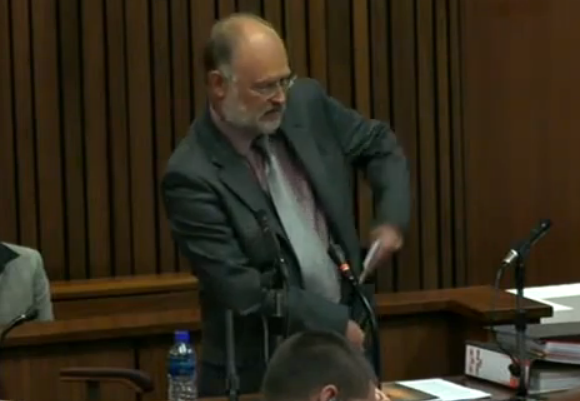
Dixon then acts out how she was falling in this sequence… the bullet hits the hip while her right arm is stretched out toward the door handle.

dixon demonstrating hip wound

Then as she is just starting to fall, the next bullet hits her upper arm.

Dixon demonstrating arm wound

He does not act out the 3rd bullet but yesterday he had mentioned that her left arm was likely in front of her, as part of an involuntary contraction movement, and the bullet went through the webbing of the left hand at that point, missing her torso and hitting the wall at mark E.

Then the 4th bullet hit her head as she is falling to the ground. He says that she would have landed leaning up against the magazine rack.

Nel tells him that if he’s wrong about B, then it makes his scenario difficult. Dixon agrees.

Nel asks, as far as the head wound is concerned, is there anything else that guided you as far as where the body was when it was struck. Dixon points out that the wound is on the top right hand side of the head.

dixon pointing to head

He says it was a horizontal wound straight through. The entry was slightly higher than the exit, so she may have been leaning forward just slightly. He wants to point out again that he’s not a wound ballistician; he’s just interpreting the sequence of events.

Nel asks if there was anything else that guided him in determining how the head was struck. Dixon says yes, the two contusions on the back combined with the contusion on the low buttock showed him that the deceased was falling downward and backwards. The magazine rack would be against the wall and she struck the edge of the rack that was furthest away from the toilet. He believes this matches the lateral contusion on her buttock.

Nel wants to know if Dixon is actually saying that even after Saayman dissected that wound, and put in his report that the wound was caused by the shattering of her hip and pelvis by the bullet fragments, that Saayman is wrong?

Dixon says that he did not see anything in Saayman’s report that said the external appearance of the contusion was directly related to the internal hematoma. Dixon says he is not saying that Saayman is wrong.

Nel is getting agitated because Dixon keeps giving very lengthy answers that are going off course. He wants him to focus on the head wound and what helped him determine the position of the body when the head was struck.

Dixon says the lack of visible wood splinters in the head indicates she was further away from the door. Also, another factor was the statement from Oscar that Reeva’s head was leaning on the toilet bowl when he found her plus the pooling of blood on the right hand side of the toilet.
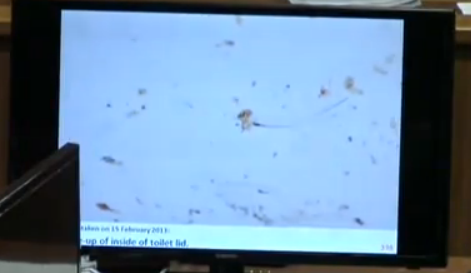
They next look at the lid of the toilet. Nel wants to know if this photo means anything to him.

toilet hair broken hair and particulate

Dixon says this indicates that the head was in reasonable proximity to the toilet when it was wounded.

Nel wants to know why he didn’t take in to account this toilet lid when determining the location of her head when it was struck. Nel points out that it is hair imbedded in tissue that is seen on that photo.
Dixon again says that yes, her head was in reasonable proximity to the toilet when it was hit.

Nel asks Dixon if he will agree that the head wound would have been incapacitating. Dixon says that from what he’s heard and read that yes, she would not have been able to make voluntary movements. Dixon says it could be possible, based on how the body lands, to have involuntary movement or spasms. For instance, the body could involuntarily fall over depending on its resting place.

Now Dixon is getting agitated by all of the bullet wound sequence questions from Nel. Dixon says “my Lady, it would be very nice if I was a ballistics expert.” I’m sure my Lady agrees. It would indeed be nice to have a ballistics expert discussing these matters.

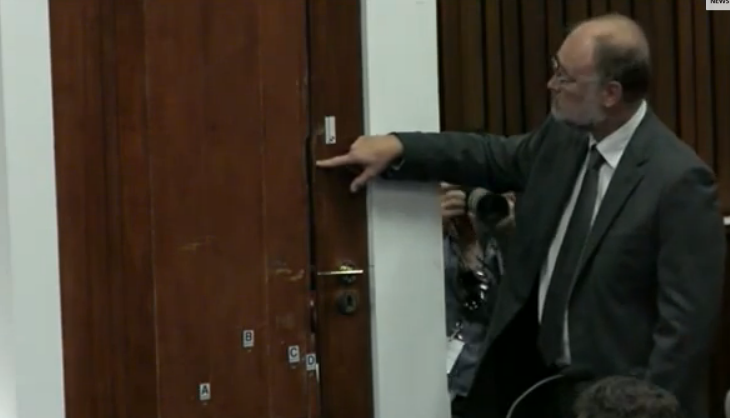
Nel then goes back to a comment that Dixon made earlier where he said that when somebody shoots a gun, the muzzle of the gun jolts upward. So if that person immediately shot another bullet, you would expect to see it hit a little bit higher than the first. That is how Dixon could account for bullet hole B being higher than A. Dixon also went on to say earlier that the person would have to refocus or correct their aim in order to get it back to the position of the first shot.

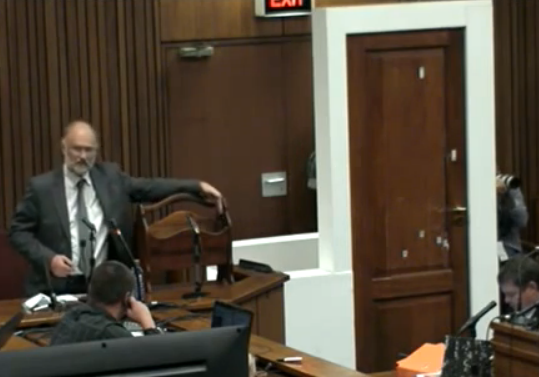
OP pic door

Dixon now back-pedals here, because obviously looking at the door it sure does look like for C and D he aimed pretty well. He tries to explain that it’s not a conscious “shoot, lift, reposition, then shoot again” type of thing. The body instinctively gets used to the pattern and can do it without a lot of thought.

Nel goes back to the magazine rack and how Reeva fell. He points out that Dixon stated that she fell on the magazine rack at the furthest point to the right.

dixon pointing to magazine rack

She then somehow got the two contusions on her back from that same rack. And then somehow she must have fallen forward towards the toilet bowl. Dixon agrees; this is his version.

Nel then says to him, Oscar stated that the magazine rack was definitely not there when he found Reeva in the toilet room. What does he think about that?

Dixon says that his reconstruction was based on the evidence that he can see and measure, and that has been recorded by other people. So Nel asks, was the accused wrong? Dixon won’t answer that and instead says, this is his interpretation of events.

Nel then asks, “can the accused be right if you are right?” Nel also says, “you are his witness.” Dixon again won’t give a direct answer on this. Instead he wants to demonstrate his answer via photo.

pic of toilet room with rack moved

Dixon points out that in the blood stain on the floor, there is a rectangular mark which indicates where the foot of the magazine rack was located. Based on the blood pooling around the leg, it is clear that this magazine was not slid or moved in this area. It was there when the deceased fell on it.

white circle showing rack leg mark

close up of leg mark in blood pool

Before they move on, Dixon again points out how Reeva would have been hit in the head as she was falling down. She hit the right side of the rack and slid down to the floor, and then slumped over on the toilet. Nel tells him based on the tissue and hair on the toilet lid, this is highly improbable. Her head would obviously have to be closer for that tissue and hair to hit where it did. Dixon says his opinion does not change.

Nel then clears up a few dates with Dixon. On March 25, 2014, Dixon agrees he went to the scene. But he does not agree that he was there on February 21st or March 18th.

They next look at a photo that depicts what the accused would have looked like from outside at night without his prosthetic legs.

outside bathroom model kneeling

Dixon says that with his understanding of Oscar’s height on his stumps, he would probably be about 20cm higher than the person in the picture. Nel points out then that this is not an accurate reflection of how Oscar would have appeared. He wants to know that why Dixon, as an expert, would give the court something that is not accurate. As usual, Dixon does not answer the question. Instead he starts rambling on about measurements. Nel asks again, why would you mislead the court with this photograph?

Dixon answers that they were testing lighting and they put a person in for scale purposes. He says he never stated that it was an exact height. Dixon says he is not trying to mislead the court. Nel asks why he didn’t just have the person lean on something to give an accurate representation of height. He is an expert. The court would expect his evidence to be accurate. Dixon says it is something that he omitted; he overlooked it at the time.

Nel then says, we are dealing with an expert, somebody who used to be a policeman and knows what he’s doing. “I want to know why you did it?”

Dixon repeats, it was for demonstration purposes with relative heights.
Nel states that 20cm is a significant variance and he wants to know why he didn’t mention it until now. Dixon says he didn’t have the trigger to mention it before. It’s coming up now, so now he’s mentioning it.

First he was busted on the redo of the gunfire tests yesterday and now today he’s busted on using inaccurate heights in their photographs. I believe Nel is trying to point out that this is not sloppy work, it’s shady work.

Nel says to him, you knew that Mr. Stipp testified that he saw somebody walking in front of that window. Are you trying to demonstrate to the court what he would have seen? Dixon says that they did want to see what Mr. Stipp would have seen.

Nel says back to him, if you really wanted to see what Mr. Stipp saw, you would have used the correct height. Dixon says a scale is a range. This model gave a scale to reference.

Nel asks how far away they were standing when they took the photograph. Dixon answers that he was standing in the road outside of the Stipp’s house at an angle so he could see around the new home. Nel reminds him again that he is an expert giving details and putting things on record. He wants to know exactly how far away he was. Dixon does not know the distance.

Nel then points out that the Stipps did not observe that window from street level. He wants to know, doesn’t that make a difference? Dixon says it would make a difference. He was standing at ground level and looking up, so the person in the window would actually look higher up than if he was looking downward or horizontally from the Stipp’s view. That person would have looked shorter from their view. Nel tells him that makes no sense at all. I agree with Nel; that does not make sense.

Nel asks Dixon what time of night they took these photos. Dixon says around 9pm. Nel wants to know if it was strange to Dixon that the Stipps had their curtains closed at that time of night. Dixon says what people do with their curtains is their own preference. He goes on to stay that at night time for privacy, it is likely that they would draw their curtains.

Nel asks, who was the model in the photographs? Dixon says it was Mr. van der Westhuisen. Wolmarans was there with Dixon observing from outside. They communicated via cell phones that night to give direction to van der Westhuisen who was inside the house.

On April 14, 2014, when Dixon returned to Oscar’s house, he was there to conduct lighting tests in the bedroom. Nel wants to know which items were still in the bedroom at the time of their testing. Dixon says the house has remained relatively unchanged. There was the bed, side tables, fans, chest with audio equipment on it, TV, bookshelf, etc.

Nel wants Dixon to describe to the court how they conducted their test.

Dixon says this test was only observation. It did not totally replicate the night of February 14, 2013, when there was no moon and there was less development in the complex.

On April 14, 2014, when they conducted this test, it was the night before the full moon and there was a lot of lighting from the surrounding homes.

Dixon looked at the construction of the curtain to confirm that it was a black-out style curtain which it was. When the curtains were open, there was quite a lot of light in the room. When they were pulled closed, it went extremely dark except for the far end of the passage where there was some light coming in from the bathroom windows. Nel stops him there.

Nel asks, with the curtains open was there quite a lot of light? Dixon says yes. Nel wants him to describe to the court what he can see.
Since this is an “observation” test, he needs to describe to the court what exactly he is seeing.

Dixon says he can see the position of everything in the room with the curtains open. He was standing in between the foot of the bed and the chest with the audio equipment on it. From there he could make out the outlines of the bed, he could see the bookshelf and he could see the end of the passage.

Nel asks, what was the source of that light outside? Dixon says from the moon and from the neighboring homes, however he can’t say exactly which homes had their lights on. Nel asks, why? He wants to know why he didn’t note these details and why would he come to court without a report. Should the court just take Dixon’s word for it? Dixon says he had been there previously when there was no moon and when the curtains were closed, it was pitch black. He was asked to go back to do another lighting test to confirm and make sure that the pitch black state was true. So this was the second time they observed the lighting conditions. He was not there to observe outside, he was there to observe the lighting inside the room with the curtains closed.

Nel says, that’s interesting. Surely you must be aware that the State’s case is that the curtains were open. Nel wants to know why he wouldn’t test that condition too. Dixon says “he’s most probably not like the rest of the world.” He doesn’t own a TV or a radio, nor does he buy newspapers. He hasn’t been following the case. He only has his testimony to present. He says he does not know all the details of the State’s case and he was unaware of the State’s position on this.

Dixon says the only other lights that could be seen in the room were tiny blue lights on the light switches. There were also small lights on the front of the audio equipment, and a blue light on the on/off switch of the CD player. The TV has a small red light on the lower frame.

Nel asks about the balcony light. Dixon says it was off. Nel tells Dixon that the balcony light was on the night of February 14, 2013, and he wants to know why he wouldn’t switch it on to do his testing if he’s trying to recreate the scene. Dixon tells the court that he was unaware that the balcony light was on, he did not have that information. He goes on to say that with the ambient light from outside, you could see a thin bit of light at the crack of the curtain and at the bottom of the curtain.

Nel wants to know more about the lighting coming through the cracks of the curtain. Dixon explains that the balcony door has a large wood frame. When the two doors come together to close, the middle section is a solid piece of wood. That would be just behind the crack of the curtain. So any light coming through the crack of the curtain is not direct, it’s a light that is reflected from the side.

Nel says to him, that light would have reflected even more if the balcony light was on. Dixon says that’s a possibility. Nel confirms, nobody told you that the balcony light was on that night? Dixon says no, they did not.

Nel confirms that Wolmarans was there with Dixon that night, and he also confirms that Wolmarans did not say anything about the balcony light either.

Dixon confirms that with the lights off and the curtains drawn, he could see the end of the passage leading to the bathroom. Nel wants to know if they had Wolmarans walk down the passage to see if he was visible. Dixon says that Wolmarans first laid down on the bed and with Dixon standing near the curtains, he could not see him at all. Wolmarans then got up and walked down the passage and Dixon could not see him until he got to the end of the passage.

Nel wants to ask him one more time, did you compile a report on this evening? Dixon says no, but he did compile one when they went on the previous visit. This night in April was just for confirmation.

Nel then focuses on the supposed “kick” mark on the door. He wants to know where the cut out portion of the prosthesis is currently located. Dixon says it’s in his possession. Nel wants to know if he has it here. Dixon says he does not. Nel wants to know why he would come to court to testify about something and not bring the evidence. Dixon doesn’t answer and simply says he can “fetch it.”

Nel asks him again, why would you not have it here? Dixon says he did not think to bring it. He then says that the cut out portion was taken AFTER the prosthesis was handed back to Oscar. It was cut out then and was always in the Defense’s possession. He thought the leg was the exhibit. Nel stops him and says, “it was cut out when?” He answers again that it’s his understanding that it was cut out after Oscar received the legs back, it was examined and photos were taken by van der Westhuisen. The piece was then given to Dixon.

Nel tells him that he’s wrong and he’ll have to ask Mr. van der Westhuisen, but the piece was cut out before the prosthesis was handed to the police. Dixon says he has no idea of the movement of the prosthesis at that stage. He became involved with the case on February 22, 2013.

Dixon also received a splinter of wood with varnish on it from the door from Mr. Wolmarans. He received the piece of the prosthesis from Mr. van der Westhuisen.

They break for tea.

Upon returning, Nel is asking Dixon if he is relying on memory to testify about the (kick) mark on the door. Dixon says yes. Nel asks him why he would rely on his memory, and why doesn’t he have a report? Dixon says when he gives evidence in court, he tends not to read out from written reports. He has been over the evidence many times and believes it’s fixed in his mind. Nel says, but the court will only accept the opinion of an expert if he can take them through the processes he followed to reach his conclusion. Dixon says, if it’s requested, he can type up the process.

Nel says, let’s start with the date that you received the piece of the prosthesis. Dixon says that information should be in one of the reports that was handed to Mr. Nel. Nel has Dixon look through his report and Dixon then says that the piece was given to him by Mr. van der Westhuisen at the scene at Silverwoods on either February 25, or March 1, 2013.

Nel asks him if he was able to find the date in his report. Dixon says no. He was just looking at the dates that he had been at the scene and figured it was one of those dates. So it obviously was not in his report.

Nel then asks if there’s any indication in his report on which date he received the splinter of wood to test the varnish. Dixon says no, but it was given to him in March of this year by Wolmarans, in a sealed bag, when they were at the shooting range. Again, the date was not in his report.

I do not see how the court is going to accept the grand majority of Dixon’s evidence. He has been proven to be a very unreliable and unqualified expert.

Nel wants to know, since Dixon had been part of the police force for several years, didn’t he understand the importance of chain of custody, in particular where the piece of prosthesis was concerned? Dixon says he has written that information down. Nel asks, where? Dixon says on his computer.

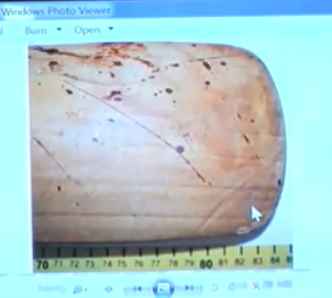
Nel moves on, and now asks Dixon if he will agree that the piece of the prosthesis that was cut out is smaller than the mark that is seen on the door.

Dixon says it is slightly smaller because that is the portion that had the maximum varnish on it. There should still be some on that surrounding area of the sole of the prosthesis. He also says that white fibers from the sock have been ripped out and are stuck to the prosthesis.

They then look at the photograph that Dixon took in court of the fibers on the door.

abrasion on door

Nel says the fibers are pointing downwards. He wants to know if there’s any significance to that. Dixon says the fibers are flexible, they could move. There’s no significance.

Nel wants to know if he would have expected a larger area of varnish to transfer to the bottom of the prosthesis, considering the size of the mark on the door. Wouldn’t the amount of varnish removed from the door be equivalent to the amount of varnish that would then be on the foot. Dixon says it’s relative to the force that was used and also points out that the bottom of the foot is not totally flat. He also mentions that Oscar was wearing a sock.

Nel then asks, wouldn’t you expect that there would be varnish on the sock? Dixon says yes, one could expect that. But Dixon never tested the sock.

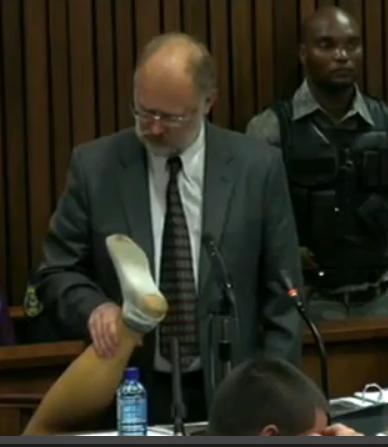
Nel then hands Oscar’s prosthesis to Dixon and asks him if that is the area where the piece has been cut out.

Dixon with leg

Dixon says it appears so. Nel wants to know why he answered that way, “it appears so.” And it is discovered that this is the first time that Dixon is seeing the leg in person. He previously had only seen it in photos. Nel tells him that he’s welcome to take off the sock. But before he does that, he wants to document for the court that a portion of the sock is missing where the piece of prosthesis was cut out, and there is a hole in the heel as well.

leg with sock2

leg with sock

Dixon says he doesn’t know if this is the original sock. Nel says it is not, that is how they received the leg. But he will give Dixon the original sock to see if he so wishes.

Nel also asks him before he removes the sock, if there are any particles of varnish on the sock. Dixon says he wouldn’t know if there were any there, they would be quite small. He then takes the sock off and says the appearance of the bottom of the foot is consistent with the photographs he has seen. Dixon then points out where the portion was cut out.

Dixon points to area that was cut out

Nel wants Dixon to tell the court what Mr. van der Westhuisen told him (Dixon) when he handed him the piece that was cut out. Dixon says that van der Westhuisen said he saw a mark on the door and a mark on the foot and he thought it was significant. So he gave it to Dixon because it was part of his responsibility to look at the marks on the door.

Nel want to know why he was under the impression that the piece he received was cut out after the prosthesis was returned from the police. Dixon doesn’t have a recollection of the exact wording that was used, but he remembers that when the piece was given to him, he was told it was a piece of the prosthesis and that it was cut after the prosthesis had been given back.

Nel wants to know if it’s significant to him when the piece was removed. Dixon says it was after the event, therefore it can be connected to the event. Also, there was a mark on the door. He didn’t receive the piece of wood with varnish until much later when it became apparent that it might be necessary. He also states that they gave him the piece of prosthesis when they did because he was at the scene with them and they viewed him as the trace evidence person.

Nel says to him that he didn’t answer the question. He wants to know is it significant to him when the piece was removed? Dixon says no, it’s not. Chain of custody for Dixon started when he received it and it’s still in his possession.

Nel then asks if he did the analysis of the varnish himself. Dixon says he prepared the samples. He scraped the pieces of varnish off of the wood, and cut only the relevant piece of the prosthesis needed and put them in viles. He did the necessary processing and put them in a gas chromatograph at the University. A company named Leco has their instrument there and the gentlemen who represents Leco assisted Dixon. Dixon says it’s the same equipment that’s used at the forensic science laboratory in Silverton.

Nel wants to know if he has a report. Dixon says he has a report of the analysis but he didn’t have it with him in court. He thinks he gave a copy to the Defense but he’s not sure.

Nel asks him if he took any samples of any other doors in the house. Dixon says no. He wasn’t aware that the leg could have kicked other doors in the house. He was looking at how many pieces of evidence could link the sole of the prosthesis with the toilet door.

He says he looked at the fibers on the sole of the prosthesis, of which some are still on there. There were also fibers on the door which were photographed by the police on February 14, 2013, that show the fibers there. That is why he was so sure the cleaning cloth (that was discussed yesterday) was not what caused those fibers on the door in court. He also looked at the physical shape of the abrasion and the striation that was in it. He believes that striation can also be seen on the sole of the prosthesis.

He goes on to say that he did not do an extensive identification of every single chemical component in the varnish. He analyzed the pure varnish sample with the contaminated varnish on the sole and it was a match.

Nel asks, but you are aware that there are other doors in the house with varnish. Did you exclude that the transfer happened from other wooden frames in the house? Dixon says again, he was not aware that other doors had been kicked so no, he didn’t check elsewhere in the house.

Nel says to Dixon that Vermeulen is of the opinion that Oscar could have stumbled on that piece of wood and caused the mark at that time. He wants to know what he thinks about that. Dixon says he doesn’t think that could happen. He likely would not have had enough force to create the mark simply by stumbling. Nel wants to know if it’s at least possible. Dixon says, not from the distribution of varnish that was seen. He’s not saying it’s impossible. He believes the plank would have to be held in place and would have to be kicked or stepped on pretty hard to cause that mark.

Nel moves on to the bat strikes. He asks Dixon if he has looked at the angle of how it hit the door. Dixon says yes he has. He did his testing from what he considers an approximate angle. He would never be able to ascertain an exact angle because of the grain of wood and shape of bat.

Nel wants to know if he included all of the photographs taken on March 25, 2014, in his album. Dixon says he didn’t prepare an album. He prepared a report. He tends to take a lot of photographs to ensure he has what he needs. Nel asks him if he has all of the photographs still available. Dixon says they are stored on his computer. Nel asks him if he has any objection to the State looking at all of the photos taken that night. Dixon says he has no objection.

Nel wants to know who was involved with the wood splinter test where they placed the white board behind the door. Dixon says himself, Wolmarans, van der Westhuisen and the people who own the shooting range.

Dixon took the photographs and assisted with setting up the door in the same position as the crime scene. He used his own camera. Nel wants to know if he has all the photographs in sequence that he took on that day. Dixon says he does. Nel wants to know if he would object to the State looking at all of those photographs as well. Dixon does not object.

Nel looks at a photograph and says it looks like a hole that’s been filled up with something. They don’t show the photo on screen, but I believe this is the photo he is referring to or at least similar.

test bullets entry

Dixon says this is the tunnel that the hole made going diagonally through the door. Dixon was standing face on to the door to take the photo so the inside of the path can be seen. Nel believes what causes that effect is that the bullet was at an angle. Dixon agrees that it was at an angle.

Nel asks him if he measured the angle at which the bullets had been fired. Dixon says he did assist with setting up the door and they determined the firing angle by using Mangena’s ballistics report and the measurements taken at the scene.

Nel also wants to know what distance they shot from. He believes it was approximately 2.1 meters. It corresponded with the distances that Mangena testified about. Nel asks again about the angle of the bullets. He wants to know if they used probes or angled meters to make sure they had the correct angle. And Dixon says no, they did not do that. That was not the purpose of their test.

Nel points out that Meranti wood has a grain that runs from top to bottom. He wants to know if the angle at which the bullet hits would make a difference in the splintering effect. Dixon says yes it would. Nel asks, why then did you not measure the angles? Dixon says that they did replicate the distance, angle and height in order to shoot bullets through the door to record the effects of the bullet passing through, and collecting the wood splinters on the boards. If the measurements were made correctly, their angles should have been correct. But they did not measure them after the fact.

Nel wants to know if he was the only one photographing that night. Dixon says somebody could have been behind him taking photos but as far as he’s aware, nobody else. Nel tells him that is a strange answer. Dixon says there were other people there in the background and he can’t say for sure what they were doing, but he doubts that anybody was taking photos. Nel wants to know out of the people who were there specifically for the test, did any of them take photos. Dixon says not that he can remember.

Nel wants to know who he gave the photographs to. Dixon says to Mr. Wolmarans, and he has copies as well. Some of the photos were used in his report.

Nel then states that when Mangena did his tests, he used a protractor and an angle finder on the hole. Nel wants to know if they did that as well. Dixon again says no, this was not a ballistics test to determine trajectory. It was a test to study effects.

Nel wants to know during this test, how many witness boards they used. Dixon remembers four. Nel asks if he took photographs of all four boards. Dixon says yes. The one that was included in his album is the one that was closest to the door. Nel wants to know if he has photographs of the other boards. Dixon says he can do better than that… the ballistics expert who will testify will bring them with him, and as far as the photographs, they should have been given to counsel (meaning the Defense should have given them to the State last night.)

Nel

Nel asks him how he knows that the witness boards will be used when the expert gives evidence. Dixon says because it’s in question now. Nel says no, I want to know who told him that between yesterday and today. Dixon says nobody.

Nel asks, who told you that the photographs were handed over? Dixon says nobody, it was requested in court yesterday.

Roux stands up and says that they were requested to make the other photos available of the board and he was involved in that process.

Nel stands up and says that they asked THIS witness (Dixon) to personally make them available but instead they got them from the Defense. So Nel wants to know how Dixon knows that they got the photos from the Defense. Remember, the Defense is not supposed to be communicating with their witnesses during cross-examination! That’s a big no-no. The Judge understands what Nel is saying and allows him to continue.

Nel asks Dixon, “how do you know that the Defense made photographs available to us?” Dixon says that he’s employed by the Defense and they have all of those items. He was unaware of the fact that he personally had to hand them over. He was of the opinion that if a request was made in court for any items, that counsel would handle that. So he’s essentially trying to make it sound like he didn’t understand that HE needed to provide them and that he didn’t KNOW that Defense handed them over, he just assumed they did.

Nel tells him no, you can’t get away with that. Nel says, you put it as a fact not as an inference. Dixon says he sat in the court and loaded the files from his computer on to a memory stick and gave it to his counsel for them to make the copies required. He did not have enough memory sticks to make copies, so he handed it to them to take care of it.

Nel tells him that he’s even more worried now because Dixon first tried to pawn it off as an inference, and now he’s telling them that he sat in court and handed over a memory stick. He could have just simply stated that when Nel first asked the question but instead, he just came off as trying to hide something.

Dixon is all flustered now and apologizing to the Judge, not because he did anything wrong but because he is (seemingly) trying to act like he didn’t know he had to give it directly to the State.

Nel now pushes him about the boards. He wants to know how Dixon knows that the expert witness (Wolmarans) will bring them in to court. Dixon takes a long sigh and says that since they had the tests done, the boards have been packaged and have been in court on a number of occasions with Wolmarans as he did not know when he was going to testify. It was his assumption based on that behavior that he (Wolmarans) would have them with him when he did testify. Dixon says he was not explicitly told that by anybody.

Nel rests.

Roux is up for reexamination.

Roux takes a few minutes to locate a photo. When they return, they hand the photo to Dixon. It is not shown on screen but it is described as a photo taken at the post-mortem which shows the bruises on Reeva’s back, and lividity has set in.

Roux wants to know where the bruise was that Dixon had previously seen on her back (the bruise that supposedly wasn’t identified by Saayman or anybody else.) Dixon says the bruise was in a line with the other two contusions, a few cm above the contusions. Roux asks if it was in the area of the lividity that is now seen. Dixon answers yes. He adds that the area all around the contusions had gone red as well.

Roux now points him to the ballistics album and shows him a photo.

paper from State shooting test

Roux asks him if he’s seen this photo and Dixon has not. Roux wants to know what this replicates to him. Dixon says this looks like somebody fired through a target causing secondary missiles to hit the paper. Roux says unfortunately this was not presented by the State in their case. Roux says there are a number of photos of this test done by the State but Dixon did not have access to them. Dixon agrees, he did not.

Roux asks him if he was ever given information about these photos outside of court by Mangena or anybody else. Dixon says, no.

Roux wants to know the surname of the range master. Dixon believes it was Roux.

Roux asks, after hitting the door with the cricket bat at the range, did the range master speak to you? Dixon says the recording equipment was being set-up. He hit the bottom portion of the door four times quickly just so they could set up the microphones for the right level of recording. As soon as he did that, the range master came out and asked if they had started shooting because they were supposed to wait for the go ahead telling them it was all clear. The range master thought that when he hit the door, they had started shooting.

Roux wants to revisit the photo that shows van der Westhuisen kneeling in front of the window.

inside bathroom model kneeling

outside bathroom model kneeling

Roux wants to know if they took any measurements to see if they could compare what is seen in this photo to Oscar. Dixon says he measured how high the head was from neck up. The head of an average male is approximately 35cm. He also measured the height of the windows. He did have the measurements of Oscar, and Oscar is about 20cm taller on his stumps than the man in the window.

Dixon goes on to say that he was informed that when Oscar is on his stumps, his lower legs have some length to them but one is longer than the other. He was also aware of the problem with the callus. So he couldn’t pinpoint an exact position.

Roux says what’s important to remember is that Mr. Stipp saw the figure in the right side window, and he could only see the top portion of that window (because of trees.)

view outside window from Mrs Stipp side of bed

Roux wants to know from Dixon, what would be the position of the person even if you added the 20cm? Dixon thinks the person would be about half way up the illuminated portion of the window, or slightly lower.

But keep in mind, not only did they neglect to use the correct height for Oscar, they also did not use the proper vantage point from which Dr. Stipp viewed the figure in the window. So their tests are not reliable.

Roux has no further questions for reexamination. Dixon is excused.

Roux says that the next witness’s evidence in chief will take longer than the available court time today. He has discussed this with Nel and they are in agreement that it would be best not to start the testimony today. Roux states that in order to make up the time, they are willing to start early upon return to court in May.

The Judge grants this early adjournment but asks that everybody be prepared to work extra hours when they return.

Court will resume on Monday, May 5, at 9:30am.

Oscar Trial – Day 23, April 16 DIXON

Dixon nervous smile

The Judge begins the day by granting the application for postponement that was submitted by the State yesterday. The court will be on recess starting this Friday and will commence on Monday, May 5.

Roger Dixon is still on the stand.

They show a photo and Dixon explains that he was asked to prepare a diagram of the various heights of marks.

dixon graph

He measured the heights of bullet holes B, C and D. They range from 97 to 104 cm. He also measured the heights of the ricochets marks E and F. Mark E is on the left and mark F is on the right. Next he measured the magazine rack and the front portion is 62cm from the floor. The back portion is 76cm from the floor.

His observation is that mark E on the wall has horizontal marks, meaning that the bullet didn’t hit that mark head on; it grazed along the wall from the side. He states you can see metal on the wall. He used an x-ray spectrometer and picked up the presence of copper and lead. This means the bullet still had the jacket on at this point. So the bullet grazed along point E and hit point F, creating the cracking of the tiles.

MARK E
62

MARK F
61

MARK E, F AND G TOGETHER
8

LOCATION ON WALL OF E, F AND G
60

Roux asks him what the energy of the bullet would be after it hits point F. Dixon says the amount of speed and energy will be reduced at this point. By the time it hit F, that would now be the 3rd thing that it hit (first the door, then grazing the wall and finally hitting the tile.) If it had lost all of its energy, one would expect it to fall to the floor. If it still had energy left, it could ricochet again in a direction. Although he can’t say for sure which direction, he would expect that it would probably bounce backwards from there. However, if there was a breakage plane in the tile, then it could bounce at an angle. So there really is no definitive way to know where it would have gone.

He goes on to say that in order for it to hit the back of the deceased, it still would need to have quite a bit of energy.

The wounds that are on her back are one on top of the other running along the spine.

back contusions

He doesn’t see how the bullet could have come downward and strike the bottom contusion and then go upwards causing the vertical striations. Also he would expect that the projectile would have jagged edges at this point from the jacket causing cuts and tears in the skin.

Roux reads from Saayman’s findings that these contusions were caused by some type of blunt object, edge of chair, possibly even a missile.

One of the junior lawyers goes in to the box with Dixon and Dixon holds the photo of the confusions to his back so we can become familiar with the orientation of the wounds.

dixon with image on lawyers back

Each contusion is along the spinal process, the hard boney part of the spine. Dixon repeats that he can’t conceive of a scenario where the bullet would hit the bottom contusion and go upwards.

Roux says it’s also common cause that there were no holes in the back of the t-shirt. He wants to know what Dixon thinks about that. He believes this indicates that there was no fabric covering that area. He would expect that there would be some type of stretching on the shirt in that area. He believes that her shirt likely was lifted up as she fell down.

Roux says there is another issue with Mangena’s assertion that the contusions were caused by a bullet fragment, and Roux says that is the “mass” of the bullet.
Dixon goes on to say that “numbers are not his best friend” so he has to refer to his notes.

dixon reading from notes

According to Saayman’s evidence:

1. Bullet A was retained in the abdomen so that would not have hit her back.

2. The bullet that hit her arm fragmented in the bone and there were bits and pieces in the front of her shirt and some on the floor. Those pieces would not have been able to go backwards so that excludes this projectile as being the cause of the back wounds.

3. With the head wound, the largest piece that was retained in the head weighed 93.6 grains. The mass of a black talon is 127 grains. If a piece came out of the head exit wound, it would have to be approximately 33 grains. This is likely not large enough to cause the size of the contusion that was on her back.

The fragment of the bullet core that was found in the toilet bowl weighed 65.9 grains. If you add 65.9 (from the one in the bowl) to 93.6 (the one in the head), you get 159.50 grains which is in excess of what a bullet weighs. Therefore, the bullet fragment in the toilet bowl cannot be the other half of the bullet that went through the head. The remaining head bullet fragments were likely on the ground.

4. The fourth projectile is the one that hit the wall at points E and F. He believes this impact caused the jacket to come off and the core itself is what landed in the toilet. The jacket then would have either fallen to the floor or ricocheted elsewhere, but he believes this jacket would be too sharp to cause the wounds on her back.

Dixon does agree with Mangena’s assertion that the hip shot was the first one.
Roux wants to know if he agrees with Mangena that Reeva was standing in front of the door and facing the door.

He states that the autopsy said the wound was eccentric, not concentric. If she was standing in front of the door and the bullet came at her straight on, he would expect the wound to be concentric. If she was standing in front of the door and it came at her at an angle, it would be eccentric.

But we do know the bullets were fired at an angle, so I’m not sure how his point helps the Defense. I think it actually supports the State. She can still be standing in front of the door facing it when the bullet hit her at an angle.

hip wound

Roux asks him to state his opinion on how she was standing when she was shot. Dixon says that based on the splinters in her forearm, together with the puncture wounds around the hip wound and some splinters seen in her torso, he believes she was leaning toward the door handle with her arm stretched out higher than the area where the bullet hit the hip.

He also notes there were splinters found in the upper arm and in the t-shirt and states the person would have been quite close to the door.

There were no splinters found in the head or on the hand wound. He believes this is because these parts of the body were now far enough away from the door when they were hit that they were not impacted by spraying splinters.

He thinks that after the initial hip and arm shot in front of the door, she would have fallen as her right hip gave out. Her right arm would have no function so would be limp at her side. He thinks the left hand was probably in front of her as an involuntary contraction type movement from the shock of the initial bullets and the bullet that missed her and hit the wall went thru the webbing of her fingers at that point.

And then for the head wound, he believes that she would be sitting too high up on top of the magazine rack for the bullet to hit her head considering the height of the bullet holes. The highest hole was 104cm and the lowest was 93cm. He also thinks she’d be too low if she was leaning over. So his conclusion is that the 4 bullets were fired in rapid succession and the 4th bullet hit her in the head as she was in the process of falling down. He says she would have fallen against the rack, landed on the floor with her head coming to rest on the toilet bowl.

He thinks that she fell against the magazine rack on this area of the wood.

dixon with magazine rack

They move on to sounds now. Roux first replays the cricket bat sound test from yesterday. The first sounds are from 60 meters, the second at 180 meters.

Then he plays the gunshot sound test which was also done at 60 meters and 180 meters.

The cricket bat sounds start around 53:28 on this video.

The gunshots start around 54:40 on this video.

Roux asks Dixon if these are in accord with the tests that he attended. “My Lady, the first ones were the cricket bat at 60 and 180 and the second were the gunshots at 60 and 180, yes.”

Roux rests and Nel begins cross-examination.

Nel’s first question… “Mr. Dixon, you are qualified as a Geologist, am I right?” Dixon says his first degree was in Chemistry and Geology. His current employment is at the University of Pretoria in the Department of Geology. Nel says that he sees he is not currently affiliated with any forensic body and Dixon says that’s correct.
Nel establishes that he had previously worked for the forensic lab with the police.

Nel asks him if he understands the difference between an expert witness and a normal general witness. He says he does. Nel wants him to explain. Dixon says the layman does not have specific knowledge in the area in which they are testifying. The expert would be somebody who has experience in applying their training to the matter at hand.

Nel points out that an expert witness should be able to show the court how they came to their conclusions and what processes they used. Dixon says if it is requested then yes. Nel says not just when requested, it’s essential for everything. Dixon says he agrees. Dixon then goes on a long explanation of how he used other experts’ reports and paired them up with his own knowledge and investigation. He acknowledges that he is not a ballistics expert, nor is he an expert in numerous other fields. In reconstructing the sequence of events, he believes that his training as a Geologist is quite applicable and he once again goes in to a long explanation of why.

Nel asks him if he is a sound expert. His answer is “I would hope that my evidence that I present is sound.” I really can’t help but laugh out loud at this answer. Nel then, fairly exasperated, asks again, “are you a sound expert, sir? Have you received training in decibels and sound?” Dixon answers that the sole purpose of the sound tests was to see if the sounds of a cricket bat hitting the door could be confused for the sound of gunfire. Nel wants to know what expert skills he used to do this. Dixon says the expertise used was reconstructing a situation. His part of the test was to wield the bat to produce the sound that other people were recording.

Nel asks him, who was involved in this expirement? Dixon says the range officer, Mr. Wolmarans (ballistics expert), Mr. van der Westhuisen (also ballistics expert), the wives of the ballistics experts, two sound recorders (he didn’t know which company), and possibly a few others.

Nel asks if he wore ear protection during the cricket bat test. Dixon says no. A cricket bat doesn’t make the same cracking noise at close range. Nel asks if his ears were ringing after he hit the door and he says he noticed some echoing.

Nel asks if his analysis of visibility in the dark required any expert skill. Dixon says that the instruments he used were his eyes. He says he wasn’t measuring light levels and he’s not an expert in this field. Nel asks if anybody else used instruments to measure light levels and he said not when he was present.

Nel recaps… so for the cricket bat test you just hit the door with a bat. And for the light test, you just looked with your eyes. Dixon agrees.

For the fiber evidence, Nel wants to know if he did any analysis. Dixon says he looked at them under a microscope and saw a consistency between the fibers on the door and the fibers on the bottom of the prosthesis. He did not go further to determine what type of material they were because in his mind he had excluded all other possibilities.

Nel asks him if he compared the fibers on the door to the fibers on the sock and Dixon says no, he did not have the sock for testing. He only looked at the fibers on the bottom of the prosthesis. Nel asks him if he ever saw the socks and he said he saw photos of them being worn at the scene but he didn’t actually examine them. His deduction was that the fibers that were attached to the sole of the prosthesis came from the sock that was worn.

Nel asks him if he ever had the socks in his hand. First Dixon says that on November 15th at the forensics laboratory he remembers the clothing being there but then continues on after some prodding from Nel that he never touched them. Nel wants to know why he’s avoiding the question. Instead of answering Nel’s question he just says “I did not pick them up.” Nel called him out on this and Dixon really couldn’t say much more.

Nel asks Dixon if he is a blood spatter expert. Dixon says he has received no training in this area. Nel points out that yesterday he referenced blood on the door when he was doing direct with Roux. He wants to know what inference he made about that blood.

crack thru bullet 2

Dixon answers that his inference was the panel was broken and there was blood on one side and not the other. Nel then asks, didn’t you tell the court yesterday that one panel fell on to blood? Dixon says he can’t say where the blood was that got on that panel.

Nel shows him some photos to test his knowledge of the scene and where items were found and Dixon can’t really comment. Nel is pointing out to him how silly it is for him to be giving testimony on blood and where it came from when he clearly doesn’t know the scene, nor is he qualified to testify about it.

Nel then covers Dixon’s expertise as a mark analyst. Dixon does believe he is an expert in this field and his evidence has been accepted in court a number of times.

Nel asks, at the forensics laboratory, one has to constantly do proficiency tests to indicate that you are still proficient in your area of expertise, is that correct? Dixon says in your main area of expertise, it is typically the norm to do one test per annum and for other areas, if they are available, once every two years.

Nel wants to know when he did his last proficiency test. Dixon does not recall. When pressed further by Nel he says that he thinks it was 2011 or 2012. Nel wants to know if he does any other refresher courses. Dixon talks for a long time about his experience, but does basically say that there is no course that teaches physical matching.

Oscar

Nel points out to Dixon that yesterday he referenced “a” cricket bat when talking about the marks. He wants to know if he used “the” cricket bat when doing his physical matching on the door. Dixon starts talking about the sound tests on the door and says that he used a different bat to hit the door. Nel stops him and points out that he’s not answering his question. The question was about the physical matching. Did he use the actual bat or not. It’s a pretty easy yes or no question. Dixon gives a very long winded answer that honestly I can’t even summarize.

Nel points out again that his question was whether or not he used the actual bat to do his physical matching. Another long winded answer on Dixon’s behalf finally reveals that he did hold the bat in his hand at the forensics laboratory on November 15th.

Nel wants to know if he ever consulted with Dr. Perumal (the pathologist who was at the autopsy for the Defense team). He says no, he did not. Nel wants to know if he read his report. He says yes, he did. Nel wants to know if Perumal’s report helped him reach his conclusions. Dixon says that Perumal’s report was very similar to Saayman’s report so he used Saayman’s. This is the same exact answer that Dr. Botha gave on the stand. This must be the standard Defense script for this question. Remember, Dr. Botha is the man who came to testify about the autopsy findings, not Dr. Perumal who was actually present for it.

One can pretty safely infer that Dr. Perumal did not want to come and testify because he cannot make the assertions that the Defense team wants him to make, most likely about the stomach contents. Also, Dixon is now being called out by Nel for not being an expert in many of the areas that he’s testifying about. There were ballistics experts that worked on this case for the Defense, but instead they are trying to sneak in evidence via Dixon and it’s not working so well for them. You don’t have to be a rocket scientist to figure out that the Defense team is having a hard time getting their qualified experts to come to court and support their theories.

Nel asks Dixon if he has drafted a report to support his evidence. Dixon says that in the course of examining materials and informing counsel, he did write various reports. So Nel calls him on this. He wants to know specifically which reports he has written. He stumbles here and then says they are on his computer at home. He starts to say that his reports include his observations about the lighting, he also took photos… and then Roux stands up.

Roux says he can help Nel out; he has a report that he’d be glad to give him and he hands it over. Nel looks at it and says that according to the paperwork it was drafted on April 5, 2014. It’s a report with photographs about the marks on the door. Dixon then chimes in and explains how he has updated various reports over the past year as information has changed. But what he’s testifying to in court is what is being asked of him in court, not necessarily what is in the reports.

This answer is obviously a red flag, as well as the fact that the Defense did not give Nel a report prior to Dixon’s testimony. Looking back at Oscar’s testimony over the past week, I think Nel did a great job of proving that Oscar tailored quite a bit of information on the stand. He seemed to be changing and adding things as the days went by. No doubt the Defense team is now scrambling to support the details that Oscar has changed or added. A perfect example of that is the “double tap” theory. That was thrown out after Mangena testified for the State and I guarantee you that is part of the reason why the Defense sent Wolmarans back to the shooting range to record the newly theorized “rapid succession” gunshots. You will read more about that later in this post.

The next report that Nel holds up that was just given to him by the Defense is the “origins of two contusions on the back” dated April 5, 2014. Also the “wood sequence in relation to position and posture” dated April 5, 2014.

Nel points out, there is no report here for the lighting conditions.

Dixon says there were bits of notes and paper sent over the course of a year. Nel points out that he’s reading from bits of paper in front of him today. Dixon says these are his notes to remind him of details. Nel tells him that if he had a proper report before court, then notes would not be necessary. Dixon says he was not requested to do that.

This whole exchange is pretty embarrassing. Dixon is flipping through his notes now and explaining what each one says. He’s also talking about the rest of the Defense investigative team and starts to get himself in trouble with that. He claims to have seen a draft of the ballistics report but not the final one.

Time for tea break.

When they come back Nel tells Dixon that since he has not read his reports yet, he is just going to ask him general questions at this point.

Nel wants to talk about the draft ballistics report from Wolmarans that Dixon has supposedly seen a copy of. Nel asks Dixon if he agrees with the sequence of shots that Wolmarans reported. Dixon says he thinks there may be differences from then to his interpretation now. Nel wants to know what the differences are. Dixon says he doesn’t know because he hasn’t seen the final report. Nel says, I’m not talking about the final report, I’m talking about the draft report that you saw. What are the differences? Dixon says he can’t remember because it was a while ago. Nel points out to him that he was the one who just said there were differences, so what are they? Dixon says he does not remember specific differences. He does remember that as the case progressed and more information became available things changed, but again, nothing specific. Dixon again verifies that he did not have access to the final report of Wolmarans.

This was a totally nonsensical, evasive answer.

Nel then asks him if he has seen the final report from the sound recording people. Dixon believes that the actual sound recording itself was essentially the report, meaning there was no written component. Nel asks him if he feels, as a scientific expert, that just recording sounds is enough. Dixon says yes. Nel points out that the court doesn’t know where they were, what recording equipment was used, how the door was set up, etc. All Nel wants to know is if Dixon, personally, feels that just recording sounds is enough. Dixon pauses a bit but ultimately answers yes without elaborating.

Nel asks if there were any decibel tests done of the two different sounds. Dixon says to the best of his knowledge, no decibel tests were done. Nel wants to know if Dixon agrees with him that there is a difference in decibel level between the gunshots and the bat sounds. Dixon agrees.

Nel then says there is something that Dixon has not shared with the court. That would be the retesting that was done last week. He asks Dixon about that. Dixon says he was not involved in the retesting but is aware that it was done. Dixon says that for the original tests a gun was obtained by Mr. Wolmarans, the same model that Oscar had. The gun was brand new out of its box but there was a problem with it and it kept jamming after each shot, so each shot had to be fired individually.

In order to replicate the rapid succession sound, they took a recording of the single shot and then repeated it to create the sound. But Dixon goes on to say that this is not considered to be a true reflection of events. Therefore, Mr. Wolmarans went back to shoot shots in succession to give a true recording of the noise rather than a repeated sound.

Nel points out to Dixon that when the sound tests were played in court, he stood there and identified those sounds, however he wasn’t present when some of them were done.

Nel puts to Dixon that this is about his integrity. He wants to know why he would be here in court testifying about gunshots when he wasn’t present for them. Dixon says because he has heard gunshots before. Nel tells him no, that’s not good enough. He wants to know why he identified gunshots that he was not present for when they were fired.

Nel tells Dixon that it is a serious thing to be testifying about sounds that he was not present for.

Roux objects. He believes that when the gunshot sounds were played in court, Dixon was not specifically asked to identify them as the test shots that were fired on the same night that the cricket bat sounds were recorded. He was just asked to identify them as gunshots.

Nel says his argument to the court is that Dixon never informed the court that the sound tests were done at two different times, he presented them as one occasion. The Judge tells him to argue that at the end of the case after they have all read the record.

I really think the Defense was trying to avoid having to put Wolmarans on the stand because, first, I think it’s possible that his opinion of the sequence of shots matches what Mangena said. And second, I think he was forced to go back to the shooting range after Oscar/the Defense changed their double tap story. I think they are trying to pawn it off on a gun that wasn’t working properly (sound familiar?) but it really was because the testing that they had did not match the brand new rapid succession theory. It’s all very suspicious. The more that Nel discredits Dixon, the more need for the Defense to now put Wolmarans on the stand.

Nel asks Dixon if they took any video of the testing that they did on the range. Dixon answers no. Nel points out that the only person who then can give the court any details about how these tests were done is him. He agrees but states that there were other people present.

Dixon now tries to explain to the court how he did the cricket bat testing – at what distances, how the bat was held, what was recorded, etc. but his recounting of it is quite confusing. Nel stops him and asks the Judge if he can request that the Defense turn over a report about the testing (not just a recording of the sounds) so he can review it and so that it can be handed up to the court as well. Roux says yes, he can do that. He also says the State is entitled to this. He was going to hand it over with his next witness, but he’s ok to do it now. They all agree.

And there it is… obviously Roux was trying to slip this past everybody, and uses the silly explanation “I was going to have the next expert do it” but surely everyone can see through that.

Nel then says, “since we now know that Mr. Wolmarans is going to be the next witness,” tell me what Wolmarans’ role was on your first night at the shooting range. This produced a good laugh from Oldwage.

Dixon says Wolmarans organized the range, as well as the recording people. He was there in a supervisory capacity. Mr. Wolmarans sat with the recording engineer and listened to the sounds at 60m and 180m. He was not involved with the striking of the bat.

On the same night that Dixon was there for the testing, the gunshots were fired by Mr. van der Westhuisen.

Nel wants to know now if the recording of the second night at the range (the test done last week) was ever played to him? Dixon says to the best of his memory, yes. Nel says it can’t be “to the best of your memory,” as an expert witness. Why would you say that? Dixon says “it’s a manner of speech.” Nel says “let us work with yes.”

He wants to know when he heard the recording. Dixon says this past week, the last few days. Nel wants to know where he was when he listened to it. Dixon says in the high court chambers on the 8th floor. Nel asks who was present. Dixon answers Mr. Wolmarans, himself, and the counsel seated in front. Nel wants to know if it was explained to him how the testing was done. Dixon answers, no he does not know the exact process they used and can only assume it was the same range. He has no knowledge of who fired the shots.

Nel goes back to the first night of the original testing and wants to know if the recording of the gunshots was ever played for him. Dixon says yes. Nel asks when. Dixon says he acquired copies and he listened to them himself. Dixon then says they were played to them the night the recordings were captured so that they did not leave the range with poor recordings. They had to make sure that everything worked.

Nel asks him how many shots were fired that night. Dixon says he cannot say exactly but it was not very many. Possibly 6 or 8. He said they were aware that because the gun was jamming, they would likely have to do the testing again. Also, he goes on to say that they did not have a lot of ammunition because the black talon ammunition is difficult to get.

Nel establishes with Dixon that there were two options that must have been discussed after that test – one option would be to do retesting and the other option would be to create the rapid succession sound by using electronics (repeating the sound of the single bullet as Dixon earlier testified.) Nel wants to know more about their discussion in relation to electronically engineering the sound.

Dixon says the sound engineer that they used was a music producer and the editing of recordings is a common aspect of sound production. Dixon had suggested that they play the recording in fast succession, however in order to present a sound that has not been tampered with by editing, Mr. Wolmarans went back to do the retesting with the gun. Dixon says there was no design or intent on the night of this testing to mislead the court, the prosecution or the defense.

Nel asks him, then why did you not tell this information to the court? Dixon says it didn’t come to his mind that it was in question.

Nel makes the point that they chose to use a music producer rather than somebody who specializes in the sounds of gunshots or explosions. Dixon starts talking about his discussion with the sound engineer that night, and starts to tell the court what the engineer said to him but Nel stops him. He does not want Dixon to give hearsay evidence.

Dixon then explains how he went online to listen to sound bites that are used by people when they dub them in to movies, like wood breaking, bats hitting, etc. Nel interrupts Dixon because he’s going off on a bender with his answer and as the two men are talking over each other, the Judge steps in and gently asks Nel to restrain himself. Nel cools off a bit and reminds the witness to respond to the actual question that is being answered.

Nel asks, was this sound expert an expert in recording sounds such as gunfire and explosions? Dixon says he does not have knowledge about the engineer’s expertise.

The next question Nel asks is if Dixon has ever heard the recording of the electronically changed gunfire from the first night of testing. Dixon says, on his computer he just hit the repeat button to hear what rapid succession would sound like. Nel says no, he’s referring to the recording by the music producer. Dixon says all the sounds heard were made by the music producer that evening. Nel says he’s going to keep repeating the question until he gets an answer. “Did you at any time listen to a recording by the music producer of the first night’s shots where they seem to be rapid?” Dixon says no. “To my knowledge I have never heard a digitally enhanced recording where the sounds which were made on the first night have been edited in to a rapid sequence of sounds.”

Nel asks Dixon if he is an expert on wound ballistics. Dixon says no. He then asks if he’s aware that Dr. Saayman is an expert on wound ballistics. Dixon says upon reviewing his CV, he’s aware that he has some expertise in that area.

Nel then asks Dixon if he ever consulted with the accused about the hitting of the door with the bat. Dixon answers, “to the best of my knowledge, and I did not record this, I asked the accused once what his position was and what it felt like when he hit the door.”

Nel asks him when that was. Dixon says he believes it was in March at the beginning of the trial. He also asks who was present. Dixon says both counsel and Mr. Wolmarans. Nel asks, “did the accused give you an answer?” Dixon says yes, he said there was a strong vibration. Nel asks, with which strike did he say there was a strong vibration? Dixon says the first strike. Nel wants to know if he asked him about the other strikes. Dixon says, if his memory serves him, it was just the first strike. Nel then wants to know if he asked him about his position in front of the door – if he moved or if it changed? Dixon does not recall this question. He believes he assumed that he was moving around as it would be unlikely that somebody would be standing in the same exact spot.

Nel asks to see Dixon’s notes that he has in front of him. The court hands them to Nel and he puts them down on the desk and continues with questioning. It looks like Vermeulen is taking a peek at them.

Nel receiving Dixon notes

Nel now wants to deal with Dixon’s ballistics expertise. Nel says, you have made a finding, and he’s using that word “finding” loosely, that the deceased was standing upright behind the door when she was shot in the hip. He wants to know which hole in the door that would be. Dixon says according to the reports of Mangena, and utilizing the height of the hole on the door, he concurs that it was hole A.

He then asks Dixon which bullet hole belongs to the bullet that missed the deceased. Dixon answers that in his opinion, none of the bullets missed her.

Nel then asks him which bullet hole belongs to the ricochet mark E on the toilet room wall. Dixon answers probably C, however C and D are close so it could be either. Nel wants to know why he answered that. Dixon says because the height of the arm injury is high. The deceased would have fallen after the hip injury but would start falling a bit slowly and then quicker as she goes down. He thinks the higher height of bullet B makes sense in hitting her arm. So, hole B goes along with the arm shot.

Nel wants to know how he is able to establish this. Dixon says he was present at the examination when probes were put in the holes by Mr. Wolmarans. Also, he has read the report of Mangena. The trajectories all come to the general area of the corner of the toilet room.

30

He was looking not only looking at the action of the bullet and its path, he was also taking in to consideration where the person was standing and how they would fall.
Dixon also goes on to say that when a person is firing a gun, there tends to be a recoil which causes the hand to lift. If the person is firing successively, the barrel can move. He looked at the horizontal line from A to D and interpreted that the shots were fired in that order and the recoil accounts for the spread of the bullets.

door 4

Nel then says to Dixon, if I put it to you that the only bullet hole that can be linked to mark E with a laser is hole B, what would you say?

laser pointer 2

laser pointer showing trajectory of bullet b

Dixon says that he has looked at photographs taken by the police of their probes in the door versus the probes that Wolmarans put in the door and there are variations. Dixon says the more you put probes in to a door, the wood expands so it’s not exact.

Nel tells him that he is talking about a laser, not a probe. But not only that, Oscar agrees that he took that position from the corner when he fired that shot.

Nel asks, taking that in to consideration and knowing that bullet hole B is the only one that can be matched up with mark E, what does he think about that? Dixon says that it is possible to put the laser through the holes and move them slightly up and down, and you could hit a number of different spots. He rambles on for several minutes about the different factors that go in to reconstructing the scene, then reminds the court that he’s not a ballistics expert.

Nel then asks Dixon if he has seen Wolmarans link bullet hole C with mark E. Dixon is not sure about that, he cannot recall. Nel says, we are talking about the one particular day that you were at the house with this exact door. Can you remember which hole Wolmarans linked with mark E? Dixon asks to look at his notes. Nel hands them over, Dixon reviews them and then says he doesn’t have a record of that information.

Nel asks him why he doesn’t have a record of this. Dixon says there was debate. Different people from different areas of expertise are looking at a situation where there are many variables. He goes on to say this is why he said earlier that there were differences in information over time. He says, “my understanding of what happened at the crime scene has even changed over the past week when I see more evidence and more photos because the more information you have, the better a picture one can draw.”

Nel asks, did Mr. Wolmarans use a laser? Dixon says yes. Nel asks, on that day? Dixon says yes.

Nel then refers him to a photo and asks him if the photo is cropped.

test board

Dixon answers that the board was large and the area of interest was cropped. Nel asks, where is the photograph of the whole board? Dixon says it’s on his computer at home. Nel says, so you can bring it to us tomorrow? Dixon says yes. Nel wants to know if splinters can be seen on other parts of that board. Dixon does not give a direct answer, he appears agitated and starts talking about the board and how it’s a ballistic test and his understanding was that Mr. Wolmarans would be giving testimony about this board. Nel stops him and tells him to just bring the complete photograph tomorrow.

Nel then has Dixon look at two more photographs. These are photos of a mark on the door. They are not shown on the screen but I believe they are referring to these photos.

abrasion on door

sock fibers in abrasion

These were taken on March 13th, 2014, in the courtroom. Nel asks him if he has other photographs of that particular mark from his previous examinations. Dixon says there are a number of photographs of the door that were taken at the scene. Nel clarifies, photos of the mark (not the door)? Dixon says yes, photos of the mark. But goes on to say that the lighting here in court showed the mark very nicely. In previous examinations the mark was not as visible. He saw it, he could see the fibers, but they didn’t have good pictures. But the lighting in this courtroom is good so he took pictures there.

Nel says he hears what he’s saying but wants to know if he, Mr. Dixon, has other close up photos of this particular mark with the fibers. Dixon says no, he didn’t take any photographs. Nel, very animated, says so the first time you took photographs of that mark is here in court?

Dixon says that he has taken other photographs but he doesn’t have any where the fibers are clearly visible. So the Defense has no evidence of fibers on the door prior to March 13, 2014. Nel then asks Dixon if he remembers that when he came in to court on March 13, there were people cleaning the door and Dixon was upset by this. Dixon remembers. Nel goes on to say that it was no longer an exhibit, it was in the public domain. And this is the first time you took close up photos of that mark, why?

Dixon says in his years of experience with the forensics laboratory, he has often been required to attend crime scenes a long time after the event has occurred. You have to extract original information from the existing scene. Dixon had seen the mark and had seen photographs taken on the day of the event by the police. However when he saw it in court with the lighting, he thought “yes, that is nice.” He didn’t have the opportunity with good lighting and a good camera to take it before that.

Nel asks him if he excluded that those fibers could be from the cleaning cloth that was used by the cleaning ladies that day. Dixon says he did not observe the cleaners putting an excessive amount of energy in to cleaning the door. He stands by his conclusion that the fibers are from the sock. He did not take a fiber sample from the door. He only examined the fiber that was picked off of Oscar’s prosthesis and compared it visually to the fiber on the door. He did not do any physical testing to rule out that it was from a cleaning cloth.

Truly, I cannot make this stuff up. The Defense, in my opinion, has clearly done some very shady stuff with the sound testing, the mark analysis, the lame lighting analysis, Oscar’s scream test which may or may not exist, their shoddy stand-in pathologist, etc. Part of me almost felt sorry for this guy Dixon because he was clearly used by the Defense. But then I am jolted back to reality and remember that this is a paid witness and he voluntarily put his neck out on the line to say what the Defense wanted him to say. They didn’t force him to sell his soul.

Nel now refers to Dixon’s report about the “wound sequence in relation to position and posture.”

Nel notes that Dixon wrote the following: “secondary wood projectiles caused lacerations to the right forearm and punctuate abrasions around the entrance wound to the hip.” Dixon says yes, he saw them on a photograph that he reviewed which was taken at the post-mortem after the deceased was washed. Nel says that Dr. Saayman’s evidence was to the contrary that he did not observe any.

Dixon says he’s aware of that. Nel wants to know if Saayman was wrong. Dixon says he saw a photograph of the wound after it had been cleaned and around the wound were tiny little spots where it looked like there had been bleeding. Nel points out to Dixon that he was not at the post-mortem and he’s not a wound ballistics expert. Dixon agrees. Nel goes on to point out that even though Dixon is not a qualified expert, he is still willing to say that Saayman made a mistake.

Dixon says he is not saying that Saayman made a mistake, he is just stating what he observed. Nel wants to know if Dixon is willing to concede that Saayman would know better than him.. Dixon says that if Saayman were to state categorically that those spots were not made from splinters then that is his statement. But from what Dixon observed on the photograph, as well as from other photographs of wounds and the sequence of events, his deduction was that it was most probably caused by the small lightweight wooden splinters.

Nel says it’s on record that Saayman’s findings do not show any marks of that nature that Dixon is testifying to.

Roux objects and says they are looking for a photo of what they are discussing. He wants Nel to reserve his question until they can show him the photo. Nel says, as the court pleases.

He moves on to a photo of the bottom of Oscar’s prosthesis.

bottom of right prosthesis

Nel asks him who took the photograph. Dixon says that the photo was taken by Mr. van der Westhuisen. Nel wants to know if he was present. Dixon says no. Nel wants to know who extracted the fiber from the foot. Dixon says Mr. van der Westhuisen and he was not present for that either. Dixon says he was not involved with the case at that time.

Nel asks him, when did he get involved in the case? Dixon says on the Friday of the bail hearing verdict. Nel asks how he got involved. He says he received a phone call asking him if he would be willing to assist the Defense team in the reconstruction of the scene.

They then look at the graph that he testified about this morning. Nel points out that in that graph, Dixon used bullet hole C as the hole that can be linked to mark E. He didn’t use any other holes. Dixon says that was the most probable hole.

Nel then has him look at a photo of the blue mark on the buttock and tells him that Saayman would not agree with his opinions about the cause of bruising. That mark was not caused by the magazine rack, but by a bullet. Dixon is rambling trying to explain his conclusions. He said these are his conclusions based on the evidence that he had available.

Nel has the court hand the cricket bat to Dixon. Dixon states that he believes when the bat hit at the lowest mark (the 3rd strike) that is when the bat went through the door panel and created the marks that can be seen on the bat.

tip of cricket bat

He believes the small plank that broke fell inwards to the toilet room. When he conducted his testing, the same thing happened to him. He also says it is possible that you could get marks on the bat from the bat being wedged in between the panel and twisting it back and forth. He does not exclude this as a possibility.

They break for lunch.

Upon return, Nel wants to review what Dixon had previously said about the kinetic energy of the bullet moving Reeva backwards as the bullet hit her in the hip. Dixon says when the bullets hit the hip and upper arm it transfers energy to the body and could cause it to go backwards.

Nel says, we see that in movies when a person gets shot and they are flung backwards. Is it something like that? Dixon says he doesn’t think so. Nel says, because it’s impossible. A bullet that weighs that amount cannot move a person backwards. Dixon tries to back-peddle and says that Reeva’s hip wound caused the instability moving her backwards, he was not stating that the blow flung her backwards. Nel welcomes him to look for any literature that indicates that the force of a bullet can make somebody move backwards. Dixon says he will attempt to look for something to please the court.

Dixon testifies that he has been to three post-mortems in his life. Nel wants him to look at a photo that he (Dixon) provided in his report that points out a bruise that was not identified at the autopsy. Nel points out that there is artificial shadowing on this photo.

Nel points out shadowing on pic

Dixon says the area that he interpreted to be a bruise has a lighter edge around it before the dark shadowing at the edges of the photo. So he believes it could have been a bruise.

Nel points out that Dr. Botha did not identify this as a bruise, nor did Perumal or Saayman. Yesterday when Dixon testified about this bruise he stated that it was only seen on this one photograph which was taken at the scene on the morning of February 14th. By the next day at autopsy, the bruise was gone. Dixon says he can only say what he saw in the photographs. He does not know if Botha, Perumal or Saayman had access to this photo from February 14th. Nel asks him if he will agree that the bruise was not seen at the post-mortem. And Dixon agrees, he could not identify that mark from the post-mortem photos.

Nel then asks for Dixon’s notes again which he has now slipped in to his pocket. He was probably hoping that Nel forgot about them. He grabs them out of his pocket and hands them over.

Dixon pulling notes out of pocket

They now look at the autopsy report and read Saayman’s finding about the bruise on the buttock. It states that there was no foreign object found beneath the skin in that area. Nel asks Dixon from this, did he conclude that it could be a bruise from when she fell against the magazine rack? Dixon says taking this finding from Saayman, plus the photograph plus his reconstruction of the events and the magazine rack, he did make that interpretation.

Nel then has him look at page 8 of the autopsy report. Dixon seems surprised by this page, as if he hasn’t read it before. Nel has him read it out loud. It’s where Saayman describes how the shattered hip, pelvis and shrapnel caused the bruising on the buttock.

Nel tells him that he just made an inference without reading the full document and wants to know why he would do that. Dixon gives an answer that again, I don’t know how to summarize. It made no sense. But he did very kindly point out to the court that he was a “layman” in this area.

Nel tells him that it’s very irresponsible of him to be making inferences in areas where he’s not an expert. Dixon’s response is that he was only testifying to what he saw. Nel tells him, “you interpreted it to fit your case.” Dixon says he does not have a case, he has a scenario which he was recreating.

Nel asks Dixon why he would come to this court and give evidence without reading the full report. Dixon says he read the document a while ago. Dixon can’t really give a good reason and Nel has made him look like a complete fool at this point.

Nel asks him which days he visited the crime scene. Dixon says the first day he was there was the day of the bail hearing verdict. He didn’t do much, they were just assessing what they needed him to do and at the time they thought that primer residue may be of importance. Dixon says this changed with time to other things. Nel asks him what other things and he answers he was asked to look at the marks and what caused them, and “so on and so forth.” Nel points out that it is of concern to him that he would use a phrase like “so on and so forth” in court. Dixon says there was no definitive statement of what exactly he needed to do, it evolved over time as new things were discovered.

Nel asks him if there was anything that he was asked to investigate on his own, without assistance from anybody else on the team. He answers, the suspected varnish on the prosthesis from the door to prove contact.

Nel asks him if he ever analyzed the varnish on the prosthesis and could it be linked to the door. Dixon answers yes, he analyzed it and the material that he found on it had the identical chemical characteristics to the varnish removed from the door. Nel asks him when he removed the varnish from the door to analyze it. Dixon says a piece of wood from the door was given to Mr. Wolmarans last year in a sealed evidence bag and he received that bag from Mr. Wolmarans. Dixon found that the two varnishes had the same composition.

Nel wants to know if there was anything else he was requested to do on his own. Dixon says he was also asked to work out a sequence of events.

Nel wants to know where the cricket bat is that was used at the range for their sound test. Dixon says the bat is in Mr. Wolmarans’ possession. Nel also wants to know what happened to the first firearm that they used for the test (the one that jammed). Dixon answers that he does not know.

Nel asks him if he knows what ammunition was used for the testing. Dixon says it was a problem getting the black talon ammunition, the black colored one, so if his memory is correct it was ranger ammunition that they used, which he says is the same design.

Dixon then says he was not tasked with sourcing ammunition and fumbles a bit here… he goes on to say they did tests on the shooting range the night before the sound recording and the ranger bullets were used the night before. The black talon was used for the actual test and the recording.

Dixon continues on saying it was dark that night, he doesn’t remember everything but there are likely photographs taken from that night, although he doesn’t have them, but he recollects discussing the ammunition issue with Mr. Wolmarans.

Nel asks, who took photographs on that night? Dixon answers Mr. van der Westhuisen. Nel asks him what he took photos of. Dixon is not sure, he wasn’t following him around. Nel asks him if he was photographed. He says he presumes he was but he was not paying attention to that, he was concentrating on the tests on the door.
Nel wants to know if he has seen photographs of this test. Dixon says no. Nel asks are these photos seen anywhere, in any reports? Dixon says no. Nel asks if there was a video camera. Dixon says no, it was very dark.

Nel then asks, you said you had gunshot sounds on your computer from that very first night, correct? Dixon says he received some files from Mr. Wolmarans later. Nel says, so you still have the results of the first night of shooting on your computer at home? Dixon says yes. Nel asks if he’ll bring them to court tomorrow. He says yes.

They adjourn a half hour early today so Nel has time to read through the reports he just received today.

Oscar Trial – Day 22, April 15 Part 2 DIXON

The next defense witness is Roger Dixon. He is qualified as a geologist. He worked in forensic science at SAPS from 1994 to 2012. He was previously the head of the department that Vermeulen (the State’s bat expert) worked in and Vermeulen is now the head. He has testified in court before although not often. He estimates about 3-4 times per year.

The first item he was tasked with by the Defense was to examine the lighting of the bedroom. He went to Oscar’s home and closed the curtains, switched off all the lights and then looked around to see what he could see. With all lights off, including electronic equipment, on a dark moonless night you could only see a little bit of light at the end of the passage to the bathroom. The room was completely dark. He could not see his hand in front of his face. He did this on March 25, 2014. He said he picked a moonless night because that was the condition on Feb 14, 2013.

In the bedroom close to the bed are two light switches. They have tiny blue lights on them but they do not give off light.

The CD player (amp) light does gives off a little bit of light, but only enough to see your hand in front of it. With your back to that same light, you can’t see in to the darker areas of the room.

He also testified that when you first close the curtains and turn around, your eyes take a while to adjust to the pitch darkness. If you stand in the room for a while and your eyes become accustomed, you will start picking up shapes in the room, but it’s not quick.

Dixon confirms that the light in the toilet was not working. All the lights to the bathroom are controlled by one switch which is on the right hand side of the entrance to the bathroom. The bulb in the toilet room was not functional.

On March 25, he also went to the outside of the Stipps house. Since February 2013, a new home has been constructed in between Oscar’s house and the Stipp’s house but if you look past the corner of it, you can still see approximately in that direction. They stood in the street with the Stipps house to their backs to do their testing on the bathroom.

The photo depicts the small balcony off of the Stipps’ bedroom which is just above their garage. Their backs were facing this part of the house during the tests.

stipp small bedroom balcony

Roux mentions that it was the evidence of Mrs. Stipp that their bedroom curtains are always open. He wants to know what Dixon sees in this picture. Dixon points out that the curtains are draping fully closed without being pulled back. He’s trying to discredit Mrs. Stipp.

I’m not surprised that their curtains are closed. They are witnesses in a murder trial and the defense has been conducting tests near their home for several months. I would close my curtains too!

Dixon first took a photo of Oscar’s bathroom with all of the lights off. The photo is basically black depicting the pitch black condition of the home with no lights on.

bathroom from outside no lights

Next they look at a photo of the inside of the bathroom. A replacement door has been put in the frame.

inside bathroom

The next photo shows a model kneeling on the floor, which is intended to depict Oscar on his stumps. The purpose of Roux showing this photo is also to discredit the Stipps’ testimony about seeing a figure walking in front of the window that night.

inside bathroom model kneeling

(I just have to inject a funny side note here… when I first saw this photo, all I could think of was The Blair Witch Project, with the creepy guy standing in the corner of the room.)

This photo shows the bathroom with the lights on and the toilet room door fully closed. The toilet room light is still not working and the toilet room is not visible from outside without that light.

outside bathroom model standing

The next photo shows the bathroom with the lights on and the toilet room door slightly open. Dixon said the degree of lightness in that toilet room increases the more the door is open.

outside bathroom door slightly open

This photo shows the toilet room door totally open. The toilet window is much brighter now and the door also obscures a good portion of the open window. The model can now be seen in the middle of the frosted window. You can no longer see him clearly; he looks more like a silhouette behind that window.

toilet door fully open

They then look at a photo where the model is on his knees facing outside. The toilet door is slightly open. For reference, the window sill is approximately 1.1 meters above the ground.

outside bathroom model kneeling

Dixon testifies that he has examined the bathroom door. He believes it was done on November 8, 2013. This examination was done at Oscar’s house and the door was reinstalled by the SAPS. Then on November 15th they went to the forensic laboratory in Silverton where in the presence of Vermeulen and Mangena, they examined the door again.

Dixon’s finding was that the damage on the right side of the door was caused by a cricket bat that hit it very hard. He said the marks on the side of the frame and on the inside of the doorframe on the panel are consistent with damage by hard blows of a cricket bat. The exam showed that there were probably only 3 blows.

They look at a police photograph of the door and the labels that were put there by the police.

reconstructed door at scene

Dixon now demonstrates on the door in court where the cricket bat hit the frame of the door. He believes this was the first hit.

dixon pointing to mark

Another bat strike hit in this location.

dixon pointing to mark 2

And one more bat strike hit here.

dixon pointing to mark 3

Roux asks him if he ever tested the sound of the cricket bat on the door. Dixon says in order to test whether the bat did hit the door, they took a duplicate door from the house made of the same wood and design and did conduct tests. They hit the door with the bat and they fired bullets through it in order to replicate the effects. Dixon was the one who hit the door with the bat.

The tests were done on a shooting range at night in order to eliminate as much extraneous noise as possible. One recording station was at 60 meters and the other was at approximately 180 meters.

The test door was situated so that it was at the same angle to the recorder as the real life door would have been to the window.

They prepare to play the tape and Oscar plugs his ears in the dock.

oscar plugging ears

Here is a clip of the sounds that they played in court (heard at 00:40 on this clip)

http://www.youtube.com/watch?v=xPAecyMNghs

Dixon states that they first recorded the sounds at a distance of approximately 60 meters.

He did three bat swings wielding the bat over his head as Oscar stated he did in court. This was the first set of sounds heard on the tape.

roger holding bat 2

roger holding bat 1

He next did four bat swings in rapid succession with the bat low and in a batting position, hitting the door with the tip. This was the second set of sounds heard on the tape.

roger swinging bat low

They now move on to some further analysis of the door.

The next picture shows the bullet hole D. It has a crack running through it.

crack thru bullet 1

crack thru bullet 2

Dixon believes that this bullet hole was in the door first prior to the cricket bat creating the crack. If the crack was there first and the bullet hit it, it would have likely taken a chunk out of the door.

He also points out some spots of blood that can be seen just above the bullet hole on the left portion of the crack. He says the reason why one side of the crack has blood on it and the other doesn’t is because these pieces of wood likely fell in two different directions on to the floor.

The next photo is from their testing. They first put a crack in the door with the bat and then they fired a hole through it. He points out that this crack is continuous whereas the crack on the actual door is not.

test hole with crack

The next photo they look at is the abraded area on the door panel. Dixon also points to where it can be seen on the door in court.

abrasion on door

dixon showing location of door abrasion

Dixon points out that varnish is smooth and when you make varnish rough, you get a light reflection like you see in the photo. At the top of the abrasion just below the curved edge you can see two white spots.

sock fibers in abrasion

Dixon says that these are white fibers stuck in the varnish. He also says that in reconstructing this scene, the only material consistent with the fibers is the white sock worn over the prosthesis of Oscar.

They break for lunch.

Roux introduces the next photo. This is the sole of the right prosthesis.
He points out with the white cursor an area that has vertical striations and a chunk missing.

bottom of right prosthesis

Dixon says this was caused by the foot impacting on the door. The dark vertical striation is from the varnish of the door. He says only a forceful kick upwards could cause that.

They next look at a picture of Oscar’s prosthetics as he was wearing them that night.

prosthetic legs

Dixon says the fibers that were stuck on the door match the fibers of these socks.

Roux wants to know if it’s possible that the mark could have been caused when the panels were on the floor and Oscar stepped on them. Dixon does not believe that the act of stumbling or stepping would give sufficient force to cause that damage.

In this next image, Dixon’s finger is pointing to the top most impact point of the cricket bat.

dixon pointing to top mark

And in this side view image of the door, you can see two bat impressions one on top of the other next to the white marker.

top and bottom bat marks

He believes that the mark on the bottom was the hardest blow that broke the panel. The panel is at its thinnest in that location right on the edge of the frame.

bat mark on frame

Dixon testifies that the wood is meranti and it is splintery and brittle. There would have been lots of splinters that broke off along with the panel itself.

The door is not fitted in to the doorframe such a way that it is completely firm. The walls around it consist of brick, plaster and tiles on top. He believes that when the first blow struck, there was a strong vibration. That vibration went through the door to the outer jam and caused the tiles and plaster to fall.

1

The next image shown is a close up of the top mark, the mark that the defense believes is the 3rd bat mark that Vermeulen didn’t identify as being caused by the bat. Dixon believes that this strike would not have been sufficient enough to break the panel in.

close up of top bat mark

An image of the cricket bat is now shown and the white cursor indicates where there are grooves from the door.

tip of cricket bat

Dixon says cricket bats are made of English willow. It is a fine grain wood and its lightweight. When these bats are manufactured, they are created to survive the repeated blows of cricket balls therefore they are subjected to compression so there are no air pockets in the wood. The tip of the bat is very dense. The meranti wood has much larger cells and is splintery. When it is hit hard, the wood will snap and throw splinters.

The next image is a close up of the strike to the frame, the first hit, which was very hard and caused the tiles to fall.

oscar bat mark on frame

And this photo depicts the test that Dixon conducted on the door. This was his bat mark on the same area of the door frame. He says he hit that frame quite hard but he didn’t have the strength to cause the same damage that Oscar caused on his door.

test bat mark on frame

This photo, which was taken by Col Motha, shows the door from the inside of the toilet. This was the original reconstruction. He points out that on each bullet hole there is wood splintering in a vertical pattern to the left.

bullet holes from inside toilet

And this photo is taken from the outside of the toilet room, looking in through the broken out panel. He points out that the panel in the door was one big piece. The fact that it was found in multiple pieces shows that it was ripped out in pieces.

door from outside with panel out

The white cursor in this photo is pointing to plaster dust. A shoe print can also be seen to the left of that.

plaster on door

This next photo shows a better view of the shoe print in between the two bullet holes.

foot print on door

Dixon testifies that this shoe print could only happen if somebody walked on it. Roux wants to know how this fits in with the preservation of a crime scene. Dixon says, “it is most unprofessional.” He goes on to say that upon arrival at the scene, unless there is an urgent need to save a life, there is no pressing need to walk around the scene. The first person there should secure it first.

They show another close up of the bullet hole with the plaster dust shoe print over it.

close up of bullet hole and shoe print

The next holes are the test shots that were fired by Dixon and Mr. Wolmarans on the test door. This is the same door that they used for the cricket bat testing. This was done at an indoor shooting range.
This photo depicts the entry point of the bullets. These were taken at a right angle, slightly downward.

test bullets entry

And these are the exit points of the bullets.

test bullets exit

During the test firing, this board was placed behind the door and used to determine the distribution of the wood splinters. You can see where the bullet hit. And then above that, all of the black specks are where the splinters were distributed.

test board

Dixon reviewed autopsy photos (which they do not show in court) to see where the wood splinters were lodged in the deceased. He says that after she was washed and then photographed, you could see small punctures, not bruising, around the hip entry wound.

On the arm, there was a patch of wood splinters. There were also some larger wood splinters at the waist level. He says these were caused by being at close proximity to the door.

Roux asks him how close is “close proximity”?

Dixon says based on his testing, at 20cm away from the door, there were very few splinters. He says it is possible for some larger pieces to travel further. They did put their board at various distances and at 60cm they only got one or two splinters.

• At 6cm, quite a lot of splinters.
• At 10cm, they still got quite a lot.
• At 20cm and further, there was a sharp drop in the quantity.

Taking this in to consideration, when he looked at photos of the arm of the deceased he inferred that the arm was stretched out, above bullet hole A, leaning towards the door handle.

dixon demonstrating arm position

There were splinters on her forearm as well as on the top portion around the wound. There were also pieces of wood found on the fabric of her t-shirt. Dixon believes that the upper portion of her arm, as well as her forearm, were close to the door when the wound was inflicted.

Next is a photo taken by police on February 14th at 5:42am. These are the contusions on her back.

back abrasions

Dixon says that what they see on this photo was not seen in subsequent photos due to the moving and washing of the deceased. In addition to the two large dark contusions, there is also a bruise to the right where the white cursor is pointing. The bruise is located right at the area of the spinal process.

The striations that are seen on the largest abrasion are almost vertical in nature. He believes that these occurred when Reeva fell against a hard, blunt object.

The next image is not shown on the screen in court but I was able to get a screenshot of Dixon holding the photo. It shows the backside of the deceased with a white scale pointing to where the abrasions were located on her back. They appear to be higher up than I anticipated. I think this may lean in favor of the bullet fragment hitting her back and not the magazine rack because I don’t see the rack hitting her that high up.

location of abrasion on back

Lividity has set in so there is now redness in the area and the bruising that was previously seen to the right of the contusions can no longer be seen.

But what can be seen is on the inside middle of the right buttock is a severe vertical contusion which is blackened. Leading outward towards the outside of the buttock, is a bruise line that is slightly curved.

According to Saayman’s autopsy, he could feel nothing inside the buttock, no objects, that would have caused that. In Dixon’s opinion, the positioning of that bruise is consistent with the deceased having fallen hard against the magazine rack. The sideways projecting bruise could be the edge of the magazine rack.

Dixon is then given the original magazine rack in court. He believes her buttocks and her back hit the front of the rack as she was coming down.

Dixon receives magazine rack

dixon pointing to magazine rack

Roux informs Dixon that Mangena’s testimony was that Reeva was seated on top of the magazine rack when the 3rd and 4th shots hit her, and there was also a shot that missed her and ricocheted off the wall hitting her across the back causing the two marks. He wants to know what Dixon thinks about that.

Dixon believes that if this were the case, the bullet would have to be smooth, so as not to cut the skin, and also traveling upwards in order to get the vertical striations that were seen. He doesn’t see this happening.

Roux asks him if he knows about the projectile that was found in the toilet bowl. He says yes, it was a bullet core. It was found after the initial investigation by police. The size of the bullet core is inconsistent with having come from one of the bullets that penetrated the body and fragmented. Therefore, theorizing that this is the bullet that ricocheted off the wall and missed her.

Dixon can’t conceive of a scenario where the wounds on the back would be caused by a ricochet.

They adjourn for the day.

Oscar Trial – Day 22, April 15 Part 1 OSCAR

inside view of courtroom resconstructed toilet room

Nel begins the day by presenting an application to the court to take a two week postponement beginning on Friday due to professional and personal commitments. He requests that they return on May 5. The Judge will consider this request over night.

Oscar is on the stand and Nel asks him, on his version, is it correct that Reeva must have opened the bathroom window and he says yes. Nel wants to know if she did this before or after she went to the toilet. He answers, before.

Nel reviews the basic steps that Oscar took after hearing the noise (the window opening):

1. He retrieves his gun from underneath the bed
2. Walks to passage and screams

Nel stops here and says, on your version, she must have had time to void her bladder and get dressed. Nel points out to him that she had her clothes on, including shorts pulled up, when she was shot. Oscar says yes, she had clothes on when she went to bed. She was wearing basketball shorts.

They are able to establish that she would have done the following all before slamming the toilet door shut and locking it (presumably out of fear from Oscar’s screaming, according to his version):

1. Walked to the bathroom undetected
2. Opened the window
3. Voided bladder in toilet
4. Pulled up shorts

Nel tells Oscar that he does not believe that she would have had time to do all of this prior to him screaming. Oscar says he disagrees.

Nel then has another few go-arounds with Oscar about his tailoring skills, in particular as it relates to the magazine rack being the “wood moving” that he heard behind the door.

They move on to the jeans in the bedroom that were found inside out. Nel wants to know why these jeans were left like this when everything else that Reeva had was neatly packed. Oscar is not sure.

Nel says it indicates that she had to take them off quickly. Oscar says when he got home that night she was already in her pajamas in the kitchen and considering she had only gotten home a few minutes before him, she probably was in a hurry to get changed and go downstairs.

Nel theorizes that during the argument she wanted to leave and had to get undressed quickly.

Oscar says he doesn’t see how that makes sense. If she wanted to leave quickly, why would she have to get undressed and then put on Oscar’s clothing (the shorts and tank must have been his)? Wouldn’t she have just left in what she was wearing?

I actually agree, I’m not following Nel on this line of thought. Nel says to Oscar he hears what he’s saying but he’ll deal with it in argument.

Nel then picks up where they left off yesterday. Oscar is on the bed, with his gun next to him, putting on his prosthetic legs. He ran back to the bathroom and ran in to the door with his shoulder, nothing happened. He grabbed the handle and tried to shoulder charge the door, nothing happened. He backed up and then kicked the door, nothing happened.

Nel then asks, “You did all this knowing that the door opens out, right?” Oscar says that’s right. Great observation by Nel.

He ran to get the cricket bat and ran back to the bathroom.

The first time he hit the door he was screaming. He hit the frame of the door and got a shock. He wanted to hit the door a little more on the left (I think he meant right) because he thought if Reeva is inside he didn’t want the plank to hit her. He hit the door and it broke.

Nel asks him if he was screaming when he hit the door and Oscar replies that he was screaming the whole time. So Nel goes back to when he’s on the bed putting on his prosthetics and asks if he was screaming then. Oscar says he was screaming the entire time. He was screaming for the Lord to help him and yelling out for Reeva.

Nel asks, “that continued in to the bathroom?” Oscar says that’s correct. He was also screaming while he’s hitting the door.

Nel asks Oscar when he placed the gun on the carpet.

gun and reeva phone

Oscar answers that he put it down when he ran back in to the bathroom with the cricket bat.

Nel asks him so you ran in to the door with your shoulder, shoulder-charged it, with the cocked gun in your hand?

Oscar says his right shoulder was injured so he charged with his left side.
Nel wants to understand, so you have the cocked gun in your right hand and you’re shoulder charging with your left shoulder, holding the door handle with your left hand. Oscar says that’s correct.

Nel asks him, so you hit the door with your left shoulder because of your injury and Oscar says no. He tries to explain that since the door handle faces to the left, it’s better to grab it with his left hand and lean in to the door to give more leverage.

Nel asks him, if you wanted to do anything possible to get that door open, why would you still be running around with a gun in your hand? Oscar says he doesn’t know. Nel tells him because it’s not true.

Nel asks Oscar, you also kicked the door with the gun in your hand? He says, that’s correct.

Oscar says he was crying out and screaming the whole time, yelling “Reeva, Reeva”. He was overcome with “terror and despair.”

He ran to get the cricket bat and went back to the bathroom. Oscar says he hit the door three times.

Nel has Oscar get up to demonstrate how he hit the door. He is wearing his prosthetics. This is done off camera.

Nel summarizes for the record that in both instances Oscar was standing in front of the door to the left. Back foot was about 1 meter (3 feet) away and front foot was about 30cm (1 foot) away from door. Oscar looked at the marks and hit the marks but Nel believes that (if he wasn’t looking at those existing marks) he would have hit the door higher than he is doing right now.

Oscar says after he hit the door a small piece (the right panel) of wood broke off. He peered in to the toilet and saw Reeva. He tried to unlock the door but there was no key. He then grabbed the bigger piece of panel and ripped it out into the bathroom. While leaning over he saw the key on the floor. He picked it up, unlocked the door and flung it open.

Reeva was sitting on the floor to the right of the toilet. She was seated on her right buttock with her right arm on top of the toilet bowl. Her head was resting on her right shoulder. Nel shows Oscar a photo so we can understand the position.

toilet floor 1

Oscar says the magazine rack was not where it is seen in this photo. He goes on to say that her head was on the toilet bowl where you can see the blood and her legs were where the white circle is seen on the photo.

toilet floor location of reeva legs

Nel asks Oscar where the magazine rack was and he says to the far right against the two walls.

Nel shows Oscar another photo and Oscar points out again that the magazine rack was not where it is seen. Nel points out the long wood panel that is seen in the toilet room and asks him where that was and he doesn’t know.

straight in view of toilet room

Nel asks, so the magazine rack was to the right of the panel? Oscar says that’s correct.

Oscar crouched down over Reeva and put his left arm underneath her right arm and checked to see if she was breathing or had a pulse. He didn’t feel that she did so he pulled her on top of him. At that point he heard her breathing so he immediately tried to pick her up and get her out.

He wasn’t able to pick her up so he scuffled around with his legs which he theorizes is how the magazine rack got moved, he may have kicked it. At this point he was seated against the left hand part of the door frame inside the toilet room with Reeva’s weight on top of him. He managed to turn her around and get her on the ground.

This does not seem likely to me. I think the blood pool and droplets inside the toilet would have been much more disturbed if Oscar was “scuffling around” with his legs as he says he was.

Nel asks him if he remembers kicking the magazine rack or if that is a reconstruction? Oscar says he doesn’t remember, he’s guessing. But he does remember that it wasn’t there when he picked her up.

He placed her half way between the toilet room and the frame. (this is presumably where there is a pool of blood seen just outside the toilet door.)

He was trying to pick her up but he couldn’t. He then moved her in to the bathroom. He next saw her phone which was in the toilet room located where the long wood plank was.

Nel asks him if there was anything wrong with the phone. Oscar says no. He couldn’t make a call out for help because she had a passcode and he didn’t know it. Nel asks if the phone was on and he says yes.

Oscar said he then dropped her phone and ran to his room to get his phones. Nel asks, “you dropped the phone?” Oscar answers, “that’s correct, my Lady. Well, I put it down. I dropped it or put it down, I don’t remember.”

He ran to the left hand side of his bed where his cell phones were and he grabbed them and ran back to be with Reeva. He called Johan Stander to come over and help him pick her up.

Nel then asks, “keeping in mind your version that the scenes were tampered with and/or changed, is there anything wrong with this photograph?”

bathroom floor scene

Instead of answering the question, Oscar talks about how the investigators’ own photos differed so it’s hard to know from any photo which one is the right placement. He doesn’t remember putting down the gun, he doesn’t remember placing the cricket bat, etc.

Nel asks him, “you don’t have an independent recollection of where you put the gun?” Oscar says no and neither with the bat.

Nel points out the phone and asks him if it’s possible that he put it there.

gun and reeva phone

Oscar says it is possible. Nel asks him if it’s possible that the cover was off. Oscar says he believes there’s another photo where the phone is in the same position but the cover is on, but he concedes that it’s possible that he dropped the phone and the cover came off.

Nel asks about his white phone. Nel asks if it’s possible that it was found underneath the towels. Oscar’s response, “I don’t remember placing the phone anywhere my Lady, so it is possible.”

another phone found at crime scene

Nel wants to confirm that he doesn’t have any specific recollection of the items in the bathroom that he is saying police tampered with; he is basically only claiming tampering by referencing photographs. Oscar responds, “all my references with the photographs, there was a lot of tampering that I could see, but with reference to what I remembered from that morning to the photos, um, I wouldn’t be able to say what I remember and what I don’t remember, my Lady.”

Oscar continues with the story, he called Johan Stander, and then he called 02911 (Netcare). He asked the operator what to do and the operator said that he should take Reeva to the closest hospital and shouldn’t wait for an ambulance.

I’d like to point out that on direct he testified that he did not remember what he said to the operator. He only remembered what the operator said to him. His testimony has changed. Again.

Nel then asks, were you still screaming? Oscar says no, he was crying.

Nel wants to know, so when you finally found Reeva in the toilet room were you screaming then? Oscar says no. Nel says to him, wouldn’t that be the time that you start screaming? This is when you first know for sure that it is her behind that door. Doesn’t it make sense that you would scream at that point?

Oscar doesn’t understand the purpose of screaming at that point. He says he was sad and crying.

Nel asks him, what was the purpose of screaming when you were hitting the door? Oscar says because he was in panic.

Nel points out that according to the ear witnesses, there were no more screams after the shots at 3:17pm. This is why he can’t be screaming at this stage. His story has to match what they heard. Only, Oscar wants everyone to believe it was the cricket bat and not the gun at 3:17pm.

Nel says he doesn’t understand. His panic should be at its greatest when he finally saw her through the broken door. Oscar says panic is not-knowing. When he saw Reeva he was broken and overcome with sadness.

I agree with Nel that this does not make sense. How does he know she’s dead only by peeking through the door? He should be freaking out at this point not knowing if he can save her or not. He wouldn’t immediately go straight to sad.

Oscar then says he doesn’t remember calling Baba, but from phone records he did make a call to him. The only inference he can make from this call is that he wanted Baba to come help him pick up Reeva because he couldn’t get her up from the floor.

Nel says, but he then called you, what happened then? Oscar doesn’t remember this either. Nel tells Oscar that Baba’s testimony is you said “everything is fine.” Oscar says this doesn’t make sense. Nel proclaims, you didn’t want security there. Oscar says, “then I never would have phoned them in the first place.” Nel points out to Oscar that he never spoke to him on that call. He says, wasn’t that call just a mistake?

Oscar gets a little agitated here and says he would have needed to look up the security number, implying that it was an intentional call.

Nel says to him, but they called you back and now they are talking to you and you spoke to them. Oscar says he doesn’t remember that. Nel says according to Baba, Oscar knew who he was talking to and he responded to the question that was asked of him. Nel wants to know why he can’t remember that. Oscar can’t explain.

This is so blatantly a lie. He can remember speaking to Stander no problem. He can remember calling Netcare no problem. He mysteriously can’t fully remember what he said to Netcare, but nevertheless remembers the call. And then one minute later, there’s a third call, one with Baba, and that is just nowhere in his memory. It just doesn’t exist. He wants to stay as far away from the “everything is fine” statement and the only way to do that is to say that he doesn’t remember.

He then managed to pick Reeva up and walked with her to the bottom of the staircase. He was met by Johan and Clarice Stander. He told them to help him get Reeva in to the car. They told him to put her down, the ambulance is on the way. Oscar says he argued with them and pleaded with them to let him just take her to the hospital. They said Ozzy, just put her down. So he placed her down.

Nel says Dr. Stipp and the paramedics arrived next, but it’s not of importance to review that portion of the story.

But Nel does ask, “you also phoned Mr. Devaris?” Oscar says that’s correct but he’s not sure if he spoke with him or if somebody called him. He believes from phone records that this call took place around 4am when Oscar was in the kitchen. He magically doesn’t remember this call either. I would love to know what they discussed.

Nel asks Oscar how his phone got downstairs in the kitchen. Oscar says he had his phone with him in his pocket when he left the bathroom. Nel asks him why he did that. Why wouldn’t he just drop it when he picked Reeva up? Oscar said he needed it to communicate or if the ambulance needed to phone him back. Nel says, “so you thought about that and you kept your phone with you?” Oscar says after he made the phone call, he put the phone in his pocket and picked Reeva up.

Now go back to the scene in the bathroom. Remember, Oscar’s other iPhone (the white one) was found underneath towels. The police pulled it out from underneath to photograph it. Per phone records, Oscar had only used that phone earlier in the day. He had been using the phone (that is now in his pocket) that evening and also to make the calls after the shooting. First, why would he bring two phones in to the bathroom? He only needed one. Why would he leave the phone he wasn’t using on the floor under towels for the police to find? One could strongly argue that was an intentional placement. Why would he have his phone downstairs when there are plenty of people on the scene to help with calls or anything else? And why did that phone leave his property at 8am that morning and the defense team hide it for two weeks? We STILL don’t know who took that phone and why. Much less what exactly it was they were trying to hide or accomplish by taking it. It’s very frustrating that the full story hasn’t been told. But it has strongly been insinuated through Moller’s testimony, the photos at the scene, and Oscar’s cross-examination that there was something funky going on with the phones after the crime. It will be very interesting to see if Nel addresses it in his closing argument.

Nel asks Oscar, who put the phone on a charger? Oscar says he doesn’t know. Nel asks, “If Clarice would say it was on the charger in the kitchen when she spoke to it how would that have happened?” Oscar says he’s not sure. Nel says, “it wasn’t you?” Oscar says he’s not sure. He goes on to say that there was a charger in his kitchen. He’s not sure if he plugged it in or who plugged it in, or if it was plugged in.

Nel is wrapping up his cross-examination with Oscar now.

He tells Oscar that it is not in dispute that he broke down the door, picked Reeva up and carried her downstairs. That is why there is very little improbability at this portion of the story because these things in fact happened.

But up until the shots, the reason why he struggled so much with his version is because that was the version he had to say. It did not happen.

Nel asks him if he understands what he’s saying and Oscar says he understands but does not agree.

Nel wants to challenge him on something. He shows him a photograph.

magazine rack leg in blood

Nel points out the pool of blood around the left leg of the rack and tells Oscar that the magazine rack never moved from this spot. Nel asks Oscar if he will agree that it doesn’t look like this has been moved (otherwise the blood would have smeared).

Oscar says it looks like it has been picked up and placed there and there is no blood on the rack.

Nel informs him that the magazine rack actually does have blood on it. He wants to challenge him further but needs a 5 minute break.

When they return he points out to Oscar that his own pathologist, Professor Botha, testified that the wounds on Reeva’s back had striations from the magazine rack. Oscar acknowledges this.

Oscar confirms again that the magazine rack was all the way to the right and Reeva was on the floor to the right of the toilet. He believes that the rack could have moved when Reeva fell, so it doesn’t necessarily negate what Professor Botha is saying.

Nel shows the blood on the rack to Oscar and points out that there are also smears on it which means that her hair must have brushed against it (most likely when he was pulling her out of the toilet room.)

Nel also points out that there is a smear on the wall to the right of the rack.

blood on wall to right of rack

Oscar says it’s a straight mark so that may have been from his sock or his leg when he was trying to turn around with Reeva in the bathroom. Oscar says this is probably when the magazine rack would have moved. Nel says, then there would have been an indication in the blood on the floor.

Nel asks Oscar if he picked up the rack and moved it, and Oscar says no.
Nel says to him again that the blood on the floor does not indicate at all that this rack has been moved.

blood droplets on floor next ro rack

Oscar then says he doesn’t remember it being there. He has gone from stating in fact “it was not there” to “I don’t remember it being there.” The same thing he has done throughout his whole cross examination.

Nel also points out the clear droplets of blood on the floor from when Reeva was picked up, they have not been disturbed. The magazine rack moving would have disturbed those droplets if it did indeed move. Oscar sees that and says that’s correct.

Nel tells Oscar, that rack never moved. She ended up there on top of the rack with her head on the toilet. Oscar says that’s incorrect.

Nel asks Oscar where the magazine rack was prior to this incident. He answers, toward the middle of the wall. Nel asks if that is where he normally keeps it. Oscar says, it’s not where I kept it, it’s where my housekeeper placed it.
So now it’s the housekeeper’s fault that the magazine rack was in the middle of the wall. Good grief.

Nel sums up this argument about the magazine rack and continues on with his conclusion of this cross-examination.

Nel wants to know from Oscar who we should blame for the fact that he shot her.
Oscar says he doesn’t know, he was scared.

Nel reminds him that yesterday he said that we should blame him for taking her life. Nel now wants to know who should we blame for him having shot her.

Oscar answers that he believes that there was a threat on his life.

So Nel asks, “we should blame you for the fact that you shot her?” Oscar agrees.

Nel asks again, “who should we blame?” Oscar says he’s not sure.

Nel asks, “should we blame Reeva?” Oscar says no.

Oscar says he doesn’t blame anybody, he believed there was a threat.

Nel says, “but we cannot blame you for having shot and killed Reeva?”

Oscar says that he believed there was somebody coming out to attack him.

Nel asks, “who should we blame for the black talon rounds that ripped through her body?”

The Judge asks Nel, isn’t that the same question? Nel says it’s something different and she lets him continue.

Nel asks the question again but Oscar doesn’t understand.

Nel asks, “who fired at her with the black talon ammunition?”
Oscar says he did.

Nel asks why he had this ammunition.

Oscar says it’s ammunition that’s used for his type of firearm.

Nel then puts to him that there were only two people in the house that night. He killed Reeva and is the only one who can give us a version of what happened that night. Oscar agrees.

Nel also puts to him that “his version is not only untruthful, it’s so improbable that it cannot be reasonably, possibly true.” Oscar doesn’t agree.

Nel continues, “the court will, on the objective facts and the circumstantial evidence, make the following findings:

• Reeva ate within 2 hours of being shot and killed.

• Whilst awake, there was an argument in which Mrs. van der Mewre heard Reeva’s voice.

• Johnson, Burger and both Stipps heard Reeva’s blood-curdling screams.

• Oscar shot 4 shots through the door while knowing that she was behind the door.

• Oscar knew that she was talking to him.

• She was locked in the toilet room.

• Oscar armed himself with the sole purpose of shooting and killing her.

Nel then says to him, afterwards you are indeed overcome with what you’ve done, that is true. And Oscar says, that is true.

Nel says to him, but only because you realize that it was your intention to kill her. Oscar says it’s the opposite.

Nel rests. Roux needs a 5 minute adjournment (and a drink!)

OP lawyers

Roux has a short list of questions for Oscar.

Roux reads from the record the portion of cross-examination where Oscar testified that he heard the door slam and he thought that someone was either going in to the toilet or somebody had maybe kicked the door because it was near the window and they were fleeing.

Oscar remembers this portion of testimony.

Roux then says it was put to Oscar by Nel that he either heard somebody kick or slam the door, and Oscar’s response to Nel was that he never heard somebody kicking the door.

Oscar clarifies that he was just trying to explain that he never heard the door being kicked, he just heard it slam and thought it could have been the result of somebody either slamming it or kicking it.

Roux goes on to say that Nel confronted him on this and Oscar apologized. He wants to know why he apologized. Oscar says it was put to him in the wrong manor.

Roux then asks Oscar what he means when he says it was an accident. Oscar says it’s the situation as a whole, it’s something that wasn’t meant to be.

Roux wants to know when he was standing in front of the toilet door with his gun, what emotions was he experiencing? Oscar says he was terrified, he feared for his life, scared, thinking about what could happen to him and Reeva. He was extremely fearful and overcome with a sense of terror and vulnerability.

Roux asks if he consciously pulled the trigger or not. Oscar says no, he didn’t think about pulling the trigger. As soon as he heard the noise, before he could think, he pulled the trigger. Roux asks, “but you pulled the trigger?” Oscar says yes.

Nel objects. He states that last question by Roux, “but you pulled the trigger?” was leading. Both the Judge and Roux agree and Roux apologizes.

Roux then shows him a photo of the jeans on his bedroom floor. He asks Oscar what he sees.

jeans

Oscar says the jeans are no longer inside out.

I don’t see this as an issue. The police testified earlier on in the case that they did have to move items to investigate, but they noted in the photo albums what was moved and to where. They talked about opening up the duvet because they saw blood spatter on it. They needed to open it to further investigate and did find more blood droplets. Seeing that there was also blood spatter found on the jeans, I’m sure they needed to look at both sides of those jeans as well.

Van Staden testified that photo album # 1 depicts the scene exactly as it was found. The subsequent albums do have photos of items that have been moved, but they made notes as to how the items were moved. The defense has tried very hard to make it look like the police deliberately moved evidence at the scene, often times using Motha’s photos instead of Van Staden’s, but for what specific reason they cannot say. In my opinion, there has been no concrete proof that the police did that. I’m not saying that their work was perfect, but I do think it was a lot better than what the defense would like you to believe.

Roux then asks him about his bail affidavit. He wants to know if at the time he was deposed, did he have access to the statements in the docket. Oscar says it was before Hilton Botha had given his evidence.

Next question, Roux wants to know when they did the scream test with Oscar, was he aware of any equipment being used at the time? Oscar remembers some equipment was used. He’s not sure what tests were done.

I think Oscar failed on this answer. Remember in his cross-examination he was very evasive about whether or not there was a recording of his voice. I think Roux was trying to clear that up now by having Oscar testify that he didn’t know he was being recorded. But Oscar just said he saw equipment so I think this flopped a bit for Roux.

Roux then has the court give an item to Oscar. It’s the Valentine’s Day card that Reeva gave to him. Roux asks him for which Valentine’s Day this was given and Oscar says “for the day when the accident happened.”

He has Oscar read it. The envelope said Ozzy. The card said: “Roses are red, violets are blue, I think today is a good day to tell you that I love you.” It was signed by her with a smiley face and kisses.

Reeva valentine gift and card

Roux has no further questions.

The female assessor seated next to the Judge has a few questions for Oscar:

1. Did Reeva have access to the alarm remote? He answers, she did.

2. Could she activate and deactivate the alarm? He answers that he’s not sure if she knew how to but she would have been able to if she had the remote.

3. Was the light in the toilet working at the time of the incident? Oscar says no.

The Judge asks the lawyers if it’s common cause that the structure in court is an exact replica of the toilet room.

Roux answers that it’s an exact replica of size and layout, and the door is the one from the scene (with a few missing pieces of wood.)

Oscar then interjects and tells the Judge that the frame is not similar to the one at his house.

(According to Twitter reports, Roux was not too pleased at all with Oscar interrupting the Judge here or randomly sharing his opinion on the door when she was clearly speaking to the lawyers)

Nel agrees that it’s a replica of size and layout, and the way the door is fitted.

Oscar is excused and resumes his spot in the dock. They take a short adjournment before the next witness.

Oscar

Oscar Trial – Day 21, April 14 OSCAR

Nel begins by telling Oscar that today’s cross-examination will focus on his story being concocted. Nel says it is “so improbable that it cannot be reasonably possibly true.”

Nel asks Oscar if Reeva was a neat person. He answers that she was in some senses. Her car was a mess but her room was well kept. Nel points out that Reeva’s clothes in the overnight bag were neatly packed.

34

overnight bag on sofa

The only thing out of place was the pair of jeans on the floor.

Reeva jeans on duvet

Nel wants to know why and Oscar says he does not know. Oscar points out that her “slops” (slippers) were on the floor too. Nel says that those were neatly put next to the bed on the left hand side.

Nel asks, did she sleep there the night before? Oscar says she slept at his house but not on the left hand side of the bed. She slept on the right. Nel wants to know why her slippers would be on the left side. Oscar says because there’s more room on the left of the bed, the right side is cramped for space. Oscar says she always kept her stuff on the sofa when she slept over.

Nel asks if she used the slippers when she got up from bed. Oscar isn’t sure. He says he had seen her wear the slippers before walking around downstairs, probably because the tile was cold. He doesn’t remember her wearing the slippers that day.

Nel asks, isn’t it true that Reeva wanted to leave that day? (Reeva’s text messages from that day indicated that she was going back to Johannesburg around 6pm.)

Oscar points out that the jeans on the floor were inside out so it’s likely that she just took them off and threw them on the floor. Nel says but all of her other clothing is neatly packed inside of her bag, except for this one item, and if she was leaving that day why wouldn’t it be packed? Oscar doesn’t know.

Nel asks him, “where were they when you got in to bed?” Oscar says he doesn’t remember.

Nel says that it’s the State’s position that she wanted to leave and they were both awake, they were not sleeping. Oscar says that’s not correct. Nel says there was an argument. Oscar says that’s not true.

Nel wants to know if Oscar has an explanation for the stomach contents of Reeva. Oscar does not. He says he does not have an explanation for it so he can’t comment on it.

Nel points out that Professor Botha, the defense pathologist, conceded that most people would expect the stomach to be clear 6 hours after somebody has eaten. We are dealing with 8 hours in this case, according to Oscar’s testimony. Oscar still says they had dinner just after 7pm that evening.

Nel reminds the court that Mrs. van der Mewre heard a woman’s voice starting around 2am that morning. Oscar acknowledges that he heard her evidence. Nel says that it’s possible her evidence fits in with Reeva eating within the two hours prior to her death. Oscar says they did not eat at that time. Nel tells Oscar that is impossible.

Roux objects and says that the word impossible cannot be used here. He should instead say that it would be expected.

Nel rephrases saying that all references to medical works, and both experienced pathologists, said that one would expect the stomach to be empty after 6 hours. Nel asks Oscar how can it be that there is food in Reeva’s stomach. Oscar says he’s not sure. Nel tells him that’s not possible, he was awake. Oscar says him being awake has nothing to do with Reeva’s stomach contents. He goes on to say that Mrs. van der Mewre heard a woman’s voice, not a man’s so he doesn’t know. Nel stops him and points out that he’s arguing his case again, and it’s not good for his credibility. Oscar accepts that.

Nel wants to know if it’s a possibility that Reeva ate while he was sleeping. Oscar says it’s a possibility, he doesn’t know. Nel tells him that he’s tailoring again and Oscar says to the Judge that if he wanted to tailor his evidence he would say something different. He knows that eating just after 7pm doesn’t suit his case but that’s when they ate.

Nel says to Oscar that on his version it’s impossible that she went down to eat. (What Nel’s not saying here, and what he’s waiting for Oscar to pick up on, is that it’s impossible on Oscar’s version because he testified that the bedroom door was locked with the cricket bat in front of it and the alarm system was on too.)

Oscar says it’s improbable that she did. Nel says it’s not improbable, it’s impossible. Oscar says he doesn’t want to argue the point. Nel says he does. Nel finally points out that the alarm would have been triggered. That is why it’s impossible, not improbable.

Oscar says if Reeva had switched off the alarm and went downstairs to eat and then came back up, he doesn’t think he would have known since he was asleep. But he does not think she went down.

Nel tells him this is a devastating fact for his case. Oscar says he doesn’t have an explanation.

There are two important things here that Nel is getting at. The stomach content issue speaks for itself. We all understand that. But the other important thing that Nel is pointing out is that Oscar can’t keep up with his story. If Oscar’s story was true, and Nel posed that question about whether or not Reeva could have eaten that night, Oscar would have likely answered that no, she could not have gone to eat without him knowing because the alarm was on.

Nel asks Oscar if Col. Van Rensburg was the first person who went upstairs. Oscar says he doesn’t remember who went upstairs first. He remembers an officer asking if anybody was in the home. He was in civilian clothing. He remembers Hilton Botha going up twice. He doesn’t remember who went up at the same time or which rooms they were in together. But he agrees that Van Rensburg was one of the first there.

Nel wants to know if Oscar can deny Col Van Rensburg’s evidence that he was the first to go upstairs. This is Oscar’s answer, “I remember the civilian dressed police officer going up the house first after he asked me… but if… I was crying at the time, I don’t remember, it’s possible that Col Van Rensburg went up first. What I saw was that this police officer in the civilian clothing went up first.”

Nel asks again, can you deny Col Van Rensburg’s evidence that he was the first to go up? Oscar says I don’t know, he can’t confirm or deny. Nel wants to know if Col Van Rensburg is lying? Oscar says no, he can’t deny it. Oscar then says he can take it in to consideration, he can’t confirm his evidence.

Nel points out that Van Rensburg testified that his focus was on the tripod fan in front of the door when he went upstairs. Oscar cannot deny this, he was not there.

Nel reads through some of Van Rensburg’s testimony from court about how they stopped at the main bedroom and what they noticed.

The question was posed to Van Rensburg, what did you focus on there? Van Rensburg responds: “As I previously indicated my Lady, when I entered there I noticed the watches. The box of the watches, the 8 watches. That’s the one thing that I noticed. The next thing I noticed was the trousers lying in front and then the blood stained duvet that was lying there, the fan that was standing there, and the curtains that were open as well as the door. That was my focus.”

Roux had shown the following photo to Van Rensburg during cross examination and asked him if this is what he saw.

fan moved to the left

Van Rensburg said no, the fan was not standing there. It was standing in front of the door. It was standing more right. Roux asks, do you know who moved it there? Van Rensburg says no, I do not know.

Van Rensburg was describing that the fan was actually where it is seen here in this photo. The photo that Van Staden took to depict the scene exactly as it was when he arrived on Feb 14th.

duvet day 19 part 2

Nel then asks Oscar why Roux would not have challenged Van Rensburg with Oscar’s version that the fan was actually in front of the bed. Oscar is not sure. Nel tells him because it’s a tailored version during cross-examination. Nel also points out that where Oscar is saying the fans were in his cross-examination is not the same as what he said in his chief. Oscar says he doesn’t remember.

Nel then says “let us deal with the blue light.”

Nel asks him if the blue LED light, the on/off switch of the amplifier, was the only light seen in the room that night. Oscar says that’s correct. Nel asks, anything else? Oscar says there’s a tiny light on the light switch on the wall but it doesn’t give off any light.

Nel asks if he picked up the jeans to cover that light. Oscar says yes. Nel asks Oscar if he knows what the blue light means on his amplifier. Oscar is not sure. Nel informs him that when the amplifier is off the light is red and when it’s on the light is blue. It seems odd that Oscar wouldn’t know this, but I suppose it’s possible he never noticed.

position of LED light

Nel also informs Oscar that his amplifier was on that night. Oscar doesn’t remember if it was on or off. Nel points out that there are other lights on that amplifier that are illuminated when the amp is on.

Nel asks Oscar if it’s true that the blue LED light detail was not in his bail application nor was it in his plea statement. Oscar says that’s correct. Nel also points out that the blue LED light was never discussed by Roux with Van Rensburg or Van Staden.

They now look at photos of the stereo together. Nel wants to know what the white cord is that’s attached to the system. Oscar says it’s an Apple charger for iPhones and iPads. Nel asks him if he used it that night. Oscar can’t remember.

Nel now points out the other lights on the front of the amplifier (there is a row of 6 lights on the bottom portion.) Nel asks Oscar why those other lights didn’t bother him. Oscar says because the blue light was a lot brighter. Nel then points out another blue light in the picture. The white circle depicts where the other blue light was.

additional lights on amp

Oscar says this other blue light didn’t bother him.

Oscar says the blue LED light, the on/off button, had bothered him before. Nel asks him why he didn’t just switch it off. Oscar says he’s not sure if the light goes off when you turn the system off. Nel asks him, did you try it? Oscar says he doesn’t remember. Nel says, why wouldn’t you? If the light is bothering you, why wouldn’t you try that?

This whole LED light discussion seems like a silly argument on the surface but this does actually have significance. The sequence of events that occurred in the exact moment that Reeva got up to go to the bathroom without Oscar seeing her, relies on what he was doing during that time.

He had never spoken about the light bothering him and needing to go over to cover it with a pair of jeans until cross-examination. It wasn’t in his bail affidavit and it wasn’t in his plea explanation. Roux obviously was never told this portion of the story by Oscar because he surely would have discussed the amplifier and jeans evidence with the police officers who testified, as well as with Oscar in his chief.

Defense attorneys, and certainly not one that’s as good as Roux, don’t leave out details. They work very closely with their clients to know and explain every single detail of the incident in question, even the minor ones.

Nel points this out to Oscar and tells him that he’s trying to buy time in his story. Oscar denies this.

Here’s what I think… According to Oscar’s bail affidavit, he had to go outside on to the balcony to retrieve the fan. But we all found out in court that really wasn’t the case. The two fans were primarily inside, and Oscar never had to go outside at all. He just moved them to a different location. In light of that, there is a very small window of time between when the curtains where closed and the room went pitch black, and Reeva could have slipped away without Oscar noticing. I think as Nel was cross-examining Oscar, he realized how truly small that window of time was and bought himself more time in the story. That’s what Nel was referring to when he made the comment about time.

Nel also points out a red light on the bottom of the TV. Oscar says this light didn’t bother him.

light on TV

Nel then focuses on the duvet, jeans and carpet and points out where the blood spatter was found. It’s very hard to see on our TV monitors at home but he pointed it out and Oscar acknowledged. The white circles depict some of the areas where blood was seen. These are just some of the spots, not all of them.

area on duvet where blood was found

area on floor and jeans where blood was found

area on floor where blood was found

area on floor where blood was found2

The spatter appears to go down the duvet and on to the carpet. It suggests that the duvet was always there – it was never moved by the police as Oscar claimed.

Nel also shows Oscar the watch case that was on top of the speaker closest to the bedroom entrance. They look at the blood spatter on that.

blood spatter on watch case on top of speaker

Nel says that the blood on the watch case, carpet and duvet was a result of when Oscar carried Reeva out of the bathroom and through the bedroom. Those items were not moved by the police prior to the first picture.

If the duvet is in that position on the ground, Oscar never would have been able to run back and forth to the balcony as he stated in his version. Oscar even admitted on the stand that the duvet on the ground is a problem for his version. That’s why he was insistent that it was on the bed and the police moved it.

I believe that Nel crushed his theory of those items being moved by police prior to photographing.

Oscar says that after he pulled Reeva out of the bathroom, he went to go get his phones which were next to the bed on the left hand side. He says there was also blood spatter on the wall next to the bed where he retrieved his phones, so it’s possible that the duvet could have gotten blood on it at that same point as well.

Nel points out that there’s no blood spatter on the bed. Oscar says it wouldn’t be on the bed, it would be on the duvet. Nel says no, there would be some blood spatter on the bed because the duvet would not have covered the entire bed (if they were sleeping in it that night. Theoretically, it would have been crumpled a bit, not smoothly spread out across the entire bed.)

When Nel points out to Oscar the overwhelming evidence that the duvet was on the floor, he wants to know if Oscar will agree with him. Oscar’s answer now is “I don’t remember the duvet being on the floor.” This is vastly different from insisting that it was on the bed.

Apparently at this point during testimony Oscar’s eyes were bothering him and he was rubbing them, and Nel asks him if something is wrong. The Judge steps in and says that she is aware of it. She was noticing him rubbing his eyes about 10 minutes ago. She said she has been watching the witness.

It’s important that they keep doing this because they have to make sure that Oscar is fit to be in that box. Any indication of physical or mental impairment could cause an appeal so they are going to be careful about any potential issues.

Nel then shifts focus and wants to know what Oscar said to Reeva after he armed himself. Oscar said “get down and phone the police.” Nel asks in what manner did he say it. Oscar says in a low tone. Nel says, definitely not a whisper? And Oscar says no, he remembers saying it in a low tone.

Nel then asks, if somebody said that you whispered would that person be lying? Oscar says yes. Nel points out that he testified that in his chief that he whispered to Reeva. But now Oscar is saying that he spoke to her in a low tone. The two are different. Nel goes on to say that if you whisper to somebody it would be harder for that person to hear you.

When you whisper to a person, you are likely facing the person and whispering TO them in order for them to hear you. In Oscar’s version, when he got his gun from under the bed, he said he never looked at Reeva nor leaned over toward her yet he was convinced that she would have heard his instruction to get down and call the police. How can he be convinced of that if he did not face her and only whispered?
Again, it seems like a silly argument but it is actually relevant. It’s not logical that if he had his gun and was walking to the passage with his back to her that he would whisper and she would hear it. Nel is trying to show that he changed his testimony to accommodate this detail.

Nel then asks if Reeva said anything else to him other than asking if he couldn’t sleep. He says no. Nel wants to know why she wouldn’t ask him where he was going when he got out of bed. In keeping with that point, if she was awake and asked him “baba, can’t you sleep” and he said no he can’t, chances are she would have followed that up with “where are you going” when he got out of bed. I can see this both ways though. I don’t necessarily think its a strong point.

Nel jumps now to the first noise that Oscar heard when he was in the bedroom that night. Oscar says the first noise was the window opening. He had no doubt he knew what it was. He heard the sliding and he heard it hit the window frame. Nel says to Oscar that if Reeva was in bed, she would have heard it too. Oscar agrees that she would have. Nel asks, would you have expected her to say something? Oscars says no. Nel asks why not. Oscar believes that if she heard that window opening too, she would have been as scared as he was. And when he said get down, call the police, she would not have engaged in conversation. Nel says he doesn’t agree with him. He says it’s improbable.

Nel says the other issue is that Oscar didn’t identify the noise during the bail application. Oscar said he heard a noise, he didn’t identify it. Nel asks him if he was so convinced that he knew what the noise was, why would he not have put that detail in his bail statement. That is an excellent point.

Oscar is stumbling a bit over his words here and Nel pushes him and starts to say that at the bail hearing, they all knew that “Reeva was shot in the bathroom.” Oscar stops him and says “that’s not correct, we knew that she had been shot in the toilet.”

Nel points out to Oscar that he is very astute to pick up on details when Nel makes a mistake, which means he clearly is paying attention and knows what he’s saying. But then he turns around and claims to be confused and making mistakes when he is cornered with difficult questions.

Nel asks him why would he not have been “equally keen” to point out specific details in his bail affidavit. Oscar answers that when his bail affidavit was done it was done by his legal team, he was in a holding cell, he was on medication, he was traumatized. He read it and it was the truth so he signed it. There was no understanding that it needed to be an exhaustive statement.

Nel tells him that it was not expected to be exhaustive, but they do expect him to say what he heard.

Nel is absolutely correct here. If Oscar is going to claim that his immediate terror was caused by hearing the window opening, and that terror lead to him killing a person, it makes no sense whatsoever that he didn’t specifically say that he heard the window open in that statement. Oscar will not convince the court on this one.

So Oscar then says, he stated in his bail affidavit that after he heard the noise and went in to the bathroom, he saw the window open and that confirmed what he heard.

But Nel calls him out on this and says he’s tailoring again. Just a few minutes ago Oscar said that he heard the window open while in the bedroom and he had no doubt at all that he knew what he heard. And when pressed on why he didn’t report it that way for his bail, he is now trying to say that seeing the window open confirmed it for him. They are two different things and it really looks terrible for him when he does this.

I know some people believe that he’s just under duress, which I’m sure he is, and making mistakes because of that. But if you look at this pattern throughout the last 5 days on the stand, it is extremely clear exactly what he’s doing. He’s not telling the truth so he is constantly in a position to make things fit. He twists and changes things when the questions get difficult. At other times he has an amazingly detailed memory.

Nel then asks him if he was traumatized when he signed his plea statement for court and he says he was not. He was on medication but he was not traumatized and acknowledged that he read it and signed it.

Nel points out that the detail about the window slamming open and hitting the wood frame, that Oscar so clearly pointed out had helped him to fully know what he was hearing, was not included in the plea statement. Nel wants to know why. Oscar doesn’t know why. Nel tells him its because he never told that detail to his legal team. Oscar says that’s not true. Nel tells him there is no way that his legal team would deliberately keep that out of the statement. Oscar says he doesn’t think so; he has trust in his legal team. Oscar doesn’t understand it.

So Nel goes back to the incident and asks Oscar, is this noise that you heard in the bathroom what caused you to take immediate action? Oscar says no. He states, “I stood there for a brief moment and froze, I wasn’t sure what to do, I didn’t want to cross the passage immediately because I wasn’t sure if the person or people were coming down the passage, and then I ran to get my firearm.”

He continues, “I then collected my firearm from under the bed, I took the holster off, I turned my body back toward the passage and as I started walking I said to Reeva to get down on the floor and phone the police, and I made my way as quickly as possible to the wall of the passage.”

view across bedroom to passage

Nel inquires in what position was his gun. Oscar says, “in a ready mode, aimed in front of me.” Oscar also says, “not ready to shoot, in front of me.” Nel establishes with Oscar that he was scared. Oscar confirms that his elbow was bent by his side, but his arm was in a forward direction. Nel demonstrates.

Nel arm demonstration 1

Oscar says his arm was not fully extended. Nel demonstrates what a fully extended arm would look like.

Nel arm stretched out

Oscar says he wanted to chase the people out of his house.

Nel tells him to continue on. He says he peered around the corner, he had stopped shouting, and he had already heard the door slam. Nel stops him and says no, tell me what happened when you got to where the passage begins.

Oscar is still confused about the portion of the story to tell and says he moved over to the left of the passage as far as possible so he could see inside the bathroom. (he skipped over the whole section of walking down the carpeted passage first)

entry to tiled bathroom

Nel asks him if he could see something. Oscar says he could see a little bit of light. If somebody had come out of there he would have been able to see their silhouette.

Oscar says there was more illumination in the passage than the bathroom itself.

Nel is trying to refocus him again to go back to the portion of his story that left off at the beginning of the carpeted passage.

passage to bathroom

He asks him Oscar if he was in the bedroom facing the passage and Reeva walked down the passage, would he have seen her? Oscar says yes, he would have seen a silhouette.

Oscar is back on track now, carrying on the story at the right place. He was shouting at the intruders to get out of his house and for Reeva to call the police as he continued up the passage. Nel asks him if he can remember what he shouted. He says yes he can. Nel asks what did you shout? Total silence from Oscar and a long pause. He finally says, while crying, “get the fuck out of my house.” He pauses and says it again, this time in a much more high-pitched tone and still crying, “get the fuck out of my house.”

The Judge adjourns for a few minute so he can get himself together.

When they return Nel asks him why he got emotional about what he shouted to the intruders. Oscar says because it was a traumatic night and he was terrified. Nel says to him that he was emotional because that is what he shouted at Reeva. Oscar says no.

Oscar says, “I’m traumatized by the event and by repeating those exact words I’m reminded about that night, what I felt in that evening.” And then quickly says, “morning.” He really caught himself on that one.

Nel wants him to continue on. Oscar says he was shouting to Reeva to call the police. Nel wants him to tell the court exactly what he said to her. Oscar says “Reeva, call the police.” Nel asks, so you were shouting her name? Oscar says “I think that’s how I remember it.” Oscar clarifies that he shouted to Reeva first, and then he shouted to the intruders.

Nel asks him why he needed to scream to Reeva at that point. He just spoke to her in the “soft tone” at the bed telling her to call the police. Now he is only a few more feet away in the passage and nothing else has happened so why suddenly start screaming at her to call the police.

Oscar says that he felt he was now in a safe place to protect Reeva and if he shouted that out he was hoping that the intruders would be scared knowing that Oscar was awake, in close proximity and that the police were being called. Nel wants to know if this is what he remembers or is it a reconstruction. Oscar says he remembers it.

Nel tells him this doesn’t make sense. You were just behind a wall, wouldn’t you be safer there? Now you are in the open passage where anybody could walk down toward you but suddenly you’re not too scared. Oscar doesn’t see it that way. He says he was protecting Reeva and he felt safer going towards them.

Nel says so at first you didn’t scream in the bedroom because you didn’t want to put Reeva’s life in danger. But as you are getting closer to the danger, it’s safer to scream. It doesn’t make sense.

Oscar says he was terrified in that bedroom and when he was in the passage he “didn’t have a choice.” He wanted the danger to come through him. Oscar adds in that he was hoping they would leave before he’d have to confront them.

Nel asks Oscar if he was waiting for a response from Reeva? Oscar says no.

Back to the passageway, Nel wants to know if his arm with the gun is in the same position as it was before.

Oscar says he never had an extended arm. He wanted to keep his firearm close to him because if somebody came around the corner they could grab the firearm or grab his hand.

Nel points out, so… you had time to think about that.

Nel wants Oscar to explain again how he was holding his gun. He makes a stance and asks Oscar if this is how it was.

nel arm demonstration 2

Oscar gets agitated now and says no. He says it was in his right hand, his chest was facing the cabinets in the hallway passage (because he had to hold on to the wall with his left hand to balance since he was on his stumps). So he couldn’t have the gun out in front of him because his chest was toward the cabinet.

He goes on to say the gun was never in one position. It was moving as he was “struggling” to get up the passage.

I’m not sure why he says he’s struggling. According to his own story, when he got out of bed on his stumps he walked over to the fans and moved both of them, closed and locked the doors, closed the drapes, went over to the stereo to put jeans over the LED light and never once did he say he had to “struggle” to do those things. To the contrary, when Nel asked him in testimony if it was difficult for him to close the doors and curtains on his stumps he said no.

The best they are able to establish after a few go-arounds is that his elbow was bent and the gun was in a forward position. Nel wants him to continue on.

Oscar says when he got to the very end of the wall in the passage, he looked in to the beginning of the tiled entry to the bathroom.

entry to tiled bathroom

Nel asks him if he could see at this point. Oscar says there was no light coming in, there was light outside, but he was able to make out the outlines of things. He moved in to the tiled hallway of the bathroom at that point, his gun still pointed forward, and he was leaning against the right wall. He walked all the way to the end of that wall and paused before getting to where you can see around the wall in to the bathroom.

Just around the corner of that wall to the right are the sink basins. He peered his head around the corner of that wall.

sink basins

He was looking to see if there was anybody in the toilet, maybe waiting to ambush him. At the same time his eyes were checking the window frame. Interesting that he calls it a window frame and not just a window. I wonder if he has that mixed up with his “I heard the window hit the window frame as it opened.”

10

1

When he saw that nobody was in there he took a step or two backwards so that the wall on his right was blocking his view of the shower and basins. He could only see the toilet door and window from that vantage point.

He says he stood there and started screaming again.Nel tells him that there’s something very important that he forgot. Oscar can’t remember what he has forgotten.

Nel tells him he never mentioned the door slamming.

Oscar gets upset and says he told him that happened way before in the passage before he went in to the bathroom.

But he did not say it on this accounting of the event. Nel was prompting him to give each detail as he went along and he did not mention it this time around.

Oscar says, “my Lady, it’s on record from this morning.” Nel tells him he is incorrect, he did not speak about the door this morning. Oscar does not agree and Nel offers for him to read the record from today. He asks him if he would like to do that and Oscar says no I would not.

Roux objects and believes that Oscar did mention it earlier. He would like to take a few minutes to read the record and the Judge suggests that he does that over the lunch break.

I know that Oscar has discussed the door slamming before so I think that Nel is wrong on this point.
They continue on. Nel asks him if he screamed to Reeva before or after he heard the door slam shut. Oscar says after. This is either a contradiction or a very bad mistake for him. I’ll tell you why.

First, Oscar has testified that he heard the door slam as soon as he got to the tiled entrance of the bathroom passage. He has also testified that he was screaming to Reeva as soon as he got in to the carpeted passage leading to the bathroom. So he was screaming at her before he got to the tiled portion. Now he is saying he didn’t scream to her until after that door slammed shut. So he tripped up on that inconsistency.

But the bigger problem is that under Oscar’s version, he theorized that the reason Reeva was locked in that toilet room and stayed quiet the whole time was because she heard him shouting for her to call the police. She has to hear him shouting first before she can slam that door and supposedly hide. Saying that he only screamed to her after the door slams doesn’t make sense for his own theory.

Nel asks him again, “did you hear the toilet door slam shut before or after you screamed at Reeva and the intruders?”

Oscar now replies, “It was in the process of shouting, it was after I screamed for Reeva but it was in the process of me shouting for the intruders to get out of the house.” I think he has now answered this question three different ways.

Nel points out that the noise of the door slamming was not included in Oscar’s bail affidavit and wants to know why. Oscar says he mentioned it to his legal team and he can’t explain why it wasn’t included. Nel says that’s not all. Even more devastating, it’s not in your plea explanation. Why? Oscar says he understands what Nel is saying but he’s not sure why. Nel tells him because you “invented it” and you never told your legal team.

Nel now wants to know what he noticed about the bathroom. Oscar says he noticed that the window was open, that there was nobody in the bathroom, and the toilet door was closed. Oscar says there were “many, many thoughts going through his mind.” He thought somebody might come through the window or stick a firearm out and shoot at him. He thought somebody may be in the toilet preparing to come out and attack him. He’s thinking of all the possibilities. Nel asks him if he thought somebody was in the toilet and he says yes.

Oscar then heard a noise come from the toilet. Oscar heard what sounded like the door opening, it sounded like wood movement. Nel wants to know what he means by “wood moving.” Oscar says the frame of the door was a handmade frame and it made a clicking noise. Oscar says “that’s what I thought I’d interpreted that noise to be.” Nel asks him if he could see the door and he says yes. Then Nel asks if he could see the door move? Oscar says, “I had fired before I could see the door move.” Nel stops to note that.

Nel confirms again, you never saw the door or the handle move before you fired. Oscar says no he fired “as he heard the noise.”

Nel asks him in what position he held the gun. He says it was still in front of him, he was still holding on to the wall and leaning. Nel stops him and wants to reconfirm how he is holding the gun. He asks, it’s bent and pointed towards the door? Oscar says yes.

Nel arm demonstration 3

And Nel says, but you didn’t extend your arm and point and aim? Oscar says no he didn’t aim.

Here is the trajectory of the bullets from the inside of the toilet room. With this trajectory, Oscar was clearly standing closer to the basins shooting at an angle. I believe that one could debate that these shots were aimed.

30

Oscar will not concede to “aiming” at the door but he will agree he was “pointing” at the door.

Nel asks what happened next. Oscar says he heard the noise and he discharged his firearm. Nel asks why. Oscar says because he thought somebody was coming out to attack him. Nel says, “so you wanted to shoot the person coming out?” Oscar says he didn’t want to shoot anybody. Nel asks him what he wanted to do. Oscar says, “I didn’t have time to think. I was terrified.” Nel says to him that this is the first time throughout the whole scene that he’s not thinking. He was thinking every step of the way up until that point.

Nel then asks, “isn’t your defense that you thought that you were in danger and you wanted to shoot the person that put you in danger.” Oscar says no. The Judge tells Nel that is two questions.

Nel then asks, “is it your defense that you fired at the perceived attacker?”

Oscar says no. He heard a noise and he didn’t have time to interpret it so he fired out of fear.

Nel says if that’s the case, then it was an accidental shooting and he doesn’t understand his defense. Nel asks Oscar if he understands that he can’t have two defenses. Oscar says he understands.

Nel says the way he understands the case is that Oscar acted in putative self defense, which essentially means that he perceived an attack and that he fired at the attacker to kill them or to ward off the attack.

Nel asks Oscar if this is true? Oscar says he didn’t fire to kill anybody. Nels ask if he fired to ward off an attack? Oscar says, “I didn’t have time to think.”

Nel informs him that his defense has now changed from putative self defense to involuntary action (accident).

Oscar says he doesn’t understand the law; all he can do is tell the court what happened.

Now that Nel has confronted Oscar with this fact that he just changed his defense by his own statements, Oscar switches it up. He says, “he thought somebody was coming out to attack him and he fired in the direction of where he thought the attack was coming from.”

When faced with the notion that he just messed up his defense, he changed his answer.

Nel tells him the reason why he has to keep making up answers is because he fired at Reeva. Oscar says, that’s not true. Oscar starts crying and very emotionally wails in a high-pitched tone, “I did not fire at Reeva.”

Nel says to the Judge that the witness is emotional again and requests a break, which is granted.

Upon returning, Roux lets the Judge know that he and an attorney from the State reviewed the record and Oscar did indeed mention the slamming door in testimony.

Roux also says to the Judge that Oscar is clearly getting upset by certain portions of the testimony and he feels that the State is repeatedly covering those areas with him. He feels that this is unfair.

Nel strongly objects. He says to the Judge that Oscar’s emotions cannot be blamed on him.

The Judge says to Roux that she does not believe that it is repetition. She would have stopped Mr. Nel if she thought it was. That was the end of that argument.

Nel says that he is going to argue that he thinks the reason Oscar got emotional was because he got his defenses mixed up, not because Nel asked him if he wanted to shoot Reeva. Nel points out to him that on Friday, on one or two occasions, he asked him if he wanted to shoot Reeva and he didn’t burst in to tears then. So why today? Oscar says he doesn’t know. He doesn’t even understand the laws. And Nel says that’s why you got emotional.

Nel asks Oscar what he screamed right before he fired his gun. Oscar says he shouted “get out.”

Nel wants to know if shouting “get out” should have caused Reeva to respond? Oscar says he doesn’t think so. Oscar does not remember shouting for Reeva to call the police while he was inside the bathroom, before he fired the shots. He only remembers yelling it in the passage.

Nel confirms with him that he never said the words that he was armed and he was going to shoot. Oscar says that’s correct. Nel wants to know why. Oscar says because he never intended to shoot and he didn’t want the person to know that he was armed or what his position was. He didn’t want to scare them and have them react. (This is a specific thought that he had). But then he finishes his sentence by saying “I didn’t think about that, that I must not tell this person I’m armed, at the time.” It’s a contradiction of what he just said in the same sentence!

Nel states that he was in control of the whole situation. His evidence itself indicates a person in control.

Nel asks him what combat mode is and wants to know if he recalls a Twitter message he posted about that.

Oscar tweet

Oscar explains that it’s a mindset that you train in. When a situation occurs, you go and seek out the perceived threat. Nel asks him if that’s what he did. Oscar says that’s what he tried to do. He continues that he didn’t have his prosthetic legs on like he did when he was being trained.

Nel asks him, “you’ve been trained?” Oscar says yes, Mr. Rens testified about that. Nel points out to him that being a trained person, the court will expect him not to fire under these circumstances.

Nel: “If you tell this court that you’re trained to deal with this kind of situation, the court will not accept easily that you made a mistake.”

Oscar: “My Lady, I never said I was trained to deal with this type of situation.”

Oscar says he spoke with Mr. Rens on the range about what one would do if one had a burglary, how would one go about clearing a room. Nel reminds Oscar that he put in his tests when he should shoot or not. Oscar acknowledges that. In every scenario, except one, the correct answer was not to shoot.

Nel then goes back to the sound that Oscar heard in the toilet room. Oscar says it sounded like wood moving. Nel wants to know what that is. Oscar is saying he perceived it to be the door opening but Nel points out to him that we know that door was not opening. So Nel wants him to describe the noise; what is wood moving? Oscar says in retrospect he probably heard the magazine rack moving.

Nel wants Oscar to take a look at a picture.

inside toilet room

Nel points out that bullet hole A (the furthest to the right on this picture) is pointed toward the toilet. That is the hip shot, the first shot fired.

Nel then asks Oscar if he heard Mangena’s evidence that Reeva fell on the magazine rack. Oscar says yes. Nel tells him the reason why he has now added in the sound of the magazine rack to his story is because he is tailoring from what he heard Mangena say.

Nel then tells him, you did indeed hear the magazine rack. And you changed your aim. (implying the next 3 shots were specifically aimed at Reeva and did not hit her by accident.)

Oscar tells him he’s wrong. He wouldn’t have heard anyone falling on a magazine rack whilst he was shooting.

Nel points out to Oscar that his pathologist testified that the bullet holes where “quite a good grouping” meaning that they are all fairly in the same area. Nel wants to know if that was coincidence that they all ended up where they did if he wasn’t aiming.

Oscar disagrees with his pathologist and says that over 4-5 meters distance, it’s not a good grouping at all actually. Nel corrects him; the maximum would be 3 meters. Oscar says, even more so then.

Nel wants to know what Oscar’s ballistics expert will say about this. Oscar says he doesn’t know, basically says he doesn’t discuss this stuff with them. How does he not discuss his case with his experts and know what they will testify? Of course that’s not true.

Nel asks Oscar, if you were yelling at the intruders to get out, get out, how were they going to get out? Oscar says by the window; they could have had a ladder at the window. Nel pushes him on this again and Oscar says he “didn’t have time to think.” Nel tells him that “I wasn’t thinking” is not good for him.

Nel says to him, one of the ways they could get out was through the door. Oscar says that’s correct. Nel says to him, “you never gave them a chance, on your version, because that door never moved.” Oscar says that’s correct.

Nel confirms with Oscar that he didn’t know how many people were in there, if they were armed, if there was a child in there. He says, you gave them no chance, you just fired. Oscar says that’s correct.

Nel then has Van Aardt stand up to do a demonstration. He has him go in to the toilet room and put the key in the door lock. Van Aardt clicks the lock which makes a noise. Nel says to Oscar, “you never heard that?”

He then has Van Aardt sit on the toilet. He wants to demonstrate that if Reeva had gone to the bathroom and left the door open, she was sitting on the toilet and then heard Oscar screaming, she would have to stand up and partially come out of the toilet room to grab the door handle to close it.

Van Aardt demonstration

Oscar may have seen her doing that since he stated he was yelling to her in the passage and would have been able to see figures moving.

Nel wants to know why he never heard the locking of the door. Oscar says he’s not sure, maybe the door was slammed and locked at the same time. Nel says to Oscar that we have to think in all these things to make your version plausible.

He goes on to say that he should have heard it because he was quiet at that point. (Oscar had previously testified that he got quiet right at the tiled entrance to the bathroom and this is when he heard the door slam.) Oscars answer to Nel’s question, “my Lady, I wasn’t quiet.”

So Nel wants to deal with the shouting now. He confirms with Oscar that he screamed in both the passage and in the bathroom. He also confirms that Oscar fired the shots after that.

Nel then refers to the Stipps’ evidence. He wants to know from Oscar if the first set of bangs that they heard (roughly around 3am) was the gunfire. Oscar says that’s correct. Now remember here – the gunfire is what woke the Stipps around 3am, not screams.

Nel asks him are your screams what they heard before the shots? And Oscar says that his screaming is the only screaming they would have heard that night.

Nel is trying to point out to him that the Stipps did not hear a woman screaming prior to the first set of bangs. So on Oscar’s version, his screams don’t fit what the witnesses heard.

Nel also points out that they testified the bathroom light was on immediately after the bangs. Oscar agrees that they both did say that. Nel then says, “so they must be lying.” And Oscar says, “they must be.”

In order for Oscar’s version to work everybody must be lying.
Oscar’s next sentence is interesting.

He says, “if they saw the lights on after the first shooting, then that’s incorrect.” Perhaps he mistakenly said first “shooting” instead of first “bangs” but this statement caught my intention immediately.

Nel then challenges him that the Stipps heard both a man’s and a woman’s voice screaming in between the two sets of bangs. Nel wants to know if that was also him? Oscar stumbles badly here and says “which shots”. He is acting like he doesn’t understand the question but the question is as clear as day. Was that your voice that they heard in between the two sets of noises. After a little go-around, Oscar finally understands the question.
Oscar says yes that was his voice before the second set of bangs as well.

Nel wants to know why he would be screaming after the gunshots.

Oscar says he was yelling out to Reeva to call the police, after the gunfire, up until the time that he got to the bed.

Nel asks him if he screamed while he was hitting the door with the cricket bat. And he says yes, he was screaming her name because he wanted to know where she was.

Nel says, “so they heard a woman, but it was you.” Oscar says that’s correct.

Nel asks him if he’s had his voice tested and he says yes. Nel asks him if he’s listened to his voice and he starts to say yes, and then he stops. After a pause he continues again saying he’s watched interviews and clips where he’s on the field and has shouted out.

Nel says, so you have a recording where your voice is a high pitch and Oscar says no, he doesn’t have a recording. Nel then asks him if his legal team has a recording and Oscar says he’s not sure. How can he not be sure?

Nel has to push him on this again; he wants to know if his legal team has a recording of him with a high-pitched scream. He then says yes they do, but he doesn’t. He clearly did not want to answer that question.

Nel wants to know why this recording was never played for the State’s witnesses to see if they could identify his voice. Oscar is not sure but says that they have a witness who will be coming to testify about this.

Nel says to him, wouldn’t that have been the best thing to do, play the tape for the witnesses to see if that’s what they heard. Oscar says what his counsel decides to ask is up to them. He also says, “I think they’ve got far better things to look at. They have people a lot closer that weren’t 170 meters away who heard completely different things.”

Nel asks Oscar if he was taken somewhere to record his voice and he says yes. Oscar says the recording was taken at the place where he currently resides. Oscar wants to add to the Judge that he has never screamed like that before, meaning that night. He doesn’t remember what he sounded like but that he was screaming after the gun went off, screaming out to Reeva, screaming for the Lord to help him, he ran to the balcony, he shouted and screamed for help and he doesn’t think that the screams would have all sounded the same.

Nel then asks him if the sounds were screaming and shouting, and not just crying. Oscar says yes. This is an important point because in Roux’s direct exam with Oscar, they talked about the other closer neighbors who have in their statements that they just heard crying. So from this, it’s possible to make the inference that they only heard Oscar’s cries afterwards and not any of the screaming before or during the incident. We have not heard from these neighbors yet, we’ve only heard a brief description from Roux of what some heard, so I can’t say with any certainty how their statements differ from the State’s witnesses. But I see where Nel is going with this.

Nel concludes that discussion by asking again if the Burgers heard a woman screaming, it must have been him and Oscar says yes.

After a pause, Oscar points out to Nel that he doesn’t remember both Burgers testifying. He remembers both Stipps and he remembers Burger and Johnson but not both Burgers. Nel says to him you are absolutely right. There are not two Burgers; Nel incorrectly referred to the couple that way. Burger and Johnson are a married couple who go by different last names. Nel points out to the court how great Oscar’s attention to detail is.

Nel asks Oscar how he fired and Oscar says that he fired in quick succession. Nel asks him how he knows that and Oscar says because he remembers. He discharged his firearm as quickly as he could. And Nel says, “and stopping?” He wants to know why Oscar stopped. Why didn’t he just empty his magazine, why stop at 4? Oscar says he’s not sure. Nel pushes again, if you just fired because you are scared, why just 4, why not empty the magazine? Oscar says he’s not sure.

Nel then asks, “why not fire at the window?” Oscar then says he doesn’t know why he would fire at the window. Nel says because there might be somebody on the ladder outside the window (which was Oscar’s theory in the first place.) Oscar then says he thought there was somebody in the toilet so his firearm was pointed there.

Nel then asks him if he ever thought about firing a warning shot in to the shower. Oscar says, “if I fired a warning shot at the shower it would have ricocheted and possibly hit me.” So Nel says to him you foresaw the possibility that if you fire that ammunition it could ricochet and hit somebody. Oscar then goes back to his standard answer, he wasn’t thinking. But he just outlined a moment before why he didn’t shoot elsewhere, because it would ricochet, and that illustrates that he had very conscious thought about what he was doing.

Nel wants to know if he was pointing his gun at the danger and Oscar is just being evasive about giving a definitive answer on this. Nel asks him if he just got lucky that the bullets hit the door and Oscar gets very upset by this. He cries out, “how can that be lucky, she lost her life?” Nel says to him that he’s just trying to get emotional again and it’s not worth his while. They break for lunch.

They are now discussing why Reeva had her cell phone with her going in to the bathroom and Oscar guesses that she may have used it for light and that’s why she didn’t turn the bathroom light on. Nel challenges him then, saying that he would have seen that light. Oscar says not if the phone was pointed towards her. Nel says no. In pitch dark, a cell phone used as a flashlight would have drawn his attention much easier than a blue LED light. Oscar says only if he was facing the passage and Nel says his peripheral vision would have seen it.

Oscar is now testifying that often at night he uses the screen of his phone as a light and it gives him enough light to see where he is walking. Oscar does not agree with Nel’s peripheral vision comment, he says his back was to her and he would not have been able to see.

Nel points out in this part of Oscar’s story, he would be moving and placing the fans while Reeva is getting up to go to the bathroom. If he put the fans where he says he put the fans (where the duvet is seen on the photo), the passage would have been to his left if he’s facing the bed. And if he’s facing away with his back to the bed, then the passage would have been to his right. Nel points out to him that either way he has peripheral vision, his back is not to her during this time.

Nel asks Oscar one last time how he held his gun when he fired the shots. Oscar holds his arm up (which we can’t see because it is off camera) and Nel demonstrates the position that he is showing the court.

Nel arm demonstration 4

Nel says to him that he now has his arm at normal shooting position and Oscar says that he does not think that is a normal shooting position. Nel asks, but it’s at least at shoulder-height? Oscar says probably around shoulder height. Nel says, you didn’t shoot from the hip? Oscar says the gun can be around shoulder height whether the arm is extended or it is bent.

Nel is now looking at the door and asking Oscar how a person would have gotten out of the toilet, they would have to use the handle to do that. And Oscar testified previously that he believed they were coming out to possibly attack him. So Nel is now focusing on the door handle.

Nel looking at door

Nel establishes that Oscar could see well enough in the bathroom to see the door and the handle. Nel looks at the gun holes and asks, “did you not fire at the handle?” Oscar says, “I think you can see that isn’t the case.”

Nel asks, if you wanted to shoot the intruder coming out, where would you have fired?” Oscar says probably higher, probably closer to chest height.

Nel then says, “we can now exclude the fact that you shot at the intruders once and for all today based on the fact that you did not shoot at chest height?” Oscar says, “I never said that.” Oscar says that he fired because he got a fright. Nel says, “it was all an accident.” Oscar says that’s right. (He just changed his defense again here)

Nel asks, if there had in fact been an intruder in the bathroom and he shot and killed them, would that have been an accident? Oscar says he never intended to shoot anybody. So Nel asks again, even if it had been an intruder, it would have been an accident? And Oscar says yes.

Nel asks him who he blames for the accident. Oscar says he blames himself. Nel wants to know what the accident was. Oscar says he blames himself for taking Reeva’s life.

Nel states to the court that the only position that Reeva could have been in behind that door was standing and facing Oscar in order for bullet A to hit her hip.

Nel asks, why she would be standing there if she was afraid of an intruder? Oscar says he doesn’t know. Nel says because she was talking to you. Oscar says that’s not true.

Nel asks him a few more times why Reeva was standing there and Oscar repeats that he doesn’t know. The Judge intervenes and tells Nel that the repeated question is unfair, he said he didn’t know.

Nel then moves on to what happened after the gunshots.

Oscar says after the shots, he stayed where he was for a moment and shouted out to Reeva. He kept his eye on both the window and the door. He couldn’t hear anything. He kept his firearm pointed in front of him. He slowly made his way back to the bed while shouting out for Reeva. Nel asks him if he was shouting or screaming. Oscar says screaming.

He continues that he got to the bed and he realized Reeva wasn’t there. He climbed over the bed and got off on the right hand side. He stuck his left hand out to feel the curtains hoping that maybe she was hiding behind there. He started panicking because she wasn’t replying to him. He couldn’t see her or hear her. He went back to the bathroom as quickly as he could. He screamed as loud as he could. He was scared entering the bathroom again. He put his shoulder against the small wall between the shower and the door and he was trying to rip open the door which he couldn’t. On his stumps, he ran back to the sliding door and screamed for help. He then put his legs on and as quick as he could he ran back.

Nel stops him and wants to address the details he’s just mentioned.
Nel reviews with Oscar that he ran his hand on the curtain to see if she was there, he agrees. He also climbed on the bed to see if she was there and Nel asks, where was the duvet? Oscar is not sure. He doesn’t remember the duvet on the bed. Oscar says he went across the bed. Nel asks, if you went across the bed and there was a duvet on the bed, wouldn’t you have seen it? Oscar is not sure and says he doesn’t remember this part of the night.

This again is in total contradiction to what he testified last week. Last week he was adamant that the duvet was on the bed and the police moved it to the floor. Now he seems to be very evasive about whether the duvet was on the bed or not. It makes no sense.

Nel points out to him that according to his testimony the last time he saw her, her legs were under the duvet. Oscar wants to ignore this duvet now. He just says that he crossed the bed and he would have felt her she was there.

He also says that when he got to the other side of the bed he was hoping she’d be on the floor as he told her to be. Nel says, “so you checked on the floor?” Oscar says yes. Nel says, “so you had visibility, you could see on the floor?” Oscar says no. Nel asks, then how could you see? Oscar says he felt with his hand.

So Nel continues with this, if you are feeling with your hand you would have felt everywhere frantically, right? And he is stumbling with his answer again. Nel refocuses him. He wants to know what he checked first in the room and Oscar says the bed. And then next he says he checked the curtains. So Nel reminds him that you just said you wanted to check the floor where you told her to get down. Oscar says if she was there he would have tripped over her. So his argument is basically that he didn’t need to check with his hands because he would have just tripped over her when he was getting off the bed. That most definitely does not make any sense.

Nel asks him if it’s strange that the clippers next to the bed on the right haven’t fallen over.

clippers standing up

Oscar says he doesn’t know if it’s strange or not strange.
Nel says it is strange. You have now just placed yourself there walking around looking for someone.

Looking at that photo, does it seem like he would be able to do that? Remember, he’s supposedly on his stumps as well.

Nel points out that the clipper plug hasn’t become dislodged from the extension cord either. Oscar testifies that the fan was not in his way that night and he doesn’t recall tripping over any of the items on the floor. I do not see how that is possible and I’m sure the court will find that very unlikely too.

Oscar says he then ran back to the bathroom. Nel stops him and asks him, “why did you not check if she left through the bedroom door?” Oscar says that the whole event took place in the bathroom so he didn’t think to check the bedroom door. Nel goes on to say that if Reeva’s not in the bedroom behind the curtains, the next logical place that one would look is the bedroom door. She just heard shots, wouldn’t it make sense that she ran out of the bedroom? Oscar says it didn’t even cross his mind.

Nel says to Oscar that it’s the most unreasonable first thought that Reeva is in the toilet room if you haven’t checked everywhere.

Oscar answers that you wouldn’t waste time looking everywhere. But Nel reminds him that you thought it was an intruder behind the door. That was your perception. Why would that change all of a sudden? And he goes on to say that this is why his version is so improbable.

Oscar says that it first occurred to him that it could have been her in the bathroom when he first checked the bed, not when he was checking the curtains or the floor. It was the bed where it crossed his mind. This is why his next thought was to get back to the bathroom and not waste time looking around.

Nel asks, “when you left the bathroom, why were you looking for Reeva?” Oscar says that he wanted to make sure that she phoned the police. (Ironically, Oscar never called the police that night himself.)

Nel asks if he realized she wasn’t in bed when he got to the bed and Oscar says no, when he got up on the bed and crossed it, that’s when he realized.

He also goes on to say that he really only needed to hold on to the curtains to balance himself, it wasn’t so much that he was checking them. It was really more about him putting his hand out to balance since the gun was still in his right hand. So now, according to his own admission, he didn’t check the curtains which he said he did 5 minutes ago on the stand.

Oscar does not think it’s a big leap to go from thinking it was an intruder in the toilet room to thinking it was Reeva.

Oscar is not sure why he was still carrying his firearm. He thinks he didn’t know what was happening.

He went in to the bathroom and tried to open the door. He still had his firearm with him. He put his shoulder against the wall and tried to rip open the door.

Nel asks him if he ever checked the bathroom window for the ladder. Oscar says he did not. Nel wants to know why not. Oscar answers that when it occurred to him that it might be Reeva, he didn’t think that she would have climbed out the window.

Oscar keeps on, and says that when he realized the toilet door was locked he knew that somebody was inside there. And Nel says to him that it would be a huge leap at that point to think its Reeva and not the intruder that you perceived. It still could have been an intruder at this point.

Oscar gets very weepy again and says his mind was on Reeva. Nel is pointing out to him that on his version of thinking this was an intruder, it would have made much more sense to check the entry point first – the window – rather than thinking it was Reeva. Oscar, of course, does not agree.

Aimee and Carl

Aimee and Carl2

Nel asks him if he thought it was weird that the toilet door was locked and he says no, he didn’t think it was weird. Oscar says that his thinking at this point was that Reeva must have heard Oscar shouting, got scared, and locked herself in the toilet room.

Oscar continues on with the story, he says he ran to “check” the balcony.

But he then corrects himself and says that he went out on the balcony to scream. He says he made a mistake by saying the word “check.”

Nel tells him he can’t get away with this continually saying he can’t remember, he’s made mistakes, etc. He tells him he’s being evasive.

Oscar says at this time there was still hope in his mind that it was not Reeva.

Nel asks Oscar, “did you check the balcony in hope?” Oscar says no, he ran out on to the balcony to call for help.

Nel tells him that he still had to open the door. He wants Oscar to take him through the steps of leaving the bathroom to opening the door.

Oscar says he ran down the passage past the closets and the bed. He doesn’t remember opening the curtains or the doors but he was on the balcony and he was screaming as loud as he could. He remembers standing there feeling helpless.

Nel establishes he still had his gun in his hand. Nel asks, “so you were running with a cocked gun in your hand?” And he says that’s correct. Nel points out that it would be very easy to pull the trigger to fire with the gun cocked. And Oscar agrees.

Nel says, you’re running in the bedroom, opening the curtains and opening the door and you have a cocked gun in your right hand? Oscar says, “I never said I opened the curtains.” Nel exclaims, “but you had to. They were closed!” Nel asks him, “did you open the curtains at all?” Oscar says he doesn’t remember opening the curtains.

Nel asks him how it would be possible to unlock and open two doors with a loaded gun in your hand? Oscar says he’s not sure, he probably just held the handle of the door and opened it. Oscar says he understands how this sounds. He realizes how unsafe it was. As he looks back now at all he was doing he realizes the gun could have gone off and shot “me” or Reeva again. He says, “my mind wasn’t thinking about this gun in my hand.” He is weeping now. Every time Nel catches him on difficult details, he always starts weeping.

Nel asks Oscar if he’s using his emotional state as an escape. He says no.
Oscar goes on to say that he left the gun on the floor in the bathroom in an unsafe manner. If he was so cold and calculated, he would have put the safety on and put the gun away. He wasn’t thinking about the firearm.
Oscar continues, when he came back inside from the balcony he put his prosthetic legs on.

Oscar says he can put his legs on in about 30 seconds. He said he put them on quicker than usual that night. He was trying to find his socks on the floor.

Nel asks him why he didn’t switch on the lights at this point. If he was looking for Reeva and hoping that it wasn’t her in the toilet, why not put on a light? This is a very solid point that Nel makes. It would make no sense in an urgent situation where you need to find somebody quickly that you don’t put on a light.

Oscar, of course, says he wasn’t thinking.

Oscar says he put his gun down next to him on the bed while he was putting on his legs. From there he ran back to the bathroom and tried to shoulder charge the bathroom door. Nel asks him if he took his gun along? Oscar says yes. Nel asks why (because at this point in Oscar’s story he thinks it’s Reeva in there). Oscar says he knows it doesn’t make sense and he doesn’t know why he took it. Nel tells him because his story is false. He left the gun in the bathroom after he shot Reeva. He fired the shots and he left it there. Oscar does not agree.

They adjourn for the day.

Oscar Trial – Day 20, April 11 OSCAR

Today began with June Steenkamp asking Mr. Nel to present a clarification for the court on her behalf. Yesterday Nel had asked Oscar why he hadn’t tried to reach out to the Steenkamp family prior to his apology in court. June wanted to set the record straight that he did and they were not ready to speak with him.

A very classy move on her part! And perhaps a little inspiration for him to do the same with them.

Nel starts off the exam by establishing that Oscar is Christian and he wanted a Christian partner. Reeva was not his first Christian partner.

Oscar states that Reeva prayed for him, she prayed with him and she wanted to be a better person and also listened to Christian music. Nel doesn’t really continue with this line of questioning and jumps in to the next topic.

Nel wants to discuss the crime that Oscar has experienced in his life. Oscar says he had a case against the South African police service in 2009 for wrongful arrest.

Nel tells him that he is not answering the question. The question was has he reported any crime at the police station. Oscar says no he has not. Nel wants to know why he didn’t if he had been exposed to crime.

Oscar says he can go through the crimes again with the court. He was a victim of a house breaking and a TV went missing. He didn’t think anything could be done about it. He didn’t have insurance at the time. There was no reason to report the crime.

He also talks about when he was shot at on the highway. He didn’t want to go to the police station; he didn’t think they’d be able to do anything about it.

When he was assaulted in December 2012, he didn’t want to go to the police station because the person who he had spoken to on the cell phone that night had connections at the police station so Oscar was fearful to go to the police. Because of this, Justin Devaris organized a meeting at the Hawks and they went straight to them.

The Hawks are South Africa’s new Directorate for Priority Crime Investigation (DPCI). They target organized crime, economic crime, corruption, and other serious crime referred to it by the National Commissioner of the South African Police Service (SAPS).

Nel asks Oscar if he was ever a victim of crime at his home in Silverwoods where he has lived since 2008. Oscar says no, except for the police stealing his watches.

Nel establishes that several times while Oscar lived in Silverwoods Estates the security was increased. Oscars say yes, due to breaches they had to increase measures but since he wasn’t there quite often he wasn’t at any estate meetings about this.

Nel points out that he felt it was safe enough to leave the cars outside and not in the garage. Oscar says he never thought that somebody would break in to his car.

Nel then states he must have felt it was safe enough not to fix the broken glass in the downstairs window. Oscar says he was in the process of fixing it and had already purchased the glass. Nel says, but it had been broken for a while and Oscar says that’s correct. Oscar says there’s a latch at the top and the bottom of the window that would not be reachable. Nel establishes that there’s no burglar proofing on any of the windows.

Remember in Oscar’s bail affidavit he felt it important to point out that the bathroom window didn’t have burglar bars on it. Well the reality is, none of his windows had burglar bars on them. That statement in his affidavit was misleading.

Nel wants to know how long the contractors had been working on the house prior to the incident and Oscar says about a week. Nel asks if he was concerned about the ladders that were left out in his yard every night. Oscar says he was concerned, he asked the building contractor to put them in the garage at night. He doesn’t remember checking it every night, but one night they were in there.

Nel points out on the night in question he did not check if the ladders were outside and he says he did not. Nel asks why, was that not important? Oscar says it was important to him but he doesn’t know why he didn’t check.

Nel then says, but you were up to date on the improvements to security at the estates and Oscar says no, that’s contrary to what he said earlier. He wasn’t up to date but he got information from his neighbors.

Nel says this is interesting because if he is so concerned about his safety, he would have expected him to find out exactly what measures were being taken. Oscar says he spoke to various neighbors in the estate, he can’t remember what was being done and when it was being done, but was aware of the improvements.

The estate had to build up a fund to make these improvements and when Oscar would speak to Johan Stander, the estate administrator (accounting person) he would tell Oscar about incidents that happened while he was away. And sometimes Oscar would also get incident reports.

Nel wants to now review Oscar’s alarm system. Oscar says it is comprised of internal and external sensors. It works through a monitoring box with a back-up battery pack if there are power failures. It also has a remote. There’s one button to arm, one to disarm and one to only arm the outside sensors so you can move about your home inside.

On the night in question, Oscar activated the alarm on the inside and the outside of the house. Nel asks, so before that night you were satisfied that there were enough systems in place that if somebody came up to your home from outside, the alarm would pick it up? Oscar says no, that’s not what he said.

He states that he said in his chief testimony that they were building at his house and it was possible that they had taken a sensor off the wall. When they had previously painted the house, they had taken the beacon (sensor) off the wall and it doesn’t have memory of what it saw last time it was activated. He wasn’t confident in those sensors. He knew there was a possibility that if they were painting, they may have taken the sensors off.

Nel asks him when the house was previously painted. Oscar says it was probably 2009 or 2010, and possibly even 2011. Nel says no, that’s not good enough. You gave evidence and when you gave evidence, you knew when it was.

Oscar thinks about the time when he moved in to the house. He had a year warranty. So it makes sense to him that it if was within a year, he would have gotten the builder to redo the work on the house. He can’t remember what dates it was, it could have been 2009 or 2010.

Nel asks Oscar if after those painters were there, did he check up on whether or not they removed sensors from the house. He says he didn’t. Nel then makes an obvious point… since you are security conscious, you would have followed up on whether or not they took those sensors off.

Nel points out that Oscar changed his evidence from what he gave in his chief. Nel reads from the previous record. Oscar stated “they do not work with wiring so when they painted the house in 2010, they had taken all the eyes off the outside of the house and they painted the home.” This is not what he is saying in testimony today. Nel wants to know why.

Oscar is trying to pawn this off as confusion. He is trying to claim that his evidence today was speaking about what the contractors did in 2013, not what they did in 2010. But if you listen closely, that is not true. Nel was clearly talking about the previous incident from 2010.

Nel tells him that he is tailoring his evidence.

Nel wants to know why in February 2013, Oscar did not check with his contractors if the sensors were removed or not. It’s a very valid question. Oscar’s entire case is about his intense sense of fear and insecurity. Logically, it does not make sense that he would be so lax about his security alarm.

Oscar tries to explain that he came home late in the day, the building contractor was the one who was in charge of that. Nel tells him that is the problem with tailoring your evidence, you have to keep explaining. Nel points out that he’s now in trouble and so he is just giving an explanation that is nonsensical.

Nel states to Oscar, “you gave no evidence about anybody working on your alarm in February 2013” in his chief testimony. Nel wants to know why. Oscar says he’s not sure and Nel says you can’t not be sure. Oscar once again tries to slip in that he doesn’t know why Roux wouldn’t ask him about this. Nel says we can now add that one to the Roux list of mistakes. Oscar is getting annoyed again and says “I have full trust in Mr. Roux.”

So Nel wants to reestablish what they have just learned.

In 2010, the painters took off all the sensors on the wall. Oscar agrees. Nel asks, being security conscious, did you check your alarm after that in 2010? Oscar says yes, his alarm was working after somebody came out to check that it was working.

Nel then asks, in 2013, if he was aware of any malfunction of his alarm. Oscar says he was not aware of any malfunction of his alarm. Sometimes the battery in the remote would go flat and he’d have to use the keypad. Sometimes the alarm went off in the middle of the evening as well, but he wasn’t aware of any malfunction.

Nel then says in working with your version, we have to work in somewhere the deactivation of the alarm on the night in question. Because remember, Oscar just testified that he turned the alarm on that night. Nel asks him when he deactivated the alarm. Oscar says he deactivated the alarm just before he opened his bedroom door to go open the front door. Nel wants to know why he didn’t mention this in his chief.

Nel takes him through it… after he called Stander and then Netcare, before he left his bedroom to open the front door, does he specifically remember deactivating the alarm? Oscar now says he doesn’t remember.

Oh brother, not again. He says he grabbed his keys which were on top of his speaker to deactivate the alarm. This is a habit that he does every night when he arms the alarm and every morning when he disarms it. The only reason he can say that he deactivated the alarm is because the alarm never went off.

Oscar admits that he made a mistake, he should have said “must have” deactivated the alarm not stated it as fact since he doesn’t have a recollection of it.

Nel wants to know why he would make a mistake like that. Nel points out to Oscar, this is a dangerous mistake for him. He can’t keep answering questions as fact and then turn around and say he doesn’t remember, make assumptions and then say he made a mistake in how he worded it. That will not go over well with the court.

Oscar then says “I’m tired, my Lady.” Nel tells him that his answer now puts him in a predicament. Nel wants to know if he’s too tired to continue because he doesn’t want another response today that he’s tired. He wants Oscar to tell the court if he’s too tired to proceed and if he needs time, they can discuss it with his legal team.

Oscar starts crying and says “my Lady, it’s not that I want time, it’s just that I’m tired and I’m gonna be tired. I don’t need time. I am tired and that’s not going to change.”

Nel says that he’s not convinced about his answer now. He thinks that he’s trying to cover up for lies.

The Judge stops him and says:

Judge: “Before you proceed… Mr. Pistorius, it’s important that you should be all here when you are in that witness box, do you understand that?”

Oscar: “I do”

Judge: “So if you are tired, and the reason you are making all these mistakes is because you are tired, you must say so. It doesn’t help to say it’s not going to change.”

Oscar: “I understand, I am tired my lady but I made a mistake with the way I answered the question, I said I did when I meant I must have, I don’t have an independent recollection. Mr. Nel’s right, I’m not arguing the point with him.”

Judge: “But that is not the question. The question is, are you too tired to proceed?”

Oscar: “No, my Lady.”

Judge: “Because you can be at a disadvantage when you’re in that box.”

Oscar: “I understand.”

Judge: “Do you understand that?”

Oscar: “Yes, my Lady.”

Judge: “It can’t be fair to you, and it’s not fair to this court either.”

Oscar: “I understand, my Lady”.

Judge: “Are you making these mistakes because you are too tired?”

Oscar: “I made the mistake not because I’m tired, I made the mistake because I don’t, because Mr. Nel put to me he asked me did I switch the alarm off before I left my room.” (his sentence didn’t make sense)

Judge: “But then can we accept that you haven’t made these mistakes because you’re tired. Can we accept that?”

Oscar: “I can accept that, my Lady.”

Judge: “No, can WE accept that?”

Oscar: “Yes, my Lady.”

Judge: “Thank you”

It was very important for the Judge to stop and do this. She needed to be clear on the record that Oscar is ok and not too tired to proceed. That could be grounds for appeal and she will not allow Oscar’s so called “mistakes” cause an appeal. She did not seem too pleased during this exchange.

Judge

Nel continues and asks Oscar why he’s making these mistakes. If it’s not because he’s tired then what is it. Oscar tries to explain again that switching the alarm off is a habit, he doesn’t have an independent recollection of switching off the alarm.

Nel tells him again the only reason that he’s changing his story is to tailor evidence. Oscar says that it’s fact that if he left his room and the alarm was active, it would have gone off so it’s not tailoring evidence, it’s the facts.

Nel then says to him he must have been concerned that intruders got in to his house without the alarm going off. Oscar says, “my Lady, I didn’t have time to think about the alarm going off. He didn’t think about the alarm, he just knew there was somebody in the house.”

This makes absolutely no sense to me. The whole point of having an alarm is to “alarm” you when somebody comes in. If it didn’t go off, how can he “know” somebody is in his house? It makes no sense whatsoever and he knows that. It’s not that he “didn’t have time”, like he wants to use for every dilemma that faces him, it’s that his story is untrue. Of course anybody who is security conscious who has an alarm would factor in that their alarm didn’t go off if they heard a noise. They would at least investigate it considering that fact.

Nel establishes that it’s an integrated alarm system, meaning that if one of the beams wasn’t working, it would indicate on the alarm system. Oscar agrees. And Nel wants to know if there was any such indication that night when he switched it on. Oscar says, no there wasn’t but adds in that a beacon can be taken off the wall and it doesn’t mean the system is faulty.

Oscar mentions that his windows and doors are open zones, meaning somebody coming in at those points would not trip an alarm.

Regardless of that, Nel is able to establish that if the alarm was functioning, nobody would be able to access the house without the alarm going off first before they got there. Oscar thinks this is correct.

Nel goes back to the ladders and points out that Oscar was concerned enough about the ladders to have a conversation with the contractors about putting them in the garage. So in light of that, why didn’t he have a conversation with the builder about the alarm system? Oscar doesn’t recall talking to the contractor about the alarm. The contractor had several things to do and the alarm was functioning, if he needed to take the sensors off to paint, he assumed he would do that and put them back.

But this is where he gets himself in trouble. Several times in his testimony he has implied that maybe the sensors were taken off by the contractors and then he says with certainty “the alarm was functioning.” Why imply one minute that it may not be working and then say it was the next. It looks so terrible when he does that.

Nel asks Oscar if the inside alarm was activated and he walked out of his bedroom door, would the alarm go off? Oscar says no, the first beacon is at the top of the stairs. So the upstairs bedrooms and lounge area are accessible while the alarm is on and movement would not trigger it. Movement would only be trigged past the alarm pad that is right by the top of the stairs.

It makes me ponder, if Oscar sincerely wanted to get help for Reeva, why bother taking the time to turn the alarm off. If he tripped the alarm, police would have arrived. Wouldn’t he want that? Maybe he didn’t.

Nel asks him if lying awake in his bed watching TV, did the open balcony door bother him. Oscar says no, he was awake and it didn’t bother him.

Nel moves on to the incident on the highway. Oscar states he was coming back late one evening from an interview. A black Merecedes came up behind him. He moved over, the car passed him, slowed down and then he saw a muzzle flash from the back of the vehicle. He slammed on his brakes, he was in the fast lane, he moved over to the right and he took the exit, went under the highway and parked in a place where there was a lot of people.

Oscar is not sure if this was a week night. It was about 10:30-11pm. Oscar says he doesn’t remember any other cars on the highway. Nel asks him if he and the black Mercedes were in a road rage incident or altercation beforehand. Oscar says no.

Nel then reminds him that is a very busy highway, Oscar says yes it’s the busiest stretch of highway in that area. So Nel says in all probability, there would have been other cars on that road and Oscar says possibly. Nel says possibly doesn’t really seem right, in all probability there were other cars on the road. Oscar then says “there were definitely other vehicles on that stretch of road, my Lady.”

Nel wants to know if he specifically saw a muzzle flash. Is he sure it wasn’t a camera? Oscar says no, he heard a banging noise and saw a reddish/white explosion.

Nel starts to tell him that he didn’t say that in his chief, and Oscar corrects him and says yes I did. Nel looks at the record and agrees he’s correct. He points out to him that he’s not too tired to keep up with Nel’s mistakes, and just wants to get that on the record.

Nel asks Oscar if he had a phone with him and he says yes he did. He didn’t immediately phone someone, his first thought was to get away. As far away as he could. He explains how he was frantically trying to get off of the freeway and didn’t have time to make a phone call. When he got to Rhapsody, he made a phone call.

Nel asks when this was. Oscar says 2008 or 2009. He waited in the parking lot of Rhapsody, he did not go in, and called somebody from his car. He can’t remember who he called. Nel tells him no, you cannot tell the court that during this traumatic incident you don’t remember who came and picked you up.

Oscar says this was 4 or 5 years ago, he doesn’t remember who he phoned. Nel tells him that is very improbable. I agree. Nel points out the only reason he wouldn’t want anybody to know who picked him up that night is because they would try to confirm the incident, and the incident never happened.

The one night that somebody almost shot him, the only night that somebody almost shot him, where he remembers the exact exit that he got off, where he went and where he parked, but he can’t remember who he called. It does not ring true at all.

Oscar says he left his car in the parking lot that night. He can’t remember how he got it the next morning. Somebody must have picked him up or dropped him off.

Nel says to him, can we agree that if somebody shoots at you on the highway, that is a very serious incident. One could die. Oscar agrees, that’s correct. Yet, he didn’t report it to the police. Oscar says he doesn’t see what the police could have done about it. Nel asks, why? Police investigate cases. They can find things out. Did you not trust them? And Oscar says yes, I didn’t trust in them to find out what happened or that they would give it attention.

Nel says that’s not the first time he’s heard about Oscar’s family not trusting the police.

Henke Pistorius (Oscar’s father) made public comments about the ANC not wanting to protect white citizens. The Pistorius family is known to have a large arsenal of guns. Oscar has stated numerous times in court that he had a gun for protection. His family says their guns are for sport.

http://www.thenewage.co.za/85928-1007-53-Henke_Pistoriuss_comment_racist_ANC

Nel asks Oscar if he is aware of his father’s statements about the police and Oscar says no. Nel asks if anybody in his family has discussed this with him and he’s trying like heck to avoid it now. Acting like, nope he had no idea. This is so dishonest, it’s laughable. He lives with his uncle. He sees his sister and brother all the time, probably almost daily. Of course they have talked about it! He must really be hoping this Judge is a complete idiot.

Nel tells him he is going to rephrase the question and to please think, “you have no idea what your father said in the media about ownership of guns in South Africa?” Oscar says he has “no idea.”

Oscar says he grew up in a family that did call the police when necessary and not once did they sort things out or catch the criminals.

Nel wants to know if that’s why he also did not report his burglary, because he didn’t trust the police. Oscar says yes that is possibly true. Although, he goes on to say, that I did call the police out but there wasn’t a docket that was open. Oscar is talking and trying to explain that he didn’t say he didn’t trust the police, but rather he didn’t trust that they could do anything about it. He is using semantics.

Nel moves on to the 2012 incident where he was assaulted. Nel wants to know what gave rise to that particular incident.

Oscar agrees that he approached Mr. Quinton van der Burgh when they were at a public race track. He denies having an argument with him. Mr. van der Burgh took Samantha Taylor overseas while he was at the Olympics under the pretense that it was a work function. He is in his 30s and she was 19 at the time. It later came out when they were reconciling their relationship after London, that Mr. van der Burgh was manipulative and disgusting, per Samantha, and he says he has emails to support that.

Oscar didn’t expect to see Mr. van der Burgh at that race track. When he saw him he immediately went to a different area. Oscar says Mr. van der Burgh stared at him the whole morning and made eye contact with him. Oscar claims that he said to his friends there that he felt like leaving. He didn’t feel like any confrontation with him.

As he was leaving, Mr. van der Burgh turned around and looked at him so Oscar approached him. Oscar said to him you obviously know who I am. I just want you to know that I have very little respect for what you did. He says he didn’t threaten him in any manner, he told him exactly what he thought about him and didn’t swear at him. There were many people around and Mr. van der Burgh didn’t have any reply back to him. Oscar turned around and left after that.

Justin Devaris was there, along with Mr. Balwell, Kevin Lerena, and Darren Fresco. Nel asks, if anybody says that Oscar approached him and he (Oscar) was aggressive, would they be lying? Oscar says yes. Oscar only agrees that he approached him and was unhappy with what he had done. He does not believe he acted aggressively.

Oscar then states that Mr. van der Burgh sent his management a legal letter two weeks later asking for Oscar’s address. He says it was obvious that he was trying to “pick a fight.” Oscar feels this was an intimidation letter. He sought legal advice and was told not to waste his time in replying. He basically surmised that the letter was not really a legal letter.

When he got home that day from the race track, he had a function to attend and Samantha Taylor was waiting for him at his house. She had been there throughout the day. She was planning to go with Oscar to Sun City. When he got home she was extremely upset that he had confronted Mr. van der Burgh. They had an argument and he asked her why she was defending him. She told Oscar that somebody phoned her and informed her that Oscar had told him off. He asked Samantha after everything she told him about this man, why she was defending him. She said she wasn’t defending him.

He told her he didn’t have time to argue with her about this. It was very hard for him to forgive her for what had happened. He gave her the keys to his Jeep, told her to just take her bag and leave. He had a business function to attend, the relationship wasn’t working, he could not deal with the drama of this man and her. He put her bag in his car and gave her the key. He said he’d organize to have somebody pick up the vehicle at a later stage.

She pleaded with him and said she was sorry. They got in the car together and drove to Sun City. When they got to Sun City, he was met in the foyer by Mark Batchelor. He approached Oscar and Samantha. Oscar says he must have known he was there for a function or found out from somebody else. It all came together later on that Mr. Batchelor was the person involved in this intimidation that lead them to go to the Hawks.

http://www.citypress.co.za/news/pistorius-had-a-bad-temper/

Nel tells him that this is the problem with leading good character evidence of yourself… he has left himself wide open to now be questioned on the whole of his character.

Nel wants to confirm, so you never shouted at Samantha when you got home? Oscar says they got in to an argument but he did not shout at her. He was very civil with her. He packed her bag in his car and offered for her to take his vehicle.

Nel concludes that this is the incident, at the race track, that gave rise to the incident where he got assaulted at the party. Oscar says, that’s correct.

Nel reminds Oscar that he was the one who approached the person with the cell phone at the party. Oscar agrees. Nobody approached him, he approached the person.

Oscar spoke to Mark Batchelor on the cell phone that night at the party. And Nel says that Oscar told Mark Batchelor he would “break his legs.” Oscar says that is not correct, he did not say that. Oscar is aware that Mark Batchelor has stated this and he is lying.

Oscar goes on to say that he would not be so careless to threaten Mark because he is revered to be a person who has had many assault charges. Also, Oscar says he would never threaten a person. The only reason he was on that phone was to diffuse a situation. After ten minutes of trying to reason with him, he came to the conclusion that he could not.

Mark supposedly told Oscar that Mr. van der Burgh was a good friend of his and he very explicitly told Oscar to “wind his neck in.” Oscar says they discussed this situation with the Hawks and the situation was diffused after that.

The fact of the matter is that Oscar never reported this to the police, instead Justin Devaris arranged this meeting with a very senior person at the Hawks. The people in attendance were Oscar, Justin, Mark Batchelor and Mark’s lawyer. That lawyer was representing both Mark and Quinton van der Burgh. After this meeting there were no court cases.

Oscar says that this meeting with the Hawks happened the next day after the assault at the party. Nel wants to establish again that Oscar doesn’t know who assaulted him at the party and Oscar says he does not know who assaulted him.

Come on Oscar, give us all a break. Of course you know who assaulted you.

Oscar says that it has come back to him on many occasions that Mr. van der Burgh paid Mark Batchelor a sum of money to go after Oscar. He says that Mark confessed this to Justin Devaris and that he got caught up with these people that he thought were his friends.

Nel asks Oscar, “for a man like you at that get together, would it not have been easier for you to just leave?”

Oscar incredibly points out to the court that he had his firearm with him at that time and he didn’t use it (as if he’s supposed to get brownie points for that) and he did leave. He went straight from there to Morningside Clinic where he got stitches in his head.

Nel asks him again, “Mr. Pistorius, before talking to people on the phone, before taking people on, would it not have been better for you to leave? Why did you get involved in an altercation?”

Oscar says he heard the conversation outside and Oscar thought it best to talk directly to Mark Batchelor. He says he thought maybe he would be a person that he could reason with.

Nel points out to him that he goes looking for trouble. Oscar disagrees.

Oscar says Mr. Lerena and Mr. Fresco have given evidence about this. Nel points out that they couldn’t lead with this evidence because its character evidence but now that the door is open, would Oscar be happy to get their version of events and Oscar says more than happy.

Nel points out to him that Mr. Devaris could give evidence too, and Oscar says that he’s not sure if they are going to be calling him.

Very interesting. It doesn’t seem like the Defense wants Justin Devaris to testify. He knows an awful lot about Oscar. He also spoke to Oscar right after the shooting, at 3:55am that morning, and came to his house while the police were there. They are trying to avoid Justin like the plague, I’m guessing because Oscar likely has said things to Justin that are not good for his defense.

Nel says, “that’s good, we can look in to that.”

Nel wants to go back to the scene in the early morning hours of February 14, and they pull out the photo album.

He asks Oscar, after he brought the two fans inside, what happened after that? Oscar says he closed the doors and closed the curtains. He then went to the amplifier to cover the light with the pair of jeans, and that is when he heard the noise coming from the bathroom.

Nel asks him why he wanted to cover the light. Oscar said it was distracting. Nel says so it was sharp enough light to bother him in his sleep. Oscar says it must have been. Nel said it must have illuminated an area if you could see it. Oscar says no it didn’t. Nel asks him again if it could illuminate anything and then Oscar jumps in and says it allowed him to see the silhouette of the jeans. Ah, now it does illuminate. Oscar says the jeans were about a meter away from the amp. Oscar says they were Reeva’s jeans.

Nel asked him if that LED light had ever bothered him before. He said yes, he had covered it with other things before. Nel asks him if it was the blue light that woke him up. Oscar says he doesn’t know why he woke up, he thinks because it was hot. Nel wants to know when the blue light started to bother him. Oscar says when he closed the curtains, he turned back towards the fans and saw that the blue light was on.

Nel then asks Oscar, did you cover it? Oscar says I don’t remember. It was at that point in the night, when he was about to cover the light, that he heard the noise so he doesn’t remember.

Nel establishes that Oscar wanted to cover it and he wanted to use the jeans. He had already picked up the jeans and was in the process of placing them on the amp when the noise occurred.

Oscar points out on the photo where the blue LED light is (see the white circle on the silver equipment)

position of LED light

They then look at the photo of the bedroom from yesterday and reestablish that the fan was actually where the duvet is now in the photo (according to Oscar.) The small fan was to the right of the big fan. So Nel says the denim must have been behind the small fan. Oscar says they were more or less where they are seen in the photo, about a meter away from the amp.

Oscar then heard the window sliding open. Oscar never heard Reeva get up, nor did he hear the bed creak. The fans were on and Oscar was very close to the fans. But he was still able to hear the window slide open. Oscar says this noise would be louder than somebody getting out of bed. Oscar also points out that he heard the window hit the wood frame as it opened all the way.

Nel asks him is there any mistake that this is exactly what you heard? Oscar says, no, that is what he heard.

Nel asks him if from the day of the incident up until now, is this what he heard? He agrees, that’s correct.

I see where Nel is going. I think there’s a good chance that Oscar told somebody a different story about the noise. Nel has now alluded to this a few times.

Oscar was frozen for a moment, a few seconds. He then rushed to get his firearm underneath next to the pedestal (the bed).

As he turned around to face the passage, he told Reeva to get down and to phone the police. He whispered it to her, he said it in a soft tone. Nel asks if he looked at her when he said that. Oscar says no, he had his eyes on the passage the whole time.

Nel asks him if he ever discussed the noise with Reeva. Did he ever say, “Reeva did you hear that?” Oscar says he did not. Nel wants to know why not, she’s awake. Oscar says he was not confused about what he heard. He didn’t need confirmation from her.

Nel tells him that would have been the reasonable thing to do. He reminds Oscar that in the past, when he woke up and heard a noise in the bathroom he discussed that with Samantha Taylor. Oscar says on one occasion when that happened, he heard a noise downstairs. He did lean over and ask her if she heard the noise. Oscar says his dog had come in the house and he was running around and knocking over the dining room chairs downstairs. So on that occasion he did lean over and ask her because he was unsure about what he had heard. On the morning of the 14th, he was sure of what he had heard. He didn’t want to converse more than he had to.

Nel points out, you never waited for a response. You never checked on her to make sure she was ok. Oscar says he did not. Nel then says you never told her what to do. Oscar says yes I did, I told her to get down and call the police. Nel says you whispered to her and Oscar says that he didn’t whisper to her, he said it in a soft tone.

He is fumbling a bit again because he did say he whispered. Oscar says he did not hear a response and he did not wait for a response. Nel asks him if that bothered him. Oscar says his whole being was fixated on the noise in the bathroom. When he told her to get down and call the police, he was already facing away from the bed and was making his way to the passage.

Nel then says to him you are absolutely sure the duvet was not on the floor and he says yes. Then Nel asks, but the denim was? Oscar says the denim was about in that vicinity in that area.

Nel says to him, if that photograph depicts the way that room was that morning, your version cannot be true. Oscar says, that’s correct.

Nel then says, “so for that to happen, the police must have moved the fan and put the duvet on the floor?” Oscar is getting annoyed again and says they have discussed this in great lengths and yes, that is true. Nel then points out he has another problem. The denim is lying on top of the duvet.

jeans on duvet1

Oscar doesn’t see that as a problem. If everything in the room was moved then he doesn’t see why the denim couldn’t have been moved too.

Nel asks him again, why would they do that? Oscar says he cannot answer that question.

Roux objects that photo perception can be deceiving. He’s not convinced that the jeans are on top of the duvet. Nel says to the Judge that Roux can deal with this in reexamination. Roux says he wants a proper photograph to ensure that it is actually on the jeans.

As they are arguing this point, the Judge admonished Nel and reminds him not to call the witness a liar while he is in the witness box. It appears that he is able to say that the witness is not telling the truth, but he cannot directly call him a liar.

They take a break to obtain the proper photographs.

Upon return, Nel has two other photographs to show the court. The first is a close up of the jeans from above.

jeans on duvet2

Nel points out to the court the white tag that is on the top left of the jeans. He wants the court to be aware of this tag while they are looking at the next photo. He also points out that the portion of the duvet that is under the jeans is a corner.

jeans on duvet3

They then look at the next photo from a different angle. The white circle is showing the white tag from the jeans that he pointed out before. He does not want that tag to be mistaken as duvet fabric.

jeans on duvet4

And the next photo shows the corner piece of the duvet that is under the jeans, at the area that is circled in white.

jeans on duvet5

Nel argues that it is clear from these photographs that the denim is on top of the duvet. Roux says he doesn’t see it that way. Roux wants Nel to state in his question to Oscar that it is his interpretation of the photo, not that it’s fact. The Judge states that from the photographs it does look as if the denim is on top. He can go as far as that.

Nel proceeds. Oscar agrees that it does look like the denim is on the duvet. Oscar does not think this is a difficulty. He would like to believe Col. Van Rensburg’s evidence from that day. If he saw it that way then it must have been moved after he saw it. So it doesn’t create a difficulty.

Nel tells him the question actually was that the court says it looks like the jeans are on top of the duvet. If that is so, it would create a difficulty for his version. After a bit of a go around, Oscar agrees it would create a difficulty.

They next look at the right side of the bed again. The white circle on the photo depicts Oscar’s iPad.

ipad

Oscar confirms this is the iPad that he used that night. The cover that is seen just next to the fan is the cover for this iPad.

Nel points out that if Oscar pulled the fan to the position where he said he did, the multi-plug would have moved in that direction. Oscar is not sure; he doesn’t know the lengths of the cords.

Nel points out the grey item on the floor. Oscar says that’s my vest (t-shirt). The white circle depicts the shirt on the floor.

grey shirt

Oscar says this is the shirt that was on top of his prosthetic legs. He said when he put his legs on, he threw the shirt. He presumes this is more or less where it landed. Nel points out that it landed on top of the cables.

grey shirt on cords

Nel asks him why he put his t-shirt on his legs. Oscar says out of habit. He does it at the track as well.
The white circle on the next photo depicts where his prosthetic legs were placed that night after he took them off, before going to bed.

location of prosthetics that night

Nel goes back to the photo of the fans and the balcony. He wants to know if the fans bothered him when he ran to the balcony. Oscar says he doesn’t remember if they were in his way, he imagines they would have been. He just remembers running and opening the door, he doesn’t remember the fans at that point.

Nel says if you indicated the position of the fans correctly, those would have been in your way in getting to the balcony. Oscar says possibly. He doesn’t remember that part of the evening. Nel asks him if he knocked over the fans or fell, anything like that. Oscar doesn’t remember anything about the fans at that point in the night.

Nel says they would have also been in the way when you walked to where your prosthetics were from the balcony. Oscar says I’m pretty sure they would been in the way. He doesn’t recall kicking them or anything like that. Oscar points out that in order to put on his prosthetics, he has to extend his legs in front of him. The fan as it’s depicted in the photo now, would have been in the way when he was putting on his legs.

Oscar does agree though that the cables would have been in his way, since he claims the fans were stretched to where the duvet is now. Oscar doesn’t have any memory of kicking the cable or pushing it. Nel says he can’t remember it because it didn’t happen.

Oscar starts to get upset and cry again. Nel asks him why he’s crying now. Oscar says it’s a difficult time for him to remember. Nel says but why would this question make you emotional? Oscar says, as he cries, “because this is the night I lost the person I cared about, I don’t know how people don’t understand that.”

Nel says he is giving the witness a moment because he is clearly in distress. The Judge agrees and they adjourn for a break.

When they return the Judge asks Oscar if he is ok to proceed and he says yes.

Nel establishes with Oscar that his memory was good up until he fired the shots. After that his memory is not very good.

Nel asks, when you got your gun did you have to bend down to get it? Oscar says he was on his stumps. He was using his arms and legs to get there and was already in a low position when he got there to pick up his gun. He was looking back at the passage. After he got the gun, he turned around and told Reeva to get down and call the police and he made his way to the entrance of the passage as quickly as possible. His attention was towards the passage.

Nel asks what his intention was. Oscar says his intention was to put himself in between the people in the bathroom and Reeva.

Nel points out to him that if he cared about Reeva, he would have made sure that she heard him and that she was there and he didn’t. Oscar says he was sure she was there because he had spoken to her shortly before.

Nel says to him, so that’s why you changed your story from the bail affidavit. In his bail statement she was not awake. In his plea statement, she was awake. Nel wants to know why he didn’t include that detail in his bail affidavit. Oscar says he’s not sure, he can’t explain.

Nel says for your plea statement for court, you wanted the court to understand that you knew she was in the bed. That’s why he invented that conversation. Oscar says he didn’t invent the conversation.

Nel reminds Oscar that when the witnesses, the Stipps and Burger and Johnson, described their experiences about hearing noises, they all said to each other upon waking “did you hear that?”, “what was that?” That is what reasonable people do.

Nel says you were right next to her during a time of danger, but you did not talk to her. Oscar says he was not right next to her when he heard the noise, he was next to the amplifier. Nel says, but what about when you got the gun. You were right next to her then. Oscar says yes he was next to her but he was overcome with fear and wondering if somebody was coming down the passage. He didn’t have time to think about anything else.

Nel tells him a reasonable person would have looked where Reeva was to make sure she was safe, but he didn’t.

Nel confirms with Oscar that he never established if she was scared, if she heard him, or if she heard the danger.
Oscar says he knew he didn’t have any way of defending himself without his prosthetic legs on so he ran for his firearm. Nel says that’s not true. Reeva was awake. The two of them could have taken lots of other steps. Oscar says “there was no time.”

Nel points out that they were in the bedroom, with a passageway distancing them from the bathroom. They could have done lots of other things. He had already armed himself so he could have gone out on the balcony to hide, or hid next to the bed.

Nel is trying to make the point that he already had his gun, he is armed if he needs it. Why run to the danger? Why not just hide from the danger with your gun and stay out of sight. Oscar says that he wanted the harm to stay away from Reeva, so he wanted to put himself in between the harm and her.

They continue on… Oscar enters the passage. Nel asks him if he was ready to shoot. Oscar says he was never ready to shoot (which is actually untrue because he took both the holster and the safety off of the gun.) Nel says to him, why would you arm yourself and go toward the danger if you’re not ready to shoot? Nel tells him it’s not true.

Oscar again says “I didn’t have time to think.”
Nel asks him why he released the safety mechanism. Oscar says so that if he needed to protect himself he could. Oscar points out, he did not storm the bathroom. He walked extremely slowly and cautiously until he got to the bathroom entrance.

Nel asks him, what would he have done if he saw someone walking down the passage, would you then have fired a shot? Oscar says he doesn’t know. His intention was to protect Reeva. Oscar says, as he said before, he didn’t want to harm anybody, he screamed for the intruders to get out of his home.

But think about that realistically, how are they going to do that? He is in the passage with a loaded gun with the safety off, did he expect them to say sorry sir, we’ll just climb back out the window? Come on. He wasn’t going in to that bathroom to have a chat with an intruder. It makes no sense.

Nel says to him again, you were walking down that passage with your gun, safety off, and you were ready to shoot. Oscar finally agrees.

Oscar says he started shouting and screaming as he entered the passageway. He screamed for the people to get out of the house. He screamed for Reeva to call the police.

My opinion is that these words were indeed shouted that night and Oscar needs to cover his butt in case the neighbors heard that too. I think that during their argument, Oscar screamed at Reeva to get out of his house and I think she screamed that she was calling the police. She grabbed her phone and ran in to the bathroom. He says her phone was in the toilet with her, but the police found it in the bathroom with its cover knocked off. I think perhaps he was able to knock the phone out of her hand (that’s why the cover was off of it) and she was able to get in to the toilet room and lock herself in. I think Oscar shot her at that point. This is my theory as of right now.

Nel points out to Oscar that although he is vulnerable, he chose to go toward the danger. Oscar says if he had stayed where he was then both he and Reeva would have been in danger. And Nel says no, nobody was in danger, there was no intruder.

Nel then asks Oscar, “if you remained in the room, you have a clear view of the passage?” Oscar says, that’s correct and immediately catches himself. Remember, he’s not supposed to see in that room. He back peddles and says if he stood in certain areas of that room he could see in the passage.

Nel wants to know why they didn’t just leave through the bedroom door. Oscar says he has very limited mobility on his stumps especially on surfaces like tile. Oscar says it’s easy to look back and see other options but at the time this is what he did. Nel tells him the bedroom door was the closest escape possible. Oscar says he doesn’t know why he didn’t do that.

Oscar asks the Judge to consider Samantha Taylor’s evidence, where she explained that Oscar in the past has gone to investigate noises. Oscar says that’s his personality. He doesn’t cower or run away. In that split moment he wanted to put himself between the perceived danger and Reeva.

The problem with this then is he can’t really claim to be vulnerable, in my opinion. If you are the kind of person who is bold enough to confront situations, you can’t call yourself vulnerable. They are somewhat of a contradiction.

Oscar admits that he wanted to confront the robbers. And Nel says you did that by firing, and Oscar says that’s correct. This is the look on Carl and Aimee’s face at that moment.

pistorius family

Nel says, you know your bathroom very well. You knew the only way in to your bedroom from that bathroom is down that passage. Oscar agrees. Nel goes on to say that the passage could be controlled from the bedroom. Oscar agrees and says that he didn’t do that.

Nel asks Oscar if his screams were loud. Oscar says they were very loud, both shouts and screams. Nel asks, shouting at Reeva? Oscar says no, I was shouting at the intruders to get out. He then says, at first I was shouting at Reeva to get down and phone the police and then he was shouting at the intruders.

And Nel asks again, she never responded? Oscar says no.

Now he is at the entrance to the bathroom and he kept quiet. He didn’t want to give away his position. He knelt down, he was holding the cupboards. He had his firearm in front of him. He was worried that the person was in there waiting to ambush him. He wanted to peer around the corner.

He just stated he was kneeling. I’m wondering, removing his story for now and considering that he shot Reeva intentionally, he could have had his prosthetics on and was kneeling at the time. That is why the shots are lower. Not because he was on his stumps, but because he was kneeling

Nel points out, this wasn’t split second. Now Oscar is thinking this through. At the end of the case, even if the Judge feels that there wasn’t evidence to support that he intentionally shot Reeva, this goes to the culpable homicide possibility. This shows that Oscar had time, and did indeed, think about what he was doing. Even with his own version, he can’t use the excuse that he didn’t have time to think before he fired his gun. I think that Nel has sufficiently proven at this stage of the case that Oscar did intentionally kill a person.

Nel states again, you are thinking and you’re kneeling down and you have your gun pointed in the bathroom. Oscar is getting a little frantic now and says “everything about that event was split decision.” Oscar says anything could have happened, somebody could have ran out and shot him or choked him. Nel says, you’re right! And that is why your version doesn’t make sense. If he really had run in there under those circumstances, he was leaving himself wide open to danger.

Oscar states that he heard the toilet door slam shut just before he entered the tiled portion of the bathroom. He thought that there was either somebody going in to the toilet room or that somebody kicked the door. He was hoping that maybe whoever had accessed his house was fleeing and perhaps kicked the door closed on their way out the window. He wasn’t sure if there was somebody in there or not.

When Oscar entered the bathroom he could see that the bathroom window was open. Nel then says, so there was enough light in there for you to see the window? Oscar says no, there were lights on outside – house lights, street lights. He says there was ambient light outside shining in. He clarifies that the bedroom had no light and the bathroom had limited light.

Oscar peered in the bathroom to make sure that nobody was in the bathroom. He had a very low position with his hand against the wall for balance. He peered around the corner to where the basins are and didn’t see anyone. He walked back a step or two. He could see that the toilet door was closed.

Nel wants to know if the toilet door is usually open or not. He says, “I guess it’s usually open.” Nel wants to know if he thought it was strange that it was closed. Oscar says no, he heard it slam closed.

Nel establishes that Oscar is aware of how small his toilet room is. Whoever was in there would have a very limited space to move. For them to get out they would either have to climb out the window via a ladder or come out the door.

Nel wants to know if Oscar reasonably thought that an intruder came through his window and went in to his toilet room and closed the door. Oscar says he doesn’t know what an intruder would do if they were caught off guard. Nel tells him that it is so improbable to think that an intruder would do that.

I agree. A dangerous intruder is likely not going to corner themselves in that tiny room. They either would have backed down out of the window or attacked whoever was coming at them.

Oscar then says he had to consider it as a possibility. Nel points out to him that he is “considering.” That is a conscious act. It goes toward intention.

Nel points out everything he had to consider from walking fast to walking slow, when to scream and when to be quiet. Oscar says he doesn’t know if it would be considering or if it would be instinct.

Nel asks Oscar then if he wasn’t going in to the bathroom to shoot someone, then what was he going to do. Oscar says he wanted to make them flee.

When Oscar got to the bathroom and peered in near the basin, there was nobody there. Oscar moved back a step so that just the bathroom door and the window was in line with the wall of the bathroom passageway (meaning, I believe, he couldn’t see the shower to the right, he could only see the bathroom door while peering in at this point now)

10

He had his gun in front of him, he again screamed for Reeva to phone the police. Then he shouted and he kept on shouting.

Nel states that this is the most improbable part of his story. Reeva was 3 meters away from him inside the toilet room. And she never uttered a word? Oscar says that’s correct. Nel tells him this is not possible.

I’ve seen this point hotly contested online and my own personal opinion is that I, without any question in my mind, agree with Nel on this. I am quite sure that Reeva would have been able to tell that Oscar was literally a few feet away from her in the bathroom. It’s not like he was yelling to her from downstairs. If he was screaming to her from a few feet away, and she was in a bathroom and not able to call the police, of course she would have communicated with him! It is beyond absurd to think otherwise.

But now I think I know why Oscar testified that she had her phone in the toilet room with her. Perhaps he can say that she had her phone in there and kept quiet so she could call the police. Just speculating here… I was wondering why he testified that. In evidence photos we saw the phone in the bathroom (not the toilet room) on the ground near the shower mat with the cover knocked off.

Oscar testified that he picked the phone up and tried to make a call but couldn’t because of the passcode. I don’t think that cell phone was ever inside the toilet room and I don’t think he tried to use it. Go back to my theory earlier in this post. I think she ran in to the bathroom with her phone and he knocked it out of her hand before she could use it.

Oscar agrees with Nel that she was probably terrified at that point, but doesn’t think she would have been able to scream out. He thinks she would have kept quiet. Nel points out what I just mentioned above… you are in the bathroom with her a few feet away, why would she keep quiet? Oscar says he doesn’t know.

The poor Steenkamp family is shaking their heads in the gallery at this point and have literally been through hell. Every day he sits on that stand and tells the most ridiculous stories and he hurts them even more.

Steenkamp family

Nel reminds him that they know that Reeva was standing facing the door. Oscar says that’s correct. Nel then says, if she was scared she would not have been there. She would have been hiding in there. She was standing in front of the door talking to you. Oscar says that’s not true.

door

Nel tells him that she wasn’t scared of anything, except you. “She wasn’t scared of an intruder, she was scared of you.” Oscar says this is not true.

Nel points out that if bullet hole A hit her in the hip, then she’s standing facing you. Oscar says he doesn’t dispute that. Nel says, if your version is true, if she was scared of an intruder, she would not be facing you. Oscar says nobody can know that.

Oscar thinks that in her mind she was probably thinking that he was retreating to the bathroom. Oscar says that Reeva had been involved in a similar incident before and had locked herself away for a day or so. This refers to when she and her mom were broken in to in their home years ago.

Nel then asks if she screamed at all while he shot her four times. Oscar says no.

Nel asks “are you sure?” Oscar is silent and he has to ask him again. Oscar is crying now, he says that at no time did Reeva shout out or scream. He wishes she had let him know she was there. She did not do that.

Nel then asks, “after you fired the first shot, did she scream?” Oscar says no. Nel says, are you sure? Would you have heard her? Oscar says he doesn’t think he would have heard her. His ears were ringing from the gunshot.

Nel says that is why he’s asking him the question. How can he exclude the fact that she was screaming if he couldn’t hear? Oscar says, “if I couldn’t hear it, I couldn’t hear it.” Nel reminds him that he just said she didn’t scream. Again here we are where he gave a definitive answer at first and then wants to back-peddle to a more vague answer.

Oscar said that when he finished firing the gunshots, he was screaming but couldn’t hear his own voice.

Nel says, people heard a woman scream during the gunshots. Is that possible? Oscar says no that’s not possible. Nel asks him why. Oscar says because a woman didn’t scream at any point. Nel tells him that he can’t say that because he just told the court that he couldn’t hear.

Oscar then says I’m not talking about the shooting, I’m talking about the entire evening. Nel tells Oscar that he can’t get away with that every time. Sometimes you have to take responsibility. He is not talking about the entire night, they were just specifically talking about during the gunshots. He tells Oscar that there is no way he is confused and not following along.

Nel tells Oscar that in his bail affidavit he explicitly said there was never a woman screaming that night, the screams heard were his.

Roux stands up and reminds the court that the State and the Defense have differing theories on what time the shots were, and that affects when the screams were. The Judge wants Nel to read from the bail affidavit if he is going to make a point. Nel did not have it right in front of him and tables that argument for later.

Nel says to Oscar that he’s heard his evidence about how he felt that night, but wants to know if Oscar agrees with him that for Reeva who was stuck in that small space when four shots were fired through the door, it must have been horrific. Oscar agrees. Nel points out that he’s never heard Oscar talk about how she must have reacted that night. Oscar says he’s thought about it many times and believes he’s addressed this in the answering of his questions.

Nel now returns to the incident at the point after the shouting but before the shots. He wants Oscar to continue on with his story.

Oscar says he was standing in the bathroom with his gun pointed at the door. His eyes were going back and forth from the window to the door. He heard a noise from inside the toilet. Nel asks what noise. Oscar said it sounded like wood moving. He thought he heard the door opening. Nel points out that this is the first time ever that Oscar has mentioned he heard the door open. He says to Oscar, you perceived a lot of things but it’s not in the record that you heard the door open. Why now?

Oscar says he thought he heard it, not that he heard it, that’s perception.

Oscar says that door doesn’t open properly and when you open it there is a knocking noise. That’s what he thought he heard.

Oscar agrees that the gun was pointed towards the door. Oscar then heard the noise in the bathroom which he perceived as somebody coming out to attack him.

Nel points out that a noise in the bathroom is not the same thing as somebody coming out of the bathroom. Nel asks, you never perceived that somebody was coming out, did you? Oscar says that’s not true.

Nel says to him “you knew Reeva was behind the door and you shot at her. That is the only thing that makes sense. You shot at her knowing she was behind that door.”

Oscar says that’s not true.

Nel requests that they adjourn until Monday morning and the Judge grants his request.

Oscar Trial – Day 19, April 10 Part 2 OSCAR

After the lunch break Nel establishes that Oscar has read many statements over the course of the past year but he wants to know from Oscar what he remembers and not what was reconstructed from records. Oscar says it would be very hard for him to do that after reading so many statements, hard to know which are his memories and which are reconstructions. Van Aardt’s expression as he says this.

Van Aardt day 19 part 2

He remembers everything from the time he went to sleep on Feb 13 to the time he shot the gun on Feb 14, except for how many shots there were. And there it is again, selective memory. Let’s take a tally of what he doesn’t remember. I put to you that these are very telling moments in the night that he doesn’t want to discuss:

1. He can’t remember how many shots he fired.

2. He can’t remember speaking to Netcare, but he clearly remembers them telling him to drive Reeva to the hospital himself (they never arrived from his phone call.)

3. He remembers very clearly how hard it was to pick her up, but doesn’t remember carrying her down the hallway or the top part of the stairs. His memory miraculously kicked in on the landing of the stairs.

4. He doesn’t remember calling Baba or speaking to Baba and saying “everything is fine.”

5. He doesn’t remember getting the plastic bags, rope and/or tape.

6. He doesn’t remember speaking to Justin Devaris.

This is what I think about each of these specific moments that he magically can’t remember:

1. Firing 4 shots, rather than 1, greatly implies that you had intent to kill that person. It also implies that you knew what you were doing and it wasn’t accidental. He doesn’t want to admit or explain why 4 and not 1.

2. He doesn’t want to tell anybody what he said to Netcare. The reason Netcare never sent an ambulance is because Oscar probably gave them some BS story about the nature of Reeva’s injuries. I’m sure he realized that if there wasn’t record of him calling for medical help it would look really bad OR Johan Stander may have told him to call. I don’t know a single ambulance company that after hearing somebody was shot 3 times, including one in the head, would not send an ambulance and suggest that you drive the injured person yourself. That’s ludicrous.

3. There is an arterial spurt pattern seen randomly between the bathroom and the top of the stairway landing that also hit some of the furniture down below. That is the EXACT location that Oscar’s memory disappears and then magically reappears as soon as it hits the middle landing. He was very specific about that detail. WHY? What happened in that section of the home that he doesn’t want us to know? If there is spurt, her heart was beating there. I feel very confident that he was intentionally holding off medical help and waiting for her to die. Baba testified that when he arrived at Oscar’s front door along with the Standers, Oscar was standing at the top of the stairs with Reeva in his arms. He didn’t start walking down the stairs until he saw them. Oscar was not expecting the security guards or Dr. Stipp… he was only expecting the Standers. I think he had a big “oh shit” moment when he saw Baba and company. At that point he had to kick it in to gear and get Reeva down the stairs and pretend that he was helping her.

4. The Baba phone calls are a no brainer. Why does he not remember saying “everything is fine” to Baba? Because how in the world could he possibly explain that statement.

5. This one is a no brainer too. I can’t blame him for not wanting to be associated with plastic bags, rope and tape at a crime scene. Yea, that looks pretty bad. He and Clarice were using large plastic garbage bags to stop Reeva’s bleeding. Have you ever heard of anybody using a plastic bag to stop bleeding? They had towels right there at their disposal. The only things that plastic bags are good for at a crime scene are disposal and cover-up. There is no way that Oscar was going to peg himself as the one who suggested to grab bags, rope and tape. He says that Clarice asked for the rope and tape and he just can’t possibly remember who went to get them. I think that Oscar grabbed these items on his trip downstairs when he supposedly went down there to open the front door. What was he going to do with them? I shudder to think about it.

6. The Justin Devaris phone call took place at 3:55am. I’m not totally sure on this one because Justin has not testified but I’m guessing that Oscar may have made comments to him that now don’t fit his story, hence not wanting to have to explain them.

Nel wants Oscar to tell the court what happened after he arrived at his estate just after 6pm on February 13. He states he went in to the house, chatted with Reeva, went upstairs, came downstairs and they had dinner.

Nel wants to go through it in more detail.

Oscar says they had dinner just shortly after 7pm. Nel establishes from Oscar that this is the last time both of them ate. Reeva prepared chicken stir fry for dinner. Neither Oscar nor Reeva had anything else to eat that night. Nel says this is roughly 7 hours before she was killed and Oscar says it was roughly 8 hours. Not sure why he would want to make it even longer because at 8 hours there would definitely be nothing left in her stomach. Remember, the Medical Examiner, Saayman, testified that based on the food in her stomach she could have eaten within 2 hours prior to her death.

Nel asks if it’s possible that she got up to eat without Oscar knowing it and he says he doesn’t think so.

That night, Oscar was surfing the net on his iPad, texting on his phone and he made a phone call to his cousin as well. While Oscar was on the phone with his cousin, Reeva was doing yoga exercises on the carpet.

Reeva then got up and went to the bathroom and she called him to brush his teeth. She was just finishing and went back in to the bedroom and got in to bed. Oscar brushed his teeth and went back in to the bedroom as well. The TV was on and Reeva had her phone with her.

Oscar climbed in to bed on the left hand side (closest to the bathroom.) This side is not his usual side. He was sleeping on that side because he had a shoulder injury and couldn’t place weight on his right shoulder. Oscar says he was mostly been sleeping on this side since he hurt his shoulder. When Reeva wasn’t sleeping over he slept in the middle of the bed. When she was sleeping over, he slept on the left side so he could face her.

Nel asks Oscar if he was the one who put the fans in the doorway and he says yes. The large fan had one leg outside and the front two legs were inside. The small plastic fan was beneath that fan between the two legs. Oscar’s prosthetic legs were placed next to the bed on the right side, closest to the balcony. They were lying flat on the ground, one on top of the other. Oscar then got in to bed and that’s when he started texting his cousin.

Nel wants to go back to when he got in to bed after brushing his teeth. Reeva was watching TV and they were looking at Reeva’s phone together. They were looking at pictures of homes. Oscar was on his iPad finishing some things up or looking at some things. The TV was playing and they were just kind of chatting. Nel asks him “so you were on your iPad after you phoned your cousin?” and Oscar says “I remember that, my Lady.”

Oscar then grew tired. He was telling Reeva that he was falling asleep. She was still showing him pictures on her phone. He asked her if she was tired and she said no she wasn’t so he asked her when she went to sleep would she bring the fans in and close the doors and she said yes. He laid on her stomach and had his arm around her legs and he fell asleep.

Nel asks him if she was ever on his iPad that evening. He remembers that they had a conversation about if they could each have 5 of their favorite cars in the world what would they be and they were googling and sharing pictures of those cars.

Oscar says that when he got home it was only him on his iPad but when they got in to bed that night, they were looking at things on her phone and his iPad together.

Nel asks him if he’s aware that the iPad was found on the floor and he is aware of that. Nel asks him where and Oscar says on the right hand side where Reeva was sleeping. Nel asks him why it would be there. Oscar says that’s where she would have placed it. He fell asleep with the iPad and she must have put it there.

Nel asks what woke Oscar up that night. He thinks because it was humid and hot. Nel asks him if he ever told anybody he woke up in a cold sweat because he heard a noise. Oscar says he never said that to anybody.

Oscar then said he sat up in bed, rubbed his face, Reeva asked him if he couldn’t sleep and he said he can’t. He got out of bed and was feeling around the side of the bed as he walked around. He brought the small fan in first, then the big fan. He closed the doors, locked the doors and drew the curtains.

Nel asks if Reeva was wide awake when Oscar spoke to her. He’s not sure but they establish that she spoke to him first and called him baba. She said “can’t you sleep, baba”. Nel asks “you can still remember that?” And Oscar says yes.

Oscar then replied to her “No, I can’t.” He says there was no other conversation. Nel asks him if they discussed that she hadn’t brought in the fans and Oscar says no.

Nel asks what was the position of the lights? Oscar says the lights were off. Nel says the balcony light was on and Oscar agrees.

Nel then says so you could see inside the room at that point and Oscar says there was a little bit of light in the room but the curtains were closed and draped around the sides of the fans which eliminated much of the light. Oscar states “the room was by no means light.”

He had enough light to see the fans and bring them in but when he drew the curtains it was pitch black. Nel asks if he could see Reeva when he woke up. Oscar says he didn’t look at her. When he woke up he had his head in his hands, rubbing his face.

Nel asks him if it was easy for him to close the curtains. Oscar says yes, he used the heavy curtains to balance himself. It also was not hard for him to close the sliding doors. There was nothing in the way.

Nel inquires, Reeva didn’t say a word after that and Oscar says no she didn’t. And Oscar didn’t see her get up. Nel asks him why. Oscar says his back was to the room, he was busy bringing in the fans and closing the doors.

Nel points out, considering she is on the right side, she is a maximum of 2 meters away from you. Nels says “you are telling the court you didn’t see her get up?”

Oscar gets defensive, says he’s only 5 feet tall without his legs on (I’m not sure what that has to do with anything as he can still see up over the bed at that height) and he was looking in the opposite direction placing the fans. He doesn’t know how she got up out of bed and considers that maybe she walked out at the foot of the bed.

Nel asks him if he will agree with him that it’s strange that Oscar didn’t see her and he does not agree. He says it was pitch black and she was behind him so it’s not strange at all.

Nel points out then that she must have gotten up only when he closed the curtains because prior to that it wasn’t pitch black. Oscar says he doesn’t know when she got up.

Nel wants to know if he heard her get up and Oscar says no, he had the fans blowing in his face and he didn’t have his legs on and the fan was at the same level as his face.

Oscar is getting frustrated. Nel is trying to establish when she got up. It would have to be sometime in the short timeframe that she spoke to him, he got out of bed, moved the fans and closed the curtains. Oscar goes on to say the only light that could be seen in the room after the curtains were closed was the LED light on the amplifier. Oscar states again he could barely see anything in the bedroom. Nel asks, but you can see the denim. And Oscar says yes.

Nel points out that his evidence in chief was different. He testified with Roux that he was able to see the denim because of the light from the balcony. Oscar says he first saw the denim when he originally got up out of bed and walked to move the fans. Nel points out to him that when he would have bent to pick up the denim, he would have been facing the passageway. Oscar doesn’t agree.

Nel then asks him if he walked over the duvet to get to the denim. And Oscar says no, the duvet was not on the floor.

duvet day 19 part 2

Nel asks him how it got there and Oscar says he’s not sure. He did not put it on the floor at any time. Nel then asks, so if it wasn’t you or Reeva that put it on the floor, who was it?

The police who were there that morning all gave evidence that it was on the floor. Nel wants to know if they were all lying. Oscar reminds the court that in Hilton Botha’s first statement he said that the bedding was on the one side of the bed. He said it in Afrikaans. And Oscar remembers it being on the bed.

Nel tells him no, the statement was made in Afrikaans, Oscar didn’t understand it. Botha stated that it was on the carpet on the one side of the bed. Oscar disagrees.

At this point Oldwage made a comment that could be heard by Nel and Nel says to the Judge that if the Defense would like to object they can stand up. Oldwage says he was discussing it with Roux and they very well may object. The Judge tells him it’s not proper to be whispering while Nel’s on the floor.

Nel says that Van Rensburg was the first on the scene, before Hilton Botha got there, and he testified that the scene was the same as the photo.

Roux stands up for objection. He points out that Van Rensburg said it was the same as in the photo in direct but in cross examination he had difficulties remembering. Nel disagrees and says if the Defense wants to make an objection they should read the record. The Judge agrees. Roux is going to find it and they will come back to it. Nel moves on.

Nel asks Oscar if Van Staden is to be believed that he saw the scene the way it is shown in the photo, then somebody else on the scene prior to him arriving had to have moved the duvet. Oscar agrees.

Nel challenges him, so a policeman put the duvet there? Oscar doesn’t know, he just knows that it wasn’t on the floor.

Nel reminds Oscar that yesterday he asked him if there was anything wrong with the photograph and Oscar said no. Oscar doesn’t remember speaking about this photo yesterday.

Nel wants to know where Oscar remembers the duvet being last. He says on the bed. Nel asks if Reeva was under the duvet and Oscar says yes. Nel says “so you saw that?” Oscar says that he didn’t have the duvet on him at all. Reeva had the duvet over the bottom part of her legs. Nel says “that’s interesting.. so, I didn’t see Reeva but I can now tell the court that the duvet was covering the bottom part of her legs.”

Oscar goes in to another bizarre explanation that he knows she had the duvet because he pushed it to that side. Nel asks him again if he had the duvet on him and he says no. So why then did he need to push it to the side? He says because he had to rotate his legs to get out. It still doesn’t make sense. If there’s no duvet on him, he doesn’t have to push it anywhere to get out of the bed.

So Nel wants to get on record as fact that Oscar could see that Reeva’s legs were under the duvet. Now all of a sudden he doesn’t want to say that exactly. He says he saw the duvet going up, a silhouette, so he assumed it was her legs. Nel tells him that he is once again adapting. First he said he didn’t see because his face was in his hands and now he’s saying he can remember seeing a silhouette. “You are adapting your version.”

Oscar’s response is fantastic. Here is his quote:

“When I got out of bed, I wasn’t holding my face until after I got out of bed, I rubbed my face and then I turned to get out of the bed. When I moved the duvet I saw that the duvet went up and from that I can deduct that Reeva at least her legs were under the duvet.”

This is almost as good as the story about the Valentine’s Day present he bought for her.

Nel establishes with Oscar that he did see the duvet being pushed up by Reeva’s legs. While he was getting out of the left side of the bed and walking around the bed, Reeva could not have gotten up at that time otherwise he would have seen her. He agrees to all of that. Oscar is able to exclude that she got up out of bed on the right side. Nel then says according to your version, we have to remove the duvet from the floor and Oscar agrees.

Nel then asks Oscar was there any other time after that in which he saw the duvet on the bed. Oscar says yes, when he sat on the bed to put on his prosthetics after he had opened the balcony door.

Nel looks at the photo again with Oscar and asks him what else is wrong with it. What else shouldn’t be where it is? Oscar says the fan couldn’t possibly have been where it is because it’s in the way of the balcony door opening.

Remember, after the shooting, and after discovering the toilet door was locked, (according to Oscar’s version) he ran back to the bedroom and opened the curtains and door and yelled for help. There’s no way he could have done that with the fan (and the duvet) where it is.

Nel says, “indeed.” Oscars response, it must have been moved. Nel says, it never happened. Oscar also points out that he wouldn’t have been able to open the curtains that much if he was in a hurry, so clearly the curtains were moved by the police too. Nel tells Oscar, “your version’s a lie. You never closed the curtains in the first instance and that’s why you have to come up with things.”

So Nel wants to confirm, we now have the police moving the duvet to the carpet, moving the big fan further to the left and opening the curtain wider. Oscar says that’s correct.

Nel asks him what else. Oscar says some of his watches went missing. Nel says “indeed” again.

Nel points out that Roux never challenged Van Rensburg or Van Staden on them moving these items. Oscar doesn’t remember if they were or not. Nel points out that in them doing this, they would make his defense difficult. He wants to know from Oscar if he’s right. Oscar doesn’t agree with that comment.

Nel says “That door was open when you and the deceased got in an argument, the fan was just there, the duvet was there and the curtains in that exact same position.”

Roux objects Nel stating the argument between Oscar and Reeva as fact. It hasn’t been entered in evidence as such. Roux wants that on the record.

Nel says “I will build my case to say that when you got up, you had an argument, that’s why she ran away screaming.”

Roux wants it phrased as an assumption. Nel says its circumstantial evidence. The State has evidence of screaming. They cannot rely on eyewitness evidence because the one witness they would need is dead. Nel states circumstantial evidence is evidence and Roux knows that. Nel says that the only reasonable inference that can be made from the screams is an argument and the Judge wants him to refer to it as a reasonable inference.

Nel then says to Oscar “My inference is, as the only reasonable inference, that the deceased ran screaming from there, that’s why we heard screams, and that door was never closed.” Oscar says “that’s not true, my Lady.”

Nel goes back to the photo and asks what else is missing. Oscar says nothing comes to mind. Nel says he’s going to help him out. The smaller fan. Nel wants to know why he forgot about that fan, that’s important to the story. Oscar is no longer arguing and just saying “that’s correct.”

So now we are up to four items that the police would have had to move. They would have had to move the small fan further to the right, so that they could put the duvet on the floor, and then move the big fan to the left and open the curtains wider. Oscar agrees that is correct. He wants the court to believe that all of these items were moved in this manner by the police.

Nel wants to know if this is a conspiracy. Why would they do all this to you? Oscar doesn’t know. Nel says one thing they know they can exclude is that the police didn’t move the items based on his version because they didn’t know his version at the time. Oscar says he doesn’t know what you can include or exclude but the fact is that things were moved and things were placed.

Oscar points out that the light is on in this photo and the light was not on that morning. He says that as fact. So Nel asks him if he ever switched on the light. Oscar says he doesn’t remember switching it on. So Nel asks the obvious, how can you state as fact that it was off if you don’t remember if you turned it on? Furthermore, why wouldn’t it be on.

According to his version of events, wouldn’t he have switched a light on after the shooting when he was running around the room putting his legs on, getting the bat, etc. It just makes sense.

Oscar says there was enough light with the balcony door open. I didn’t have time to think about switching on a light.

Oscar states that his next point is very important… he was putting on his prosthetic legs on the right side of the bed where they were laying and there’s no way the fan could have been where it was if he needed room to put on his legs.

So Nel says, you show us where the fan was when you brought it in. Oscar says it was in the fixed (not swivel) position, facing the bed right where the duvet is in the picture. The smaller fan was to the right of it, also facing the bed.

duvet day 19 part 2

But Oscar makes a point to say that his back was facing the bed the whole time.

Nel points out that yesterday when they discussed that same photograph Oscar never said anything about the fans being in that position.
Oscar says he’s not sure it came up in questioning.

Nel points out that if the white extension cord plug remained in the position that it’s in on the photo, the fan could not have been where Oscar says he put it.

right side bed day 19 part 2

Oscar says he doesn’t know how long the cord is. Nel says look at the cord, it’s not possible.

Nel tells Oscar, “your version is so improbable that nobody would ever think it’s reasonably possibly true.” Nel asks Oscar if he would like to comment on that and he doesn’t so they move on.

Nel wraps up the day by showing Oscar a picture of the small fan and points out that it looks like the cord is underneath the speaker. Oscar says that’s not true. On the photo that he has in front of him he can see the cord in front of it. Nel says they will look at it over night and resume tomorrow.

small fan day 19 part 2

small fan 2 day 19 part 2

Oscar Trial – Day 19, April 10 Part 1 OSCAR

Nel with door

Nel continues with cross-examination of Oscar.

Nel establishes that there were only two people in the house that night, Oscar and Reeva.

Oscar states that in January 2013, he and Reeva were still in the foundation phase of their relationship. He also states that the relationship was different towards the end of January. Nel agrees, he refers to the Whatsapp messages and notes that there were arguments. Oscar says he believes the relationship got stronger although he does acknowledge arguments.

Oscar states that he does not text or write often, Reeva wrote far more than he did. He preferred to discuss things in person or over the phone. He also says that he never got the opportunity to tell her that he loved her.

Nel says all of the arguments were about Oscar. He also states that Oscar was preoccupied with his public persona.

Nel asks Oscar about the apology he made to the Steenkamp family at the beginning of trial. He asks him what he apologized for. Oscar says for the sorrow and emptiness that he’s caused the family and the friends. Nel wants to know if he felt better after that. Oscar doesn’t think that he could feel better. He hasn’t had the opportunity to apologize to them and it’s something that he’s wanted to do for a long time.

Steenkamp gallery

Nel asks him why he would create a spectacle in court to apologize and not do it in private. Oscar says he hasn’t had the opportunity to meet them and he didn’t think they’d be ready.
Nel asks Oscar if he considered how they would feel receiving this apology in court while sitting in a public gallery or did he only think about Oscar Pistorius.

Oscar says he did think about them. He can’t say if it was appropriate or not but it was what he thought was best. He goes on to say he would have loved the opportunity to meet Reeva’s parents but he didn’t think they would want that and he completely understands. Nel reads his statement and points out that it does not say that he’s sorry for killing their daughter. Oscar is crying now and states he is terribly sorry for taking the life of their daughter.
Nel moves on to the Whatsapp messages. They look at Reeva’s text from January 26.

Reeva text

Nel points out that these are Reeva’s words and points out some specific portions to Oscar:

• “You have picked on me incessantly”

Oscar says he treated her well. He did not feel like he picked on her incessantly. Perhaps they were having a rough time in their relationship.

• “Yesterday wasn’t nice for either of us but we managed to pull through and communicate well enough to show our care for each other is greater than the drama that attacked us”

Nel wants to know what happened yesterday. Oscar doesn’t recall.

• “I was not flirting with anyone today”

Oscar agrees that he did accuse her of flirting. He says they had an argument that day at Darren Fresco’s engagement party. A part of him was a little jealous and insecure and he told her that he felt she was flirting and it hurt his feelings. Oscar explains that he was letting the situation cool off before contacting her but she sent him this message first.
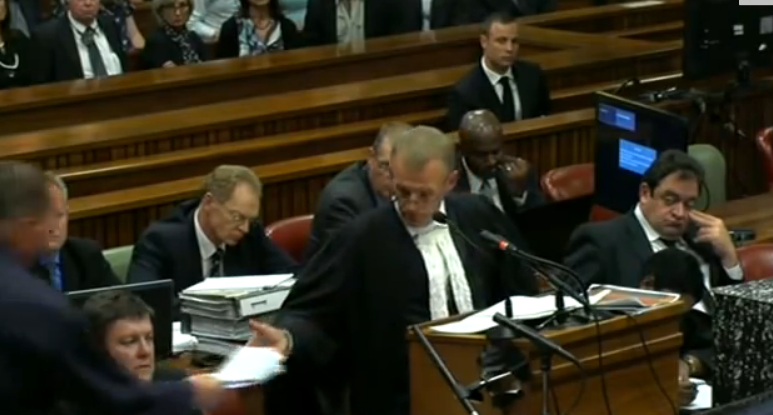
• “I feel sick that you suggested that and made a scene at the table, and made us leave early”

Nel asks him, what was this scene that he created? Oscar doesn’t answer and instead talks about how he had to leave early and go to training and she knew that. Nel points out to him that everything is about him. It all was about him and his needs. He asks him again, what was the scene all about? Oscar admits that he was agitated. When Reeva tried to tickle his neck he brushed her off and that is what she interpreted as making a scene.

• “I’m terribly disappointed in how the day ended and how you left me”

Oscar dropped her off at home and left and didn’t try to resolve it at that time. Oscar says they did resolve it, she had a friend with her and it wasn’t the time to talk. He wishes he did stay and sort it out at the time.

• “We are living a double standard relationship where you can be mad at how I deal with stuff but you are very quick to act cold and off-ish when you are unhappy”

Nel points out that Reeva believes their relationship is a double standard. Oscar states they were very different people and he thinks that he may be more sensitive to some things and maybe she didn’t speak to him when things were hurting her and felt like there were double standards in the relationship.

• “Every 5 seconds I hear how you dated another chick. You really have dated a lot of people yet you get upset if I mention one funny story with a long term boyfriend.

Nel asks him if this is correct and Oscar says that’s correct.

• “I do everything to make you happy and to not say anything to rock the boat with you”

Oscar agrees.

• “You do everything to throw tantrums in front of people”

Oscar says he’s never thrown a tantrum in front of other people. He’s maybe brushed Reeva off, like at Darren’s party and one other time at the sports awards. He thinks that at the time she wrote this message she was upset and exaggerated some things. Oscar then says “My Lady, I’ve never said I didn’t throw a tantrum”. Nel points out that he just said he didn’t throw a tantrum. Oscar apologizes and corrects himself; says that he meant he has never thrown a tantrum with Reeva in front of people, not that he’s never thrown one in his life.

• “I’ve been upset with you for two days now. I’m so upset I left Darren’s party early. So upset. Can’t get that day back. I’m scared of you sometimes.”

Nel asks why is she scared of him? Oscar answers that he thinks she’s scared of the feelings that she has for him and the way he brushed her off. Nel corrects him… she’s not scared of her feelings. She’s scared of how you react to what she does. Nel asks if he shouted or screamed at her and Oscars says no.

Nel wants to confirm that he has screamed at Samantha Taylor before, according to her testimony. Oscar says he doesn’t ever remember screaming at Samantha. He did scream at one of her friends who was drunk and disorderly at one of his parties.

Oscar then says that there were many lies in Samantha Taylor’s testimony. Nel challenges him, why did Roux not expose those lies? Oscar answers to the effect of Mr. Roux might not have been able to keep up with her lies. Nel then says why didn’t you inform your lawyer that they were lies? Oscar says I’m sitting behind him in court; I don’t have direct communication with him. Nel reminds him that he was very active during the State’s case passing notes over to his lawyers. Oscar agrees. He said he did pass notes up to his other lawyer Mr. Weber but often times he didn’t pass them forward. So now it’s Weber’s fault. There’s always someone to blame.

Nel goes on to say that this is significant evidence about his character. If Samantha’s testimony about Oscar screaming at her and her friends wasn’t true, why was that not challenged in court? Oscar reiterates that he did not scream at Samantha, but he did scream at her friend once. The friend was drunk and disorderly at one of his parties and he asked her to leave.

• “You make me happy 90% of the time and I think we are amazing together but I’m not some other bitch you may know trying to kill your vibe”

It was revealed later in testimony that after Darren’s party, when they were in a fight, they got in the car to drive home and Oscar put on the song “Bitch Don’t Kill My Vibe” by Kendrick Lamar. Reeva was not very pleased with this.

• “I’m the girl that would let go with you even when I was scared out of my mind to. I’m the girl who fell in love with you and was going to tell you this weekend”

Nel points out that this is a significant issue and Oscar agrees. Nel also points out that Oscar never followed that up. He never addressed it and never told her he loved her. Oscar says he wrote back asking when they could talk, he wanted to work it out. But per the records he did not call her. The next time they spoke it was over more messages.

Nel tells Oscar that he never followed up on this because he didn’t care. Oscar says that’s not true.

I will point out this message was on January 26 and he killed her on February 14. They never exchanged the words I love you. However… Oscar felt it important to put in his bail affidavit that they were “deeply in love” and Reeva felt the same.

• “I’m also the girl that gets side-stepped when you’re in a shit mood”

Oscar is not sure what she means by side-stepped. He says if he’s in a bad mood its usually after training, he hasn’t eaten properly or didn’t have enough sleep… essentially explaining why he has bad moods.

• “I feel you think you have me, so why try anymore”

Reeva is saying to him you know you have me so you have stopped trying. Oscar admits that may have been how she felt at the time. So Nel summarizes that as of January 26th, this is how she felt about the relationship, which wasn’t good.

• “I get snapped at, told my accent and voice are annoying”

Oscar admits that he did this. He explains that she was putting on an accent the day before for a role that she was preparing for. They were having a serious conversation about the house that he was buying and she was speaking in the accent the whole time. It annoyed him and he asked her not to do it. Nel points out to him that again, it’s all about him. It’s all about his house and what is she doing uses these voices. Oscar agrees that’s correct. He answers all of these questions very softly, very sorrowfully.

• “stop chewing gum”

Oscar explains that they had been at a function. He had been previously reprimanded by his management for chewing gum. So he told her to stop chewing gum, it doesn’t look good on camera. He said he was just helping her because he didn’t want her to look bad on camera.

• “Don’t do this, do that. You don’t want to hear stuff and you cut me off. Your endorsements, your reputation, your impression of something innocent blown out of proportion fucked up a special day for me”

Nel points out again that it was always about Oscar. Everything that was important to him is all that mattered. Oscar agrees that is how she interpreted what happened.

• “I’m sorry if you truly felt that I was hitting on my friend Sam’s husband, and I’m sorry that you think that little of me. I think from the outside it looks like we are a struggle, maybe that’s what we are. I just want to love and be loved. Be happy and make someone so happy. Maybe we can’t do that for each other cause right now you aren’t happy and I’m certainly very unhappy and sad.”

Oscar agrees that at that time she was doubting their relationship. Nel says to Oscar that he has humiliated her in public. Oscar admits that she took offense to some of the things that he did.

Nel then reads Oscar’s Whatsapp response to her email.

Oscar text

In Oscar’s text he says that he’s sorry for the things he says without thinking. He goes on to say that he was upset that she spoke to a guy and she didn’t introduce him. He wanted to be part of their conversation and she didn’t include him. He got upset and went to go eat without her.

They talk about the “Bitch Don’t Kill My Vibe” song that was put on in the car when they were driving home during their argument. Oscar explains that it was his friend Martin who put the CD in, although Oscar told him to put it in, and Reeva could have just whispered in his ear to turn it off. Nel points out that he is turning this around on Reeva. She didn’t like the song and it’s her fault for not asking him to turn it off, not his fault for playing an inconsiderate song.

Oscar’s text then goes on to say that it wasn’t just that they had to leave early because of him, they arrived late because of one of Reeva’s friends. If they didn’t have to drive her friend they could have had more time at the party. Nel points out that again, he has done no wrong, it’s Reeva’s fault that they didn’t get to spend enough time at the party. The family of Reeva’s friend that Oscar is referring to, Gina Myers, were in the courtroom and their faces were very telling. They obviously know the whole story and it doesn’t look to me like they agree with his testimony.

Myers family

Oscar points out to Nel that he did apologize to her a few times in his email, he wasn’t only criticizing her. Arguments are two sided.

They move on to another text from Reeva sent on February 7, seven day prior to the killing.

Reeva text2

• “I’d like to believe that I make you proud when I attend these kinds of functions with you. I present myself well and can converse with others while you’re off busy chatting with fans and friends. I also knew people here tonight and whilst you were having one or two pics taken, I was saying goodbye to people in my industry and Fix wanted a photo with me.”

Nel interprets that he never gave attention to what she was doing. Oscar wanted to leave and they were 45 minutes late and he blamed her. Oscar agrees that is correct.

• “I completely understood your desperation to leave and thought I would be helping you by getting to the exit before you because I can’t rush in the heels I was wearing. I thought it would make a difference in us getting out without you being harassed anymore. I didn’t think you would criticize me for doing that especially not so loud so that others could hear.”

Oscar says only one person, Oscar’s friend and his date, heard them. It was not multiple people who heard the argument.

I think the big point in looking at a lot of these messages is two things. It’s not just that they had disagreements because of course everybody has disagreements in relationships, that’s normal. It’s about how Oscar treated her. According to Reeva’s own word in her texts he threw tantrums, embarrassed her in front of other people, told her what to do, criticized her, accused her of flirting… just basically treated her crappy sometimes and it obviously hurt Reeva’s feelings. Oscar can explain away his side, but these are Reeva’s direct words and she’s not here to defend them. Nel has to do that for her.

Again, Oscar put in his bail affidavit that they were deeply in love. He told Reeva’s parents on the first day of his testimony that she went to bed that night feeling loved. That can be hotly debated when you really start to dig in to the state of their relationship.

Character witnesses are not allowed in court because they can be hugely subjective on both sides so it’s not like they can have Reeva’s or Oscar’s friends get up on the stand to verify or refute any of this. It’s just Oscar’s word and Reeva’s texts at this point. It’s important to understand them and that is what Nel is trying to do.

• “I’m a person too”

Nel points out that this is exactly what he is trying to show the court. Reeva did not feel like she was important in the relationship. It was all about Oscar. She is saying to him, I’m a person too.

Oscar says that Reeva was a person that always stood up for herself. If she felt badly, she said so. He understands that she felt badly about how she was being treated at times, he admits that. Nel points out that in a 4 month relationship where only two months were somewhat serious, they were already in a pattern of him treating her bad, apologizing, her accepting it… and then repeating the cycle.

Oscar says that sometimes she was not happy about things and sometimes he was not happy about things, if he treated her badly he will take responsibility for that.

And then Nel says… speaking of fault and taking responsibility, let’s talk about the Tasha’s incident.

They are now moving on to Counts 2, 3 and 4 that are charged against him.

COUNT 3

This is the Tasha’s Restaurant incident, discharge of firearm.

Nel wants to know why Oscar pleaded not guilty to this. Oscar says because he did not discharge the firearm.

Nel reminds him that he had the firearm in his hands at the time it went off. Oscar says he did not have his finger on the trigger… then he says he doesn’t remember having his finger on the trigger. And the fun begins. The looks on Nel’s face and Van Aardt’s face were priceless during testimony today. They are just in disbelief at some of the answers that are being given.

Nel surprised

Van Aardt face

Nel challenges him, did you or didn’t you have your finger on the trigger? Oscar states he did not have his finger on the trigger.

So Oscar is in possession of the gun, a shot went off, but he didn’t discharge the gun. Oscar says he tried to make sure that the firearm was safe. He noticed one bullet in the chamber and at that point when he was turning to ask Darren why he had given him a gun that was “one up”, the gun went off.

Nel tells Oscar that he just refuses to take responsibility for anything.

Nel asks him if he believes that Darren was negligent in this incident. Oscar says they were both negligent, he for taking a gun under the table and Darren for handing it over with a round in the chamber and the magazine in.

Oscar admits that handling that gun in the restaurant was a stupid and negligent thing to do.
Nel asks him what happened to the ejected bullet. Oscar says that he thinks Mr. Loupis phoned Darren or Kevin and told them that he had the projectile, he found it in the restaurant.

Nel tells him he is not asking about the projectile he is asking about the cartridge. What happened to the cartridge? Oscar says he has no idea. Nel tells him that’s not true, that he had it. Oscar says he doesn’t remember that at all.

Nel asks him again and Oscar says are you asking me about the round (the bullet) that fell out when I made the gun safe and Nel says yes. Oscar then says it fell out on the seat, he must have given it back to Darren at some point but he doesn’t remember when.

Nel had made a mistake here… he should have said bullet, not cartridge.

There was a bullet that ejected out of the gun when Oscar did the maneuver (cocking) to make the gun safe prior to it going off. It appears that Nel is implicating that Oscar took that bullet. Oscar says this is not true. He remembers that when he tried to make the gun safe, a bullet ejected out on to the seat and as he turned to ask Darren why he gave him a gun when it was “one up”, the gun went off. Oscar said he wouldn’t have just left the bullet there, he would have taken it and given it back to Darren.

This really makes me pause. Nel is accusing Oscar of taking a bullet from Darren’s gun. Oscar is strongly being evasive about having his finger on the trigger yet the gun went off. It can’t go off unless somebody pulls the trigger. There have been insinuations made that this was no accident. I really wonder now what exactly Oscar was doing with this gun and whether or not it really was an accident. Either way, the gun was in his possession and it discharged. Four people testified in court about it. And he admittedly covered it up by Darren taking the fall for it. I believe he is going to be found guilty on count 3.

Nel wants to know why he was even looking at the gun in the first place. Oscar says he was considering buying that type of gun. Nel establishes that this would be in addition to all of the other guns that he had ordered from Sean Rens. Oscar states that he had applied for a license to be a firearms collector.

Nel asks him again why he wanted to see it. Oscar goes on to explain that this manufacturer makes different types of this gun where you can attach a flashlight to it. When he was overseas he had purchased the flashlight for this type of gun because it was cheaper to get it there and he wanted to see if that firearm had a slide for this attachment.

Nel then states, it’s clear that you know a lot about firearms and about that particular Glock. Oscars says no he’s never owned a Glock and doesn’t know much about them. He’s grown up in a family where both of his parents carried firearms.

The Pistorius gallery is noticeably different today. A lot of weary, concerned faces.

Uncle Arnold face

Carl face

Weber face

pistorius gallery

Nel reminds Oscar that Mangena testified about the fact that a Glock cannot go off without the trigger being pulled. Oscar says he understands. And Nel goes on to say that Roux never challenged him on that. Nel asks Oscar if he will then accept that his finger was on the trigger because that gun cannot fire without a finger on the trigger. Oscar says he cannot.

Nel asks him if he made Roux aware that his finger was not on the trigger and he says yes.

So Nel wants to know if it was a mistake that Roux did not challenge Mangena when he said it was impossible for the gun to go off without somebody pulling the trigger. Oscar says he doesn’t know. Nel tells Oscar he is now placing blame on somebody else, it’s his counsel’s fault. Nel says about Roux, “I know him, he will not make those mistakes.”

He suggests to Oscar that the reason that Roux didn’t bring it up with Mangena is because it was never Oscar’s story that his finger wasn’t on the trigger.

Nel wants to know who pulled the trigger. Oscar says he doesn’t know. Oscar confirms that he had the gun in his hand, he ejected a bullet, nobody else touched the gun, and the gun went off. Oscar says he will take responsibility for the gun going off while in his possession but he cannot say his finger was on the trigger when it wasn’t on the trigger.

Nel wants to know what he said to Mr. Loupis. Oscar says that Darren told Mr. Loupis that the gun got stuck on his pants but that he (Oscar) told Mr. Loupis he was sorry, it was his fault and he’d pay for any damages. This does not match any of the testimonies that were given by Darren, Kevin or Mr. Loupis. They all clearly testified that Darren took the blame for it, Oscar did not.

Oscar claims he completely took the blame for it. Nel reminds him that nobody that testified can remember that. Oscar understands that but he says that he did apologize and offered to pay for damages. He continues that it bothered him that it went off. He says he didn’t discuss it with anyone but Reeva.

Nel brings up a good point, he wants to know if it bothered Oscar that the gun went off on its own. If he claims his finger wasn’t on the trigger and the gun just went off, how could that not bother him? Nel goes on to say you are a gun enthusiast, you wanted to buy a Glock, the gun miraculously goes off on its own and that didn’t bother you? Oscar says the whole situation bothered him.

Nel then says to him “There’s something deeper here and that is I don’t understand, and neither will the court in my argument, that if you’re presented with a set of facts that point to you having discharged a firearm, you’re not willing to accept that. That is troubling.”

At one point during the day Nel even said to him that he had to warn him, this will have implications. Basically meaning that if you continue to evade and lie, it is going to turn out very bad for you.

I can’t for the life of me understand why Oscar did not plead guilty to these charges. It looks so terrible for him to be clearly lying about them. Trust me, the Judge is not stupid, she knows he is evading responsibility on these. He should have bit the bullet and plead guilty to at least the ammunition charge and the Tasha’s charge and let his lawyers work out a deal. But instead… he has painted himself to be a liar. This will not bode well for Count 1, the murder charge. The more that I hear Oscar speak on the stand, it is greatly apparent to me that he truly believes he can get away with everything. I have no doubt left in my mind that he did not believe there was an intruder in the house that night. He shot Reeva with intention. But I’m jumping ahead, I’ll get to that in my future posts.

Oscar accepts that the gun was in his possession and it went off but he still won’t concede that his finger is on the trigger. He won’t even say “perhaps” it was on the trigger.

Nel asks him why he was mad at Darren. Oscar says because he handed him a gun that had a magazine and a bullet in the chamber.

Next, Nel asks him if he cocked the firearm and he says that’s correct. And then about 10 seconds later he says “I didn’t cock the gun, I was making the firearm safe.” He says he didn’t know there was a magazine in the gun and when he released the round out of the chamber, he thought he was making it safe.

First off, you can’t make the gun safe without cocking it so to say he didn’t cock it is just plain old evasion. He’s trying to use semantics.

I think the expression on Nel’s face says it all.

Nel face

Nel face Oscar didnt cock the gun

Nel reminds Oscar that standard safety procedures are to first check if there is a magazine in the gun and then check if there is a round in the chamber. Oscar agrees and admits he did not do that. He says it was his mistake and stupid and reckless on his behalf. He has been using that excuse a lot in court. The Judge is not going to like that.

So he checked the chamber first, saw the bullet, and instead of immediately checking to see if there was a magazine, he ejected the bullet which brought a new bullet in to the chamber which then went off. He must have pulled the trigger because the gun CAN’T go off by itself. Oscar will not admit that. The gun went off but nope, he didn’t pull the trigger.

Nel has him scrambling now and in the middle of his explanation, or I should say evasion, he says “I didn’t have time to think.” This is his rehearsed answer for the murder charge, not this charge. He didn’t have time to think. Oops, he mixed up the script. He is so reliant on that answer now that it just falls out of his mouth.

Nel says “so you are a gun enthusiast and you didn’t have time to think.”

They come back from tea and Nel continues.

Nel says to Oscar that if the gun mysteriously went off on its own, why didn’t you discuss that with Darren.

Oscar pretty much just ignores the question and gives a different answer… he says that he said to Darren what are you doing handing me a firearm that’s not safe, take it back. And he handed it to him.

Nel then asks him what he told Reeva about the incident. Oscar can’t remember, he thinks he told her that it went off while in his possession. They look at the text message that Oscar sent Reeva about that

• OP: “Angel, please don’t say a thing to anyone. Darren told everyone it was his fault. I can’t afford for that to come out. The guys promised not to say a thing.”

Oscar tries to explain that he didn’t want it to be misinterpreted in the media.

Nel tells him that he didn’t want to take responsibility for it.

Nel wants to know if it was Darren’s fault. Oscar says both. It was his fault for handling the firearm in the restaurant and Darren’s fault for handing him a gun that was not safe.
Nel says this is a good example of you, not wanting to take responsibility for anything you did.

Oscar says he did take responsibility, he offered to pay.
Nel tells him that he is lying. There is no other way that gun could have gone off. You fired that gun. Oscar says he understands but he doesn’t agree.

Nel wants to know how he carries his pistol. Oscar says in a holster, he has two different ones depending on his clothing. He carries his firearm with a full magazine. He has a mechanism on his gun that is a double safety. He carries “one up” as well.

Darren and Oscar have gone to the firing range together. Nel says to him, “as a man carrying one up, did you expect him to also carry his gun one up?” Oscar says no, Darren’s gun didn’t have the extra safety mechanism that he had and was not as safe. Nel tells him that many people would not agree with that.

Nel concludes his arguments about Count 3.

COUNT 4

96

Oscar admits that the ammunition was found in his safe. Oscar says there are two safes in his house. He is the only one who had control of the downstairs safe. And the upstairs safe has a combination code which several people had access to. Nels asks him if he is telling the court that he kept ammunition in a safe that several people had access to, and he says yes.

He does not keep his own ammunition in there. He had an extra magazine in his bedside table and the cleaning kit was in the safe downstairs.

Oscar says his father asked him if he could keep his .38 ammunition in Oscar’s safe. Nel wants to know who placed it in his safe. Oscar says his father did and he was not there at the time. Nel asks him if he is aware that his father refused to sign a statement related to that. Oscar says no, he’s not aware. He has not seen any statements. Oscar then says he and his father haven’t had communication between them for many years. So Nel asks him the obvious question… “Why would you allow him to put his ammunition in your safe if you haven’t spoken to him in many years?”

He’s obviously lying on this too. His father won’t admit to this because it’s not his. And if Oscar hasn’t talked to him in years why and how would he have access to Oscar’s home and his safe? Again, Oscar’s stories make no sense.

Oscar says there’s been communication but he hasn’t spoken to him. His understanding of the law is that you can ask other people to keep your ammunition for safe keeping. It doesn’t have to be your own safe. Nel reminds Oscar that in his competency test they dealt with ammunition. He goes on to say that Oscar did not answer in his test that others could keep ammunition for you.

Nel then asks Oscar if he checked his understanding of the law with Mr. Roux and Oscar says yes he did. Nel wants to know specifically what Mr. Roux told him. Oscar fumbles around here and comes up with some examples but they are not related directly to him keeping his Dad’s ammunition. Nel stops him and asks him again. Did Mr. Roux tell you that you could keep your father’s ammunition in your safe? Oscar now answers no.

Roux sinking in chair

Nel will not accept his ignorance on this. Oscar is a gun enthusiast and comes from a family of gun enthusiasts. He should know the law. Nel says he does not understand why Oscar didn’t plead guilty. Oscar is still rambling on about his understanding of the law but at this point it doesn’t make sense because he’s had legal counsel for over a year and they clearly know it’s illegal.

Oscar goes on to say the ammunition has been in there for a long time, he does not own a gun that can discharge that type of ammunition. Nel reminds him that he did at the time he was arrested. He had purchased a .38 from Sean Rens. He had not been licensed for it yet and didn’t have possession of it yet, but he had bought it.

invoice for guns

Oscar agrees that he had the gun on order but wasn’t licensed for it yet. So Nel points out to him and wants to establish, because clearly Oscar understands the law, “you weren’t allowed to have it in your possession, am I right?” Oscar won’t answer, again, and goes in to his story about his understanding of the law. He even actually said that “the safe possessed the ammunition.” I can’t make this stuff up.

Nel then asks him if he’s aware that keeping his magazine in his bedside drawer when he’s not at home is illegal. Oscar is aware. Nel wants to know why he did it. Oscar says for his safety.

He confirms that he kept it in there at all times when he was home. He also confirms that he had safes in his house where he could keep it. Nel wants to know why then he kept the ammunition in his bedside table. Oscar now all of a sudden says that when he wasn’t home he kept it in his safe. There may have been occasions when he forgot. He actually says to the Judge, “I can’t stand here and lie”… ok. Oscar says that he doesn’t see what this has to do with the Count 4 charge against him and Nel tells him that he’s dealing with Oscar’s negligence as a firearm owner.

Nel says to him that if he tells Oscar that it’s against the law for him to keep his father’s ammunition, then what would he say to that. Oscar says if it’s against the law then I understand that.

So Nel says then will you plead guilty to the charge. Oscar will not, wants to talk to counsel. Nel says no, it’s too late for that. Oscar won’t plead guilty, even though he knows it’s illegal. He won’t take responsibility.

Nel asks, when Mr. Roux put in your bail affidavit that the ammunition belonged to your father, did you or anybody else try to contact his father about this. Oscar claims no. He tries to explain that prior to his bail, he was in a prison cell. After he was released he stayed in his room for weeks, sleeping. Interesting… in the very beginning of his direct testimony he stated that he couldn’t sleep. Had such terrible nightmares. Eventually they had to put him on sleeping medication. Oops. He keeps going on and on and when he finishes Nel says “are you done?”

Nel asks if his brother, sister or Uncle told him that his father would not sign a statement. Oscar says no. He goes on to say that all he knows is that the police gave the ammunition to his brother and Oldwage when they were at the house on Feb 14th. The police told them they could take the ammunition along with other items. They did not take a register of the items. He claims that Oldwage asked one of the officers if they wanted to take an inventory of what they were taking and the officer said no, it didn’t bother him. Later that day, they were called to return the ammunition which they did.

Nel concludes his argument for this charge.

COUNT 2

This is the Vaal River incident, illegal discharge of firearm.

He talks about that day. There were about 8 to 10 friends out on the water. They were in a boat and some people went wake boarding. Nel wants to know where his firearm was when they were on the water. Oscar says it was on him. Nel wants to know why. Oscar says he took it with him everywhere he went. He would not leave it in his car.

He goes on to say that when he jumped in the water to go swimming, he left his gun on the towel in the boat. Nel asks him, don’t you think that’s negligent to leave your loaded “one up” gun on a towel in a boat unattended? Oscar says they were a close group of friends on the boat and they were in the middle of the water. Oscar does not consider this to be negligent.

Nel says “It’s the strangest day, you just won’t take responsibility for anything. Any gun owner would say it’s negligent, why can’t you do that?” Oscar finally agrees it was negligent.

Nel asks him what he was wearing and he says shorts. So Nel wants to know if his firearm was visible. Oscar can’t remember if he was wearing a shirt. Nel wants to know if Oscar wasn’t wearing a shirt, where would the firearm be. Oscar says in his holster on his person. Nel wants more detail, where would it be. Oscar says it would be clipped to his shorts. Nel then says it would be visible to everyone. Oscar doesn’t seem to want to concede this. He can’t seem to answer where it would have been but it’s his gun and his holster that he wears every single day, how is it that he can’t explain where he would be wearing it?

Oscar testifies that when they left that day and got back in the car that his gun was in the holster on his hip. Darren Fresco testified that he kept it on the seat between his legs.

Nel asks him when they were stopped by the police, what did he do with his gun? He says he left it on the seat and closed the car door. He didn’t want to approach the police with a weapon on him. Now this I can understand. However, legally you are not supposed to take your firearm off of you and just leave it in a car. Oscar admits that he understands this.

When the police found the gun on the seat, they shouted out wanting to know whose it was. Oscar walked over and said it was his; he’s a licensed firearm owner. Nel points out to Oscar that the police officer had every right to investigate that weapon. Oscar says the police officer removed the magazine and threw it on the seat and ejected the bullet out of the chamber and it fell in the car. Nel tells Oscar that the officer was within his rights to handle the gun. He also points out that Oscar had his gun one up, with a magazine in it, on the boat with his friends. Previously he claimed he couldn’t remember if it was or not.

Next, Oscar says he asks the police officer to hand him his gun back and the officer threw it on the car seat. He made a comment to the effect of “do you know what I can do with this firearm?” Oscar says he ignored him and started putting the magazine back in the firearm and looking for the round under the seat. The officer lit a cigarette and walked away. Another officer came over to help them look for the round in the car.

Oscar admits he was agitated at the police officer. If the officer had dealt with the situation in a more professional manner, he would have been more understanding. Oscar felt the officer was being aggressive by saying do you know what I can do with this firearm. Nel asks him quite sarcastically, what did you think he wanted to do… did you think he wanted to shoot you. Oscar says he doesn’t know what he meant but he did say it in a violent manner. Oscar says he was agitated so he ignored the officer.

This appears to be the classic Oscar we are now getting to know… hot-headed, irresponsible, moody, entitled. But as Oscar pointed out by his own admission, he doesn’t want the media or the world to really know what’s going on in his life. I can see why.

At this point in testimony, the Judge puts down her pen and crosses her arms.

Judge arms crossed

After Oscar reassembled his gun, he put it back on himself.

Nel asks if he knows Mr. Bay. This is the man who was assisting Oscar with the paperwork that he needed for the firearms he purchased from Rens. Oscar does not remember if he went to his house that day. Nel says if he shows him a picture that he took with the man’s daughter, would he remember. Oscar does recall on one occasion taking a picture with his daughter and his wife. Oscar then agrees it may be possible that he was there that day.

Nel asks Oscar if Samantha’s ever been to Mr. Bay’s house. Oscar doesn’t know. He’s not even sure if he’s been to his house. But Nel points out that Oscar just talked about the picture he took with his family. Oscar says he met him in a residential area, he’s not sure if it was his house.

Nel asks if there was ever an occasion where Oscar, Samantha and Darren all went to a residential house in that area. Oscar says no he doesn’t think so. Oscar understands that Samantha testified that they did. And Mr. Roux gave her a heck of a time about not knowing the exact location of the house. Yet Oscar isn’t sure where Mr. Bay lives either. Nel points that out to him.

Oscar then says Samantha Taylor was lying on the stand about many things. Nel wants to know if Darren Fresco was lying on the stand too. Oscar says he’s not necessarily saying that. Oscar points out to the Judge that they had differing stories about the shooting out the sunroof. They differed on where it happened, how it happened and why it happened.

Nel tells him that he’s arguing the case, not answering the questions. And also points out that if Oscar can’t remember going there that day, but Samantha and Darren can, wouldn’t that mean that they are likely correct. Nel points out that since Oscar can’t remember, he can’t say they’re wrong. Oscar says he doesn’t want to argue with Mr. Nel. Nel says he’ll remember that for the future.

Oscar flat out denies that he ever shot out of the sunroof. He said “that story was fabricated.” Nel says that’s a bad fabrication then, considering some of their details don’t match, because they haven’t spoken to each other.

Oscar says they have been in contact, they’ve been seen out at the same events. Nel reminds Oscar that when they both testified that they hadn’t had communication with each other, Roux never challenged them on that. Nel says sarcastically, looks like your legal team slipped up again.

He wants to know who told Oscar that they had been in communication and Oscar says he can’t recall. Obviously he would recall. Nel starts laughing and the gallery laughed as well. The Judge was not pleased with this and reprimanded all of them, including Nel, which was the appropriate thing to do.

Nel asks Oscar, if somebody testified that his gun was between his legs on the car ride home from the Vaal, what would he say to that. Oscar says that was not the truth. Nel reminds him this is yet another thing that Mr. Roux did not challenge. If it had been a lie, it would have been challenged. Roux does not miss things like that.

Nel jumps to the early morning hours of February 14. He asks Oscar how many shots he fired. Oscar says four. Nel asks if it was two double taps. Oscar says no, quick succession. Nel asks if he knows that for a fact. Oscar says “that’s correct, My Lady”. Nel, “because you can remember it?” Oscar, “that’s correct, My Lady”. Nel asks if it’s a reconstruction and Oscar says no.

Nel asks, why would Mr. Roux tell Mangena that they were double taps. Oscar is not sure. He says in the first break after testimony he corrected Mr. Roux. Nel wants to know why Roux would put something to the court that is not Oscar’s version; Mr. Roux would not do that. Oscar ponders that perhaps it was from when Oscar talked to him about double taps in training. His answer didn’t really make sense. Nel says no… he said to Mangena that “it’s your version that you fired two double taps.” Oscar says he did not tell Mr. Roux that he fired a double tap at any point.

This next exchange is important…

Oscar says he does know that he fired in quick succession because that is what he remembers. Nel wants to know how he remembers that. Oscar can’t explain how he remembers something. He said he didn’t know how many shots, he later found out four. So Nel asks “if you can’t remember how many shots, how can you remember quick succession.” He doesn’t know how he remembers.

Nel asks him if he remembers firing at the door. And he says yes, I remember firing at the door.”

Nel asks him if he remembers aiming at the door. His answer is “I remember pulling the trigger and rounds going in to the door.” Nel asks, how do you remember the rounds going in to the door. Oscar doesn’t understand this question. Nel asks “did you see them going in to the door” and Oscar then says “that’s where the firearm was pointed.”

Nel asks “did you fire deliberately?” Oscar says no.

Nel says “you’re still with accidentally?” Oscar says he fired out of fear, he interpreted it as somebody coming out of the bathroom, he didn’t mean to pull the trigger. Nel wants to make sure he understands his answer “I never meant to pull the trigger?” Oscar says that’s correct.

Nel asks, “so you never wanted to shoot at intruders coming out of the bathroom?” Oscar answers, “I didn’t have time to think about it, My Lady.”

Nel says no, answer the question. “You never deliberately pulled the trigger so you never wanted to shoot at intruders coming out of the toilet?” Oscar, “that’s correct, My Lady.”

Nel asks, “so whatever happened in that bathroom, the noises, what happened the whole night, never caused you to pull the trigger, it went off accidentally?” Oscar answers, “that’s the opposite of what I’m saying, My Lady.” Nel states, “no, it’s not.”

Nel asks, “if you waited a second to see if the door would open, you would not have fired?” Oscar answers, “that’s a possibility, My Lady.” Oscar then says “if Reeva had spoken to me then I wouldn’t have fired.” I find this response disturbing.

Nel pushes Oscar harder, “why did you fire?” Oscar is starting to get weepy again. He says because he heard a noise inside the toilet that he interpreted as somebody coming out to attack him.

Nel asks, “and when you heard that, you just started shooting, accidentally your finger just pulled the trigger?” Oscar answers, “I started shooting at that point, at the door.”

So Nel challenges him “it wasn’t accidentally?” Oscar says he’s getting confused with this accidental talk. Oscar, crying now, says “I didn’t have time to think, I fired my weapon.”

The point of this argument here is that he fired his weapon and he did it because he was scared, he intended to do it… he ran to that bathroom with his loaded gun and shot the bullets because he was scared (according to his version.)

But even under his own version, he won’t concede to that because it will be considered homicide. He pulled the trigger, but he can’t say that he meant to do it. This is his dilemma. In my opinion, he never wanted to take responsibility for intentionally killing Reeva so he came up with his crazy intruder story never fully understanding that it could still lead him to a murder conviction. He did not have a right to shoot anybody, intruder or not, simply because he heard a noise in the bathroom. He is totally in a pickle on this one. And that is primarily why he is crying on the stand. Because he knows he’s screwed. It’s possible his emotions are partly for Reeva, they likely are, but I mostly think they are because he knows that he has ruined his life.

They break for lunch.

Part 2 of Day 19 will be posted on my blog on Sunday, along with Day 20. Thank you everyone for reading and sharing my site! I greatly appreciate it.

Oscar Trial – Day 18, April 9 OSCAR

WARNING: GRAPHIC PHOTO SHOWN IN THIS POST

Yesterday we left off with Oscar finding Reeva in the toilet room. He continues on from there.

Oscar knelt down over Reeva. She was slumped on the toilet bowl. He checked to see if she was breathing and she was not. He put his arms under her shoulders and pulled her weight on to him. He sat there crying for some time. Her head was on his left shoulder and he could feel the blood running down on him.

At some point he heard her breathing. Oscar sat down on the ground, with his back against the wall and Reeva was still on top of him. He could see that her arm was broken. He then said he was “on his knees and one of his feet” and was pulling her in to the bathroom. He pulled one of the bathroom carpets closer and laid her down softly on the carpet.

The courtroom is absolutely silent. Oscar talks slowly and pauses often. You could hear a pin drop in that room. Everybody is listening very intently and clearly heavy with emotion.

He saw that her cell phone was in the toilet room. So her phone was locked in the toilet room with her. He grabbed the phone and tried to make a call but it was pass code protected and he couldn’t access it. He ran back to the bedroom where his phone was on the left hand side of the bed. Both his phones were there, he picked them up and ran back to Reeva.

He then phoned Johan Stander who was a gentleman who lived in the estates. Somebody that Oscar had become a friend with. He asked him to come and help. He was struggling to pick Reeva up and he needed help. This call was at 3:19:03.

He continues that he was trying to pick her up and couldn’t. He starts to explain that he took her arm and placed it across her body and Roux cuts him off there. He wants to address the other calls that Oscar made first.

At 3:20:05 he phoned 911 (Netcare). He doesn’t remember speaking to the operator but he does remember he (the operator) telling him that he needed to get Reeva to the hospital, that he must not wait for them.

At 3:21:33 Oscar phoned security (Baba). The call lasted 9 seconds. Oscar does not remember this.

He next says that after he got off the phone with Netcare, he ran downstairs to open the door. But we can’t forget that security (Baba) called Oscar back at 3:22 and they spoke. Did he speak to him while he was in the process of running down the stairs? Oscar conveniently left this out. This is when Oscar told Baba that “everything is fine”. It seems interesting to me that he can remember speaking to Johan Stander two minutes before, but he doesn’t recall this at all.
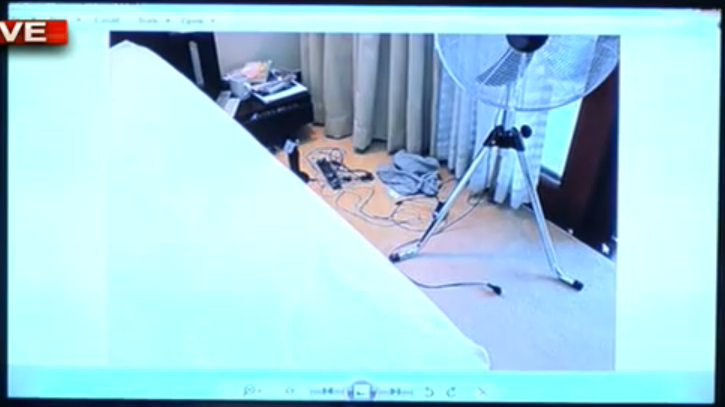
He says again that he could barely pick Reeva up so he would not be able to carry her and open the doors. I want to stop here because I’m having a hard time understanding how this man is not capable of picking up a woman who probably weighs about 110 lbs. According to him, his prosthetics were on at this point, so he has use of his legs.

oscar-pistorius

He first opened his bedroom door then he went and opened the front door. He ran back up to his room. On the way in to his room he tried to force open the door. He explains to the Judge that the door to his bedroom is a double door. The main door locks with a key and the other door has a latch at the top and bottom. He “ran in to the door and it didn’t break open.” So he reached down and unlatched the latch and it opened. Here is how the door was found by crime scene investigators.

20

19

18

17

16

15

He goes on to explain that he got the house to be wheelchair friendly. If you want to have a wider passage on the doors you have to open both doors.

He went back to the bathroom, he picked up Reeva. He doesn’t recall carrying her some of the way but he remembers arriving at the second flight of stairs. Mr. Stander and his daughter (Clarice) had arrived. Oscar was shouting for them to help him get her to the hospital.

When he reached the bottom of the stairs, one of the Standers told him to put her down and that an ambulance was on the way. Oscar kept saying we need to get her to the hospital and they said just put her down, the ambulance is on its way.

He sat there with her and waited for the ambulance to arrive. He felt helpless. He wanted to take her to the hospital. He had his fingers in her mouth to try to help her breath and his hand on her hip to try to stop the bleeding.

Roux asks him who was with him at the time. Oscar says that the Standers were there with him at that time.

Roux also wants him to explain the presence of plastic bags at the scene. Oscar says he needed something to put pressure on the hip. A plastic bag seems like a very odd thing to use when trying to stop bleeding.

He also states that Clarice asked him for tape or rope so that she could help stop the bleeding on the arm wound. Oscar can’t remember if he or Clarice went to fetch those items from the utility closet. Roux asks him if he did anything with the bags and Oscar says he can’t remember.

Again, selective memory. Plastic bags, rope and tape are very suspicious items to be found at a murder scene and Oscar doesn’t want to be pegged as the person who grabbed or used these items. It sure as heck makes me wonder what he was really going to do with these items.

Roux then asks if the paramedics arrived next at the scene or did Dr. Stipp arrive. Oscar says that Clarice told him that there was a doctor on the scene and he immediately felt relieved. He saw this person walk in to his house and he later found out that was Dr. Stipp. Oscar says he still doesn’t remember his face or what he looked like (odd considering he just testified weeks ago in court while Oscar was present.)

He says that Dr. Stipp tried to help Reeva but he didn’t seem like he knew what he was doing. He seemed overwhelmed by the situation. Everything that Dr. Stipp told him to do, he was already doing. He was already trying to help Reeva breath.

So is he somewhat blaming Dr. Stipp for Reeva not surviving? Why would he imply that the doctor didn’t know what he was doing? It certainly seems like he’s pointing the finger at everybody else for not getting her help. Netcare told him to drive her in, the Standers told him to put her on the floor, Dr. Stipp didn’t know what he was doing. Wow. He shot her, but it’s everybody else’s fault that she didn’t get help. To me, this is very telling on how his mind works.

Oscar goes on to say that Dr. Stipp was kneeling down on her right hand side for a few minutes and then he walked outside. Oscar says he was shouting for him to come back in the house and help him.

Dr. Stipp, nor Baba, testified that Oscar was shouting for the doctor to come back inside.

The paramedics then arrived. They asked for some space to work. Oscar stood up. Roux asks him if he remained there or went somewhere else. Oscar gives a long pause on the stand and doesn’t answer. Roux asks him if he remembers going to the kitchen. Another very long pause from Oscar. He finally says, very emotionally, “Reeva had already died, so I knew there was nothing I could do for her.”

He went and stood a few meters away where the kitchen and dining room meet. The lady paramedic went to him and she informed him that Reeva had passed.

The paramedic asked him for some identification for her. He went up to his bedroom to get her handbag. He says he didn’t go through it. He simply took the bag and brought it out. Clarice was waiting there outside his bedroom and he gave the handbag to her.

He then went back downstairs to where the paramedics were and he sat on the kitchen floor near the island, crying. The police offers arrived shortly after. They were dressed in civilian clothing. Colonial Van Rensburg arrived at the same time. Oscar was unable to speak with him.

One of the officers asked him to just stay in the kitchen. An officer was at the bottom of the stairs. They asked him if there was anybody else in the house. He motioned that there wasn’t. He checked the downstairs and upstairs of the home. Oscar was still sitting on his kitchen floor. Every time he would look up there were more policeman and more people inside, going up and down the stairs.

He is now standing on the far side of the kitchen. He asked the policeman if he could wash his hands because the smell of the blood was making him throw up. The policeman said he’d ask Col. Van Rensburg and Col. Van Rensburg came over to him and said he may wash his hands. He doesn’t remember washing his chest, he just remembers washing his hands and his face.

He was still standing in the kitchen when Hilton Botha arrived. Botha asked Oscar if he remembered him. Botha immediately went from the kitchen to the upstairs and then came down sometime later. Oscar says he could not look outside the kitchen because every time he saw Reeva he got sick so he stayed far inside the kitchen and also went in to the pantry and sat against the washing machine.

I’m curious why he mentions that. Perhaps he was out of sight for some time, maybe making calls or doing something else, and he needs to explain where he was. Just my speculation. It seemed like he was over-explaining.

Oscar says Hilton Botha went back upstairs a second time. And Van Rensburg came over to Oscar and put his hand on his shoulder and said that he didn’t need to speak to anybody but that he needed him to go to the garage; they’d like to take some photos and a police photographer would be there.

The same officer that had been at the bottom of the stairs took Oscar to the garage, along with Van Rensburg. That same officer stayed in the garage with Oscar the whole time.

He was in there for several hours. He asked the photographer if he could just please take all the photos he needed so he could take his bloody clothes off.

From the garage he was taken to the foyer area of his home and a police officer introduced himself, Gerard Labuschagne, and told Oscar that he was a family member of his and that he didn’t have anything to worry about. He was there to look after him.

Col. Van Rensburg then informed him that since he was the only person in the house they were going to charge him. They placed him under arrest and walked him to a waiting car in the driveway, along with two other officers. One officer sat next to him in the back of the car, one officer drove and the officer that was identified as the family member, Labuschagne, sat in the passenger side of the car.

arrest4

arrest3

arrest2

arrest

Oscar was advised that there was a lot of media outside and he should put his head down and to also do the same if any media in cars drove by them.

He was taken to a hospital and brought inside the reception area. The doctor introduced himself and he conducted various tests, took samples, etc.

Roux asks Oscar about his call to Justin Devaris around 3:55am that morning. Oscar states that Clarice asked him if she should phone anyone. She called Justin but Oscar doesn’t remember if he spoke to him or not. Clarice also contacted his agent (Pete Van Zyl) who he is very close with. She also phoned his brother Carl. Oscar did not phone any lawyer.

Roux has asked Mangena to bring the cricket bat with him today. They are going to do some demonstrations on the door.

First, Roux wants to know what Oscar thinks about Vermeulen asserting that Oscar was on his stumps when he hit the door.
Oscar states he can barely stand on his stumps let alone wield a bat on them. He says he was wearing his prosthetic legs.
Roux brings up that the Stipps and others heard what they thought were gunshots around 3:17pm. He wants to know from Oscar what those noises were. Oscar says they were the cricket bat hitting the door.

Just before hitting the door with the bat, he had previously walked through the bathroom and kicked the door. This is the time that Dr. Stipp saw a figure in the window moving from right to left. Oscar says that was him going to kick the door.
Roux then mentions that Dr. and Mrs. Stipp heard loud bangs earlier as well. He wants to know from Oscar what those sounds were. Oscar says those were the gunshots.

Roux asks Oscar approximately how long it was in between the gunshots and the cricket bat hitting the door. Oscar says he’s mapped this out and he estimates that it was 5 minutes. Roux points out this is consistent with Mr. Johnson’s notes that the female screaming was occurring around 3:12pm and the second bangs were around 3:17pm.

Roux then challenges Dr. Stipp’s testimony that there was a very brief amount of time in between bangs and Oscar says this is not physically possible.

Oscar then tells the Judge “if you look at the phone calls that were made from many of the witnesses that gave statements that weren’t used in the State’s case, and you look at all the times the calls were made, out of many, many, many facts it points to 5 minutes between the first sounds and the second sounds.”

They then do some demonstrations. Roux has Oscar show how high he can kick. They point out that it’s the height of the door handle.

Oscar then mimics how he hit the door with the bat but he first tells the Judge that it’s very difficult for him to show in a passive way right now how he did it. That night he was trying to break the door in so he hit it with all his might. He held the bat with both hands behind his head and swung down in what I imagine would be like a chopping motion (although this was off camera and we could not see it.) He does not remember where he was standing in proximity to the door. He doubts he remained in one position. He had socks on his legs at the time so the floor was slippery.

They move on to some of the neighbors and Roux tells Oscar that they will deal with the witness statements that the State chose not to use. Oscar states he has a neighbor that he knows as “Kenny” on the right hand side (if you are looking at his house from the front.) It’s house # 285 on the photo with the orange roof.

aerial view of homes

Kenny’s statement to police makes reference to crying and not a woman screaming. Both he and Oscar moved in to the estates in 2005. Oscar gave him a welcoming gift. Many times when Oscar drives by he will greet them if they’re outside. Oscar has never been inside Kenny’s home and vice versa. Oscar does not know his wife.

The neighbor on the left hand side (if you are looking at Oscar’s house from the front) is Mr. Nhlengthwa (Mike). He is house # 287 on the photo. Oscar knows him. They had the same developer that built their homes. They both shared a passion for cars. They would often chat outside. He was a good neighbor to Oscar. He doesn’t know him on a social level but they did chat often. Oscar also knows his wife but not as well as he knows Mike. Mike has never been in Oscar’s home. Oscar has been in his home once when it was first being built.

Mike’s statement to police was also that he heard crying but not a woman screaming. Oscar’s bathroom window is on the back of his house and Mike’s bedroom is on the back of his house. They are on the same side, but I don’t believe they are facing each other. Roux says that the wife’s statement is that she woke up to a bang, Mike got up, and at 3:16 he made a call to security, prior to the second bangs. She heard loud crying and not a woman screaming.

Roux asks Oscar if he knows the domestic worker who works for the Stipps. He does not know her but is aware that her statement was that she did not hear a woman screaming.

Roux wants to talk about the figure that was seen by Dr. Stipp walking in the window. Oscar says that if he didn’t have his legs on, they would likely have only seen his head or possibly his shoulders at most from the outside. They would not have seen his torso. Oscar contends that Dr. Stipp must have seen him when he went in to the bathroom to kick the door with his prosthetic leg.

Oscar reiterates that he shot with his legs off and broke the door down with his legs on.

Roux asks at Oscar at any time did he intend to kill Reeva. Oscar answers “I did not intend to kill Reeva, My Lady, or anybody else for that matter.”

Roux confers with Oldwage and they have no further questions.
Nel is up for cross-examination and it gets tense quickly with this exchange:

Nel: You were and you still are one of the most recognized faces all over the world, do you agree?

Oscar: I agree.

Nel: You are a model for sportsmen, disabled and able-bodied sportsmen all over the world.

Oscar: I think I was, My Lady, I made a terrible mistake.

Nel: You made a mistake?

Oscar: That’s correct.

Nel: You killed a person, that’s what you did, didn’t you?

Oscar: I made a mistake.

Nel: You killed Reeva Steenkamp, that’s what you did.

Oscar: I made a mistake, My Lady.

Nel: You’re repeating that three times. What was your mistake?

Oscar: My mistake was that I took Reeva’s life.

Nel: You killed her. You shot her and killed her. Won’t you take responsibility for that?

Oscar: I did, My Lady.

Nel: Then say it then. Say yes, I shot and killed Reeva Steenkamp.

Oscar: I did, My Lady.

Nel: Ok

Nel goes on to say that Oscar is known as a sports hero and people look up to him, isn’t that correct. Oscar says he doesn’t check the media anymore. He is aware that people’s opinions of him have changed. But he acknowledges that yes in the past people did look up to him.

Nel tells him he has a responsibility to the people to tell the truth. Oscar says that he has a responsibility for both he and for Reeva to tell the truth. Oscar says he is there to tell the truth, as much as he can remember, from that night. Nel asks him if he is going to hide things from the court. He says he won’t.

Nel wants to know if he lives on Christian principles. Oscar says he tries to but he’s human, he does sin. Nel then says as a Christian you will not lie and Oscar says “I will try not to lie, as I said, I am human, I’m here to tell the truth.”

Nel then asks him what is a zombie stopper? Oscar cannot recall. Nel wants to know if he’s ever seen a video of himself in the presence of other people referring to a zombie stopper. Oscar can’t recall, but he says if you can show me that video he can confirm. Nel says he’ll gladly show him.

Roux objects. Both he and Nel engage in a legal back and forth with the Judge over whether or not this video is admissible. The Judge adjourns, the video is reviewed, and ultimately she allows it in.

Here it is in full. They only showed the shooting portion in court.

http://news.sky.com/story/1218645/pistorius-at-gun-range-exclusive-pictures

They show the video and Nel asks Oscar if he now recalls. Oscar states he has seen this video before but didn’t recall the words zombie stopper. He says he was at Mr Rens’ shooting range (the man who testified about his gun training) and he was shooting at a watermelon with a handgun. It wasn’t him laughing in the background but it was him speaking.

In hindsight, it makes him upset to hear himself say something like that. But he doesn’t agree with the comparison of a watermelon to a human. Nel reminds him that he said, “it’s softer than brains, who else has brains?”

Nel asks him what kind of ammunition he was using. The first part was a shotgun and the second part was .50 caliber handgun. Did it have black talon ammunition? He says no, it was different ammunition, far bigger caliber.

Nel states you can see the effect it had on the watermelon, it exploded. He goes on to say that the same happened to Reeva’s head.

He puts up a picture the deceased Reeva and tells Oscar to take a look at it. Take responsibility and look at it.

Reeva head

Oscar says he has taken responsibility by waiting for his time on the stand to tell his story for the respect of Reeva and for himself. He has taken responsibility, but he will not be forced to look at this picture. He is extremely emotional and crying as he speaks.

He said as he picked Reeva up he touched her head, he was there, he remembers. He keeps saying “I don’t have to look at a picture, I was there.”

Nel is pushing him on the comparison of shooting a watermelon to Reeva’s head, Roux stand up and strongly objects. He feels it’s an unfair comparison, the Judge agrees and asks Nel to remove the image from the screen.

Nel asks Oscar if he can carry on. Oscar is weeping and not answering. Nel states that he can see Oscar is visibly upset and asks for an adjournment.

They come back and Nel is again talking about the shooting range. Nel wants to know what the purpose was of them making that video.

Oscar says they were using the .50 caliber ammunition because it’s not typically used in guns. He then goes on to say that Mr. Nel has been at the same range shooting the same gun so he should know it’s not black talon ammunition. He had to get that little dig in there.

Oscar states it was just simply a group of friends shooting at the range, it was not an exercise. Nel puts to him that he wanted to see the effects of the gun on the watermelon and Oscar agrees, they did.

Oscar goes on to say that he used to enjoy shooting at the range. They would shoot at various different targets. He admits that the day they shot the watermelon, the comment he made was distasteful but it was made in reference to a zombie, not a human being. They move on now.

Nel wants to know if the testimony that he has given the last few days, it his memory or is it a reconstruction?

Oscar says there were many topics discussed. He says he has been telling the truth. Obviously some of it is a reconstruction because he wouldn’t know about phone calls made by other people so he has had to rely on records in evidence that were furnished to him. It’s a mix of what he remembers and other points are a reconstruction based on the statements of the 100+ people that the State has spoken to.

So Nel now wants to test what he can remember and what was reconstructed.

Nel asks from the time he fell asleep on February 13, to the time that he shot Reeva on the 14th, is there any reconstruction. Oscar says no. He admits there are some things he doesn’t remember from that night like speaking with Mr. Baba, switching on the lights in the bathroom, parts of him carrying Reeva downstairs.

Nel wants to know again… did he take in to account any other evidence to form his version of events that he is giving in court for the time from when he went to sleep to the time that he killed Reeva.

Oscars tells the Judge that he feels it’s important to state that his version has never changed. He gave his version for the bail affidavit before he knew any of the evidence that would be compiled against him. He tendered his story to his counsel and they compiled the bail transcript.

Oscar gets defensive and he points out that there are aspects of his story that he shared with his counsel that they didn’t include in the bail statement. He also points out that the State’s case has changed many times, but he has not changed his version.

Nel wants to know why Oscar is arguing, not answering, the questions. Roux jumps in to help Oscar and tells the Judge that he thinks it would be helpful for Mr. Nel to pare down his questions, be more specific about wanting to know what is memory and what is reconstruction. Nel believes he is doing that and the Judge basically tells Nel that Oscar has answered and said sorry, so they move on.

Nel establishes that Oscar is familiar with his bail affidavit and agrees with it. He also establishes that Oscar is familiar with his plea statement for court and agrees with it. (these statements are posted on the home page of my blog for reference)

Nel asks Oscar to list the items that he told his counsel that they did not include in his initial bail statement. He states he can’t remember all of them but recalls it was Reeva speaking to him as he sat up in bed and phoning security (Baba). His understanding of the bail hearing was that he did not have to give that statement but he did so anyway.

Nel asks him if there was anything in his bail affidavit that wasn’t true. And he states no, he told the truth.

Nel wants to know if Oscar put the fans on the balcony or only one leg of the fan on the balcony. Oscar explains that he only put one leg of the standing fan on the balcony and the other two legs were inside. The small plastic fan was also on the carpet.

Nel asks to retrieve them, did he ever have to go outside and he says no, he didn’t have to go out on the balcony?

This is huge. His story rides on Reeva getting up out of bed and him not seeing her. He originally claimed he was out on the balcony when this happened, that’s why he didn’t see her.

Oscar states he was standing by the amplifier when he heard the noise in the bathroom, the window opening.

So Nel wants to know if somebody made the statement that he went out on the balcony to retrieve the fans, would that be untrue? And Oscar agrees it would be. He did not go out on the balcony.

Nel was able to establish that portion of his bail affidavit was false.

As to the reference to only one fan in the bail affidavit and the two fans in the plea statement, Oscar explains that by saying only one of the fans had a leg out on the balcony. The other one was on the carpet inside.

Nel now wants to know if it’s still Oscar’s contention that the scene was tampered with by police (as stated in his plea statement). Oscar says yes it is. Nel wants to know where there was tampering.

Oscar says he has been advised by his counsel that they will have witnesses coming to testify about this. He has seen many photos where there are massive inconsistencies and things have been moved. Nel would not accept this. He wants a specific answer from Oscar as he is asserting this in his plea.

Oscar said they can go through the photo files and he can point them out. Nel wants to know from him, what was the one thing that was changed that bothered him the most. Oscar states that anything that gets tampered with is bothersome.

Oscar points out that the cell phones in the bathroom were moved, the firearm was moved, the cricket bat had moved in the bathroom, the discs and the fans in his room were moved, the curtains were moved. Nel stops him and wants to slow down, take them one at a time.

They first talk about Reeva’s cell phone in the bathroom.

gun on bathmat and phone underneath

phone found under bathmat near gun

phone case of phone found under bathmat near gun

Nel wants to know where it was prior to it being moved. Oscar talks about the differing positions that the phone was in when he reviewed the photos, but that doesn’t answer Nel’s question. He wants to know where the phone was.

Remember, Oscar testified that he had picked the phone up from the toilet room and tried to use it to make a call. So he put it down somewhere in the bathroom.

Oscar doesn’t remember where he put it. So Nel wants to know how it was tampered with if he can’t remember where it was. Oscar says he’s not saying the State tampered with it (although he actually is, that was in his plea that there was tampering) he’s just simply saying it was moved as evidenced by different photos.

He also goes on to say that people were walking around his house without protective coverings, that’s what he considers contamination.

Nel moves on to the fans. He wants to know how they were tampered with.

Oscar states to the court that the assertions of tampering and contamination will be dealt with through his counsel using their investigation and experts. He doesn’t believe that he should have to document everything that they believe is an issue.

Nel still wants to discuss the fans. Oscar says he remembers the fans were running that night; it was an extremely warm evening. According to some of the officers, they say the fans were off, so he would say they were tampered with.

Also, in one of the photos that didn’t include a date or time stamp that was viewed in court, they saw one of the officers unplugging a fan to plug in their cell phone. This was a photo taken by police, so he believes this was tampering.

Oscar still doesn’t really want to get in to many details on the tampering, he wants his counsel to deal with it through the experts, and Nel wants to know which experts are coming to testify. He wants names.

Oscar goes around and around with him saying that he sits in on meetings but he doesn’t have all the same details that his counsel does. He then states “I’ve given them my version many, many months ago. We’ve reworked on it, we’ve spoken about it and they’ve worked with it with me, but as far as this part of the plea says from Mr. Roux, this will be demonstrated during this trial while Hilton Botha was the investigating officer so I guess it’s pertaining to while Mr. Botha was in charge of my home.”

Nel brings up that Oscar just said they reworked their evidence. Oscar says he corrected himself and said they worked with him on it. It was a mistake that he used that word. Nel says that’s interesting.

They next look at photos of the bedroom. The first photo shown is from Album 1, the album that shows the scene as it was initially found. These are the photos taken by Van Staden.

right side of bed

Nel shows him the photo and asks him if anything was tampered with. Oscar says he didn’t see his room with the lights on that morning so he wouldn’t know if anything was tampered with. But if he had to compare this photo with other photos taken, it shows the items being moved to different places.

Nel then establishes with Oscar that if he looks at this picture there would be nothing striking out of place. Oscar goes in to a long explanation of how he and his legal team have poured over all the photos and the time stamps, etc and things had been moved. But he still can’t answer the question about how the scene was when he left it.

Nel zooms in on the floor now and points out the hair clipper next to the iPad. He wants to know if that is where Oscar left it. He is not sure if it was in the stand or not but he does plug it in to that extension cord (the white one) to charge, so he says it’s possible it was there.

zoom of floor2

That extension cord is also where he plugged in the fans. Nel asks again if the clipper was plugged in to the extension cord. Oscar says it may have been or it may have been plugged directly in to the wall. Nel tells him he was right the first time, it was plugged in to the extension cord.

zoom of extension cord outlets

You can see the large black plug is for the hair clipper and the other smaller two prong black plug is for the standing fan. Nel points out the problem here is that there’s no room on this strip to plug in the small fan that Oscar claimed was also on that night. That small fan requires a three prong socket and there are none left on that extension cord strip.

So Oscar states that there’s another socket over by the TV cabinet where the smaller fan could have been plugged in.

small fan and stereo

He goes on to say that he had three fans. Two floor fans and one standing fan. A friend of his came to visit him in January and he lent him one of the fans for his room downstairs. I’m not sure why he added that in to the story, perhaps just to ramble because he’s stuck in another jam.

He’s not sure where the fans were plugged in. He says it’s possible he tripped over the cord on the way to open the balcony door, as an explanation for why it’s not plugged. He does not have recollection.

Nel reminds him that just two minutes ago when they started this line of questioning, and before he saw the photo, he said he had plugged the fans in to that extension cord. Now he is stating that he doesn’t remember.

Oscar says he doesn’t recall saying that but he’ll take Nel’s word for it. Nel pushes him on this and Oscar says to the Judge that his memory is not very good right now. He’s under pressure and it’s not easy sitting there defending for his life. He is doing his best to tell the truth and where the fans were plugged in is fairly insignificant.

Nel says to him that no it’s not insignificant, it will show that he is lying.

Next Nel says to Oscar that he stated in his plea statement that this incident was an accident. He wants to know, what was the accident?

Oscar says he discharged his firearm in the belief that an intruder was coming out to attack him. So Nel asks him was the discharge accidental. And he says that it was accidental. He asks Oscar if he knows what an accidental discharge is. Oscar says Mr. Nel can explain it to him, but his understanding is that he didn’t mean to discharge his firearm.

Oscar says he never intended to shoot anybody. He got a fright from a noise heard inside the toilet and he believed that somebody was coming out to attack him.

This is very important and Nel wants to make it clear so he asks him “you never fired your gun at the intruders with intention to shoot at them?”

Oscar says “My Lady, as I said I wasn’t meaning to shoot anyone. I went in to the bathroom to put myself in between what I perceived was danger and Reeva.” “He didn’t have much time to think.” He keeps giving a long explanation and Nel stops him. He reminds him the question is “did you shoot at intruders with intention to shoot them?”

He again says it was a desperate moment and he believed that somebody was coming out to attack me. That’s what made him fire his firearm. Out of fear, he didn’t have time to think before he discharged his firearm.

So Nel summarizes, “because you feared, you shot at them?” Yes or no. Oscar says he didn’t shoot at them, he didn’t intend to shoot someone, he shot out of fear.

Oscar can try to evade this question all he wants but the Judge is not stupid. Obviously if he says he was fearful that somebody was going coming out of that door to attack him, and he fired off his gun four times in to that door, he intended to shoot them.

At the end of this trial, if the Judge does not feel there is sufficient evidence to prove that he intended to shoot Reeva, she certainly can determine that he intended to shoot “someone”. I don’t know how he can avoid culpable homicide at this point. But I am not a lawyer and these laws are complicated, so I can’t say for sure. But this is an important point that Nel is making and therefore Oscar has to answer extremely carefully.

Nel continues, he needs him to answer. Is this accidental discharge or not. Oscar says the firearm was in his possession, his finger was on the trigger, it was an accident what happened. He didn’t intend to shoot anyone. He shot his firearm before he could even think, before he had a moment to comprehend what was happening.

Nel then asks him, “was the only way out for you to shoot this intruder to protect yourself.” Yes or no. Oscar says he didn’t have time to think about if he was shooting an intruder or not shooting an intruder.

Nel points out to him that in his testimony he was greatly detailed in his story about how he walked fast and when he walked slow… he explained every moment leading up to when the shooting happened. And Nel is absolutely right; Oscar made very conscious movements leading up to him entering that bathroom. Now all of a sudden, he says he didn’t have time to think about shooting his gun. But he had time to think about where it was, retrieving it, taking the holster off and how quickly or how slowly he was going to approach the bathroom, if he was going to scream or not scream. All of that was thought out, in Oscar’s version of events. But the one moment that counted, he all of a sudden can’t be responsible for thinking.

Oscar does admit that he pulled the trigger. Right there, you cannot consider it accidental. Pulling the trigger is not an accident.

He then goes on to say that he believed he was in danger, he had many thoughts about what could happen. So right there he admits he is having thoughts. If he can have thoughts about the danger, he can have thoughts about what he is going to do about it.

The more he talks, the deeper he is digging himself. All the while, Reeva’s relatives are shaking their heads in the gallery.

And as he continues to talk, he starts crying again. Nel wants to know why all of a sudden he’s crying. The Judge stops Nel and tells him not to ask that question. She points out that he has been emotional throughout.

Nel says to the court that he won’t pursue that question, but he does say to Oscar that he’s not going to go away. He tells him that he (Oscar) is over-thinking every question and trying to figure out the implications of what he’s going to answer, isn’t that correct.

Oscar says that his life is on the line, of course he is thinking about the implication of everything he is saying, it would be reckless not to do so.

Nel points out that Reeva doesn’t have a life anymore because of what he’s done. So he needs to listen to the questions and give the truth and stop thinking about the implications for you.

Nel concludes by reading the bail affidavit that clearly states, in Oscar’s words, “I felt trapped as my bedroom door was locked and I have limited mobility on my stumps. I fired shots at the toilet door and shouted to Reeva.” Oscar then says “I think it’s obvious that I shot at the door.” Now it’s obvious.

Court adjourns for the day.